Foshan kung fu
A First-Timer’s Guide to Foshan Kung Fu
Foshan’s martial-arts culture is bigger than one style or film hero. Use three evidence lenses to understand Wing Chun, Hung Kuen, Choy Li Fut, lion dance and the stories that connect them.
On this page
- Use three evidence lenses
- Documented record
- Lineage account
- Screen story
- See more than Wing Chun
- Read Wong Fei-hung and Ip Man beyond the screen
- Understand why lion dance appears beside kung fu
- Use the Ancestral Temple as a starting point
- Check live information before you go
- Assess a martial-arts class before joining
- Question claims of authenticity
- Use the site’s English terminology
- Choose what to read next
- Source notation
Foshan kung fu is not one style, one master or one cinematic universe. It is a broad local culture shaped by different martial-arts traditions, community transmission, Guangdong lion dance, museum interpretation and generations of screen storytelling.
This guide gives you a reliable first framework. You will learn how to distinguish documented records from lineage accounts and film stories, why Wing Chun is only part of Foshan’s martial-arts landscape, how lion dance relates to kung fu without being the same thing, and what to verify before planning a visit or a class.
Use three evidence lenses
The quickest way to misread Foshan’s martial-arts culture is to treat every story as the same kind of evidence. Use three lenses instead.
Documented record
This includes material supported by an official heritage register, a museum, a government cultural body or carefully identified historical research. It can establish such things as an intangible-cultural-heritage classification or the documented role of a venue. It should still be stated no more broadly than the source allows.
Lineage account
A school, family, teacher or community may preserve its own account of an art’s origin and transmission. Such accounts are culturally meaningful, but different branches may tell the story differently. Attribution matters: ask who holds the account and which branch it describes. Foshan Living does not turn one lineage account into a universally agreed city history. [S6]
Screen story
Film, television and popular fiction have carried Foshan-associated martial-arts figures to global audiences. These stories explain cultural influence and public memory; they do not, by themselves, prove the details of a person’s life.
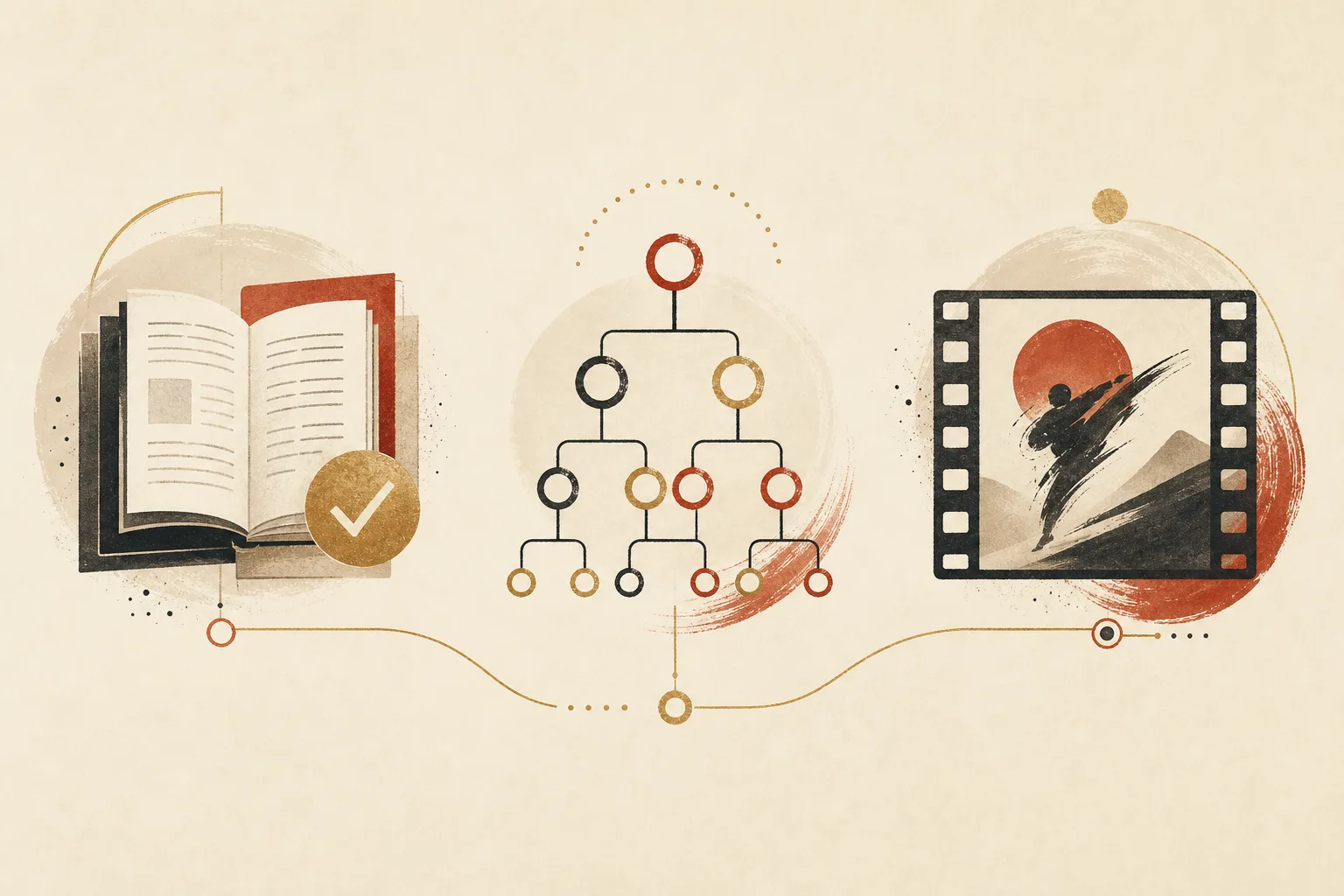
When a story is compelling, the first question is not whether it feels authentic. Ask which of these three lenses it belongs to.
See more than Wing Chun
Wing Chun is one of Foshan’s most internationally recognisable martial-arts traditions, and Foshan Wing Chun is represented within China’s national intangible-cultural-heritage system. [S1, S4] It is still not a synonym for all Foshan kung fu.
National sports-cultural material presents a wider city context that includes Wing Chun, Hung Kuen and Choy Li Fut. [S5] These traditions have different training approaches, personalities and transmission branches. A first-time reader does not need to memorise every genealogy, but should keep four distinctions in view:
- Wing Chun is a southern Chinese martial-arts tradition with important Foshan transmission memories, including those associated with Ip Man. Its origin and transmission narratives are not limited to one uncontested version. [S1, S6]
- Hung Kuen forms part of Foshan’s wider southern martial-arts culture and is closely connected with public memory of Wong Fei-hung. Screen portrayals should not be used as a substitute for the history of the art. [S5]
- Choy Li Fut is another important southern tradition in the city’s broader martial-arts context. Any claim about a specific branch still needs its own evidence. [S5]
- Guangdong lion dance has deep links with martial-arts communities and physical training, but it is classified as traditional dance rather than as a martial-arts style. [S2, S3]
This wider view makes the subject more interesting, not less. It also prevents a famous international keyword from flattening the city’s cultural diversity.
Read Wong Fei-hung and Ip Man beyond the screen
Wong Fei-hung and Ip Man are two powerful entry points into Foshan’s public martial-arts memory. Both are also surrounded by screen images that can become difficult to separate from history.
With Wong Fei-hung, films have combined martial skill, medical practice, lion dance and moral heroism into a durable cultural figure. That screen legacy deserves attention as screen legacy. Individual fights, relationships and dramatic conflicts should not be carried into a biography unless historical evidence supports them.
Ip Man is an important figure in understanding one influential line of Wing Chun transmission connecting Foshan, Hong Kong and a much wider international audience. Displays associated with him can introduce that line, but no single memorial display represents every Wing Chun branch. The same caution applies when discussing Bruce Lee: teacher–student connections, a person’s later martial development and cinematic image are separate questions.
At the Foshan Ancestral Temple Museum complex, displays associated with Wong Fei-hung and Ip Man place these figures inside a broader local cultural setting. [S8] Treat them as gateways into further reading, not as proof that Foshan martial arts form one continuous lineage.
Understand why lion dance appears beside kung fu
Guangdong lion dance is listed in the national intangible-cultural-heritage system as traditional dance. [S2] Research published through the national heritage platform also describes its historical relationship with southern martial-arts halls, physical training and community transmission. [S3]
Both points can be true:
- lion dance and martial-arts culture have deep connections;
- lion dance is not a style of combat and is not simply “kung fu in a costume.”
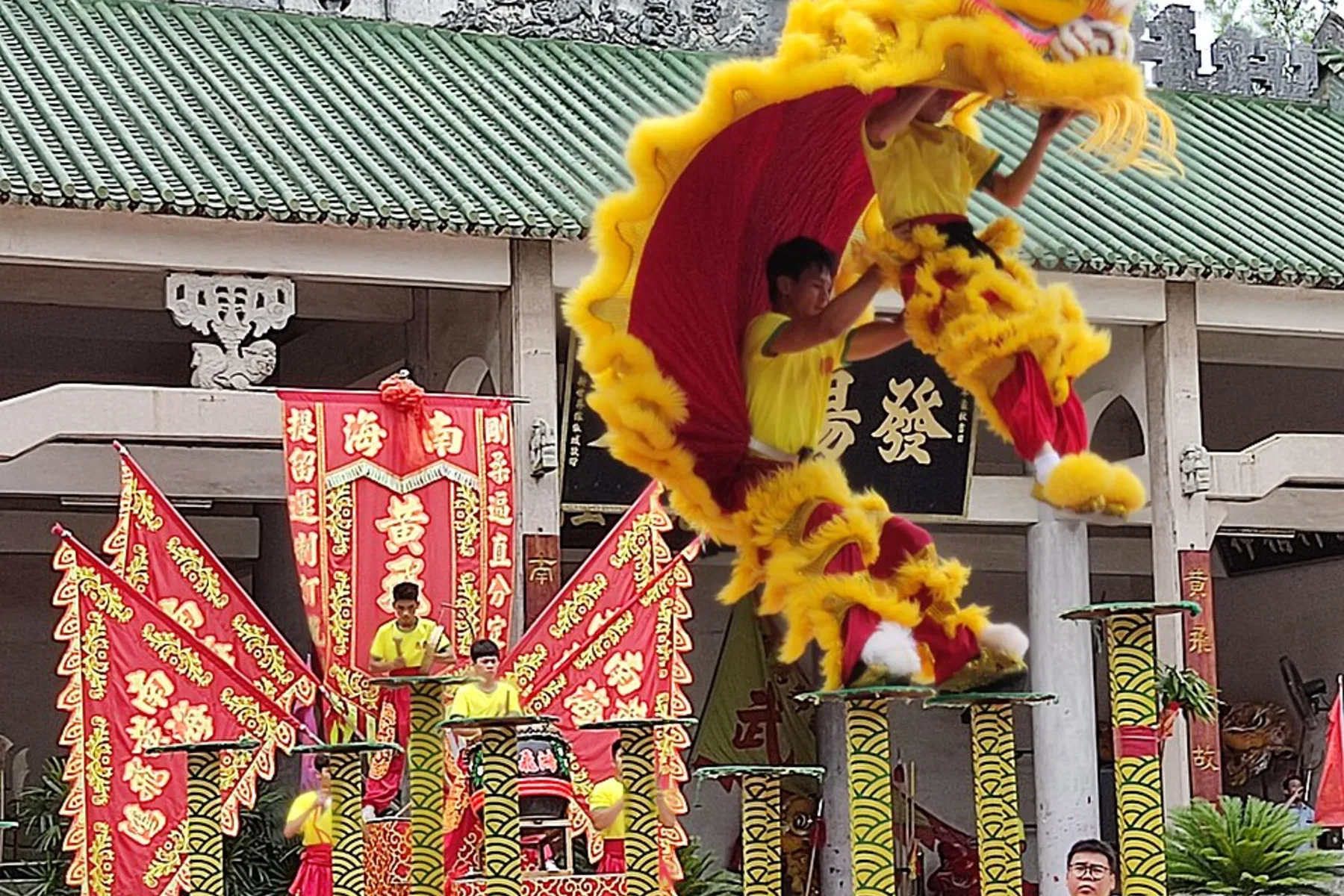
When you watch, look beyond acrobatics. Notice how drums, gongs and cymbals cue movement; how the eyes, mouth, ears and body of the lion create character; how stance, balance, strength and coordination support the performers; and how a ground routine differs spatially from a high-pole competition.
Context matters too. A community ritual, a festival appearance, a competition and a visitor programme are not interchangeable. Do not assume that one represents all lion-dance practice.

Use the Ancestral Temple as a starting point
For a first visit, the Foshan Ancestral Temple Museum complex offers a practical cultural frame because heritage architecture, local belief and folk traditions sit near displays associated with Wong Fei-hung, Ip Man and lion dance. [S7, S8]
That makes it a useful starting point, not a complete map of Foshan martial arts. A sensible sequence is:
- begin with the historic complex and its local cultural context;
- check which individual exhibition spaces are actually open that day;
- use the Ip Man material to explore one Wing Chun transmission line;
- if the official same-day information confirms a lion-dance programme, decide whether it fits your visit;
- continue into the surrounding Zumiao–Lingnan Tiandi area rather than chasing unverified “kung fu check-in spots” across the city.
This is an editorial route, not an opening promise. The official venue channel remains the authority for same-day access. [S7]
Check live information before you go
Opening arrangements, partial closures, performance programmes, entrances and ticket details can change. They are deliberately excluded from this evergreen guide.
Use this verification sequence:
- check the official venue channel close to your visit;
- confirm the date on any notice you read;
- if a performance is central to your plan, verify it before arranging the rest of the day;
- treat old timetables, screenshots and reposted travel notes as leads, not confirmation;
- keep a visit plan that still works if a programme is cancelled or an exhibition space is unavailable.
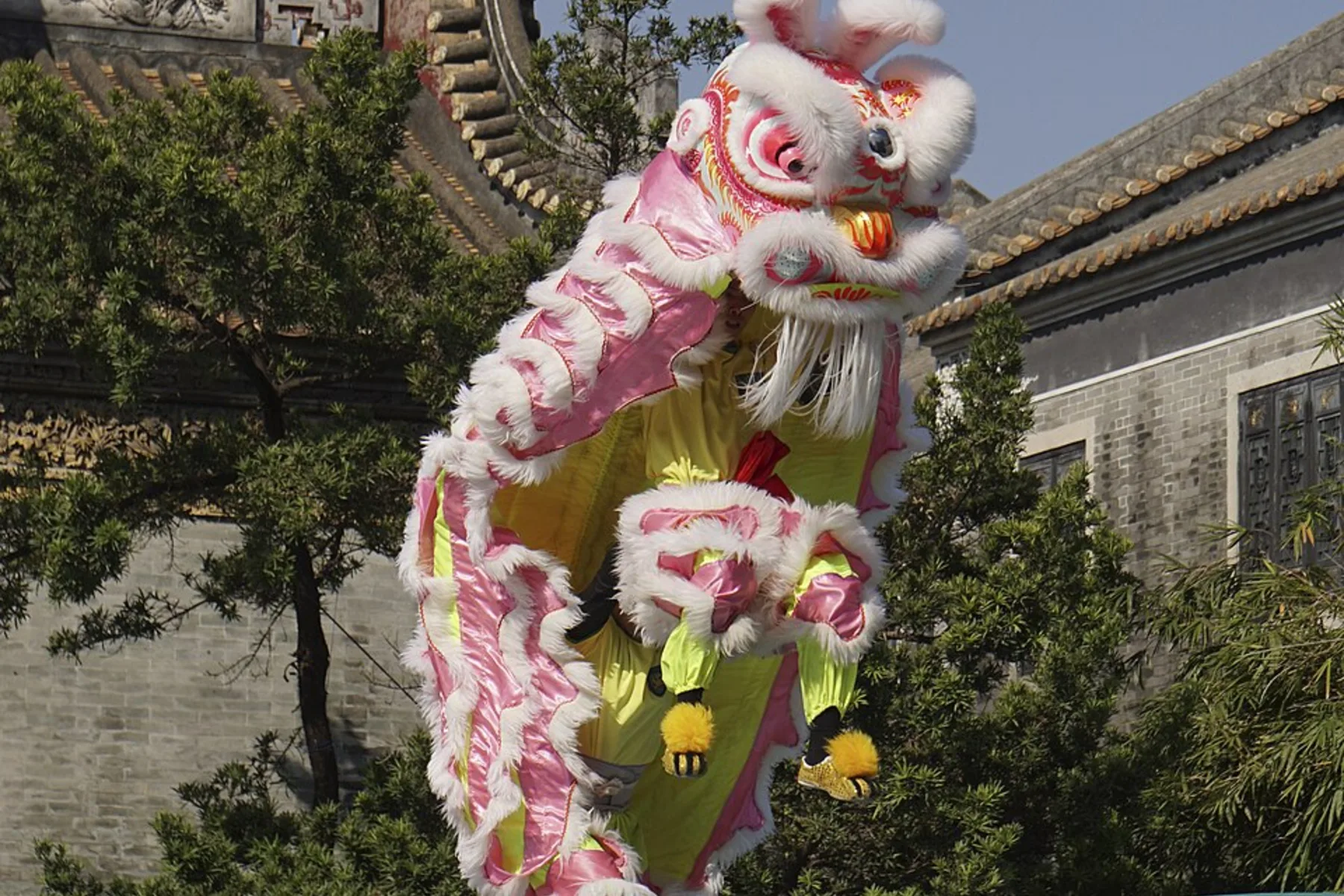
.jpg)
At a live programme, keep fire exits, residential entrances and staff areas clear. Do not touch lion-dance equipment, instruments or preparation areas unless invited.
Assess a martial-arts class before joining
Watching a public demonstration and joining contact-based physical training are different decisions. Foshan Living does not recommend or provide a booking link for a school until the following points have been checked:
- the operator’s legal identity and contact details;
- the instructor’s qualifications and clearly attributed lineage claims;
- whether short-term beginners are accepted;
- language, age, health-screening and guardian requirements;
- expected contact, protective equipment and training intensity;
- injury response, insurance and emergency procedures;
- photography, recording and privacy rules;
- the full price, cancellation terms and any commercial relationship.
If these answers are missing, enjoy the cultural material and postpone the class. A famous lineage name is not a substitute for a current safety process.
Question claims of authenticity
Terms such as “the only authentic school,” “direct transmission” or “the oldest style” may carry meaning inside a particular community. They do not automatically become city-wide historical facts.
Ask four questions:
- Who is making the claim?
- Which branch or community does it describe?
- Is there independent documentary, heritage or museum support?
- Is the page explaining a tradition or selling a course?
Respecting a living tradition and labelling its evidence are compatible. Clear attribution protects both the reader and the tradition.
Use the site’s English terminology
Foshan Living uses these primary English forms:
- 咏春拳 — Wing Chun
- 洪拳 — Hung Kuen
- 蔡李佛 — Choy Li Fut
- 广东醒狮 — Guangdong lion dance or southern lion dance, depending on context
- 叶问 — Ip Man
- 黄飞鸿 — Wong Fei-hung
Romanisation varies across Cantonese, Mandarin and lineage usage. A spelling is a search aid, not a test of authenticity. Where another form matters to a specific branch or source, the article should name that context.
Choose what to read next
Continue with these Foshan Living guides as they become available:
- First Time in Foshan for a broader city orientation;
- Visiting the Foshan Ancestral Temple for a practical venue guide with live-status checks;
- Understanding Guangdong Lion Dance for music, movement and performance contexts;
- A Beginner’s Guide to Wing Chun in Foshan for heritage and transmission;
- Wong Fei-hung: History and Screen Memory for a careful separation of biography and cinema;
- Foshan Museums by Theme for wider cultural context.
Start with the evidence lens that matches your interest, then verify any live visit detail through the responsible official channel. You do not need to choose between enjoying the films and taking the history seriously—you only need to keep them clearly labelled.
Source notation
Source IDs in this article map to the reviewed Chinese-language sources in source-register.md. Visuals are declared separately in asset-manifest.csv and are not used as factual evidence.
Image credits and disclosures
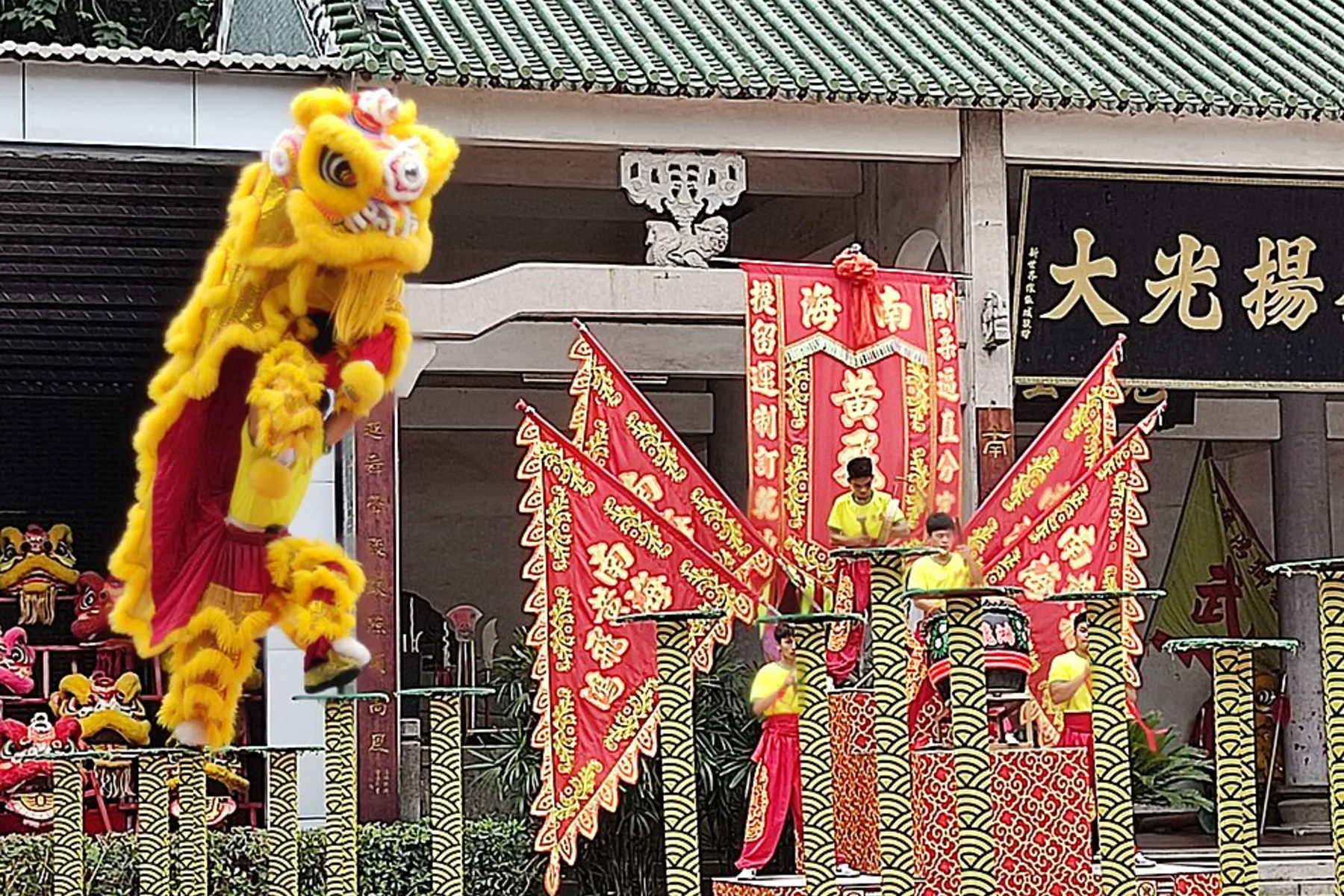
- hero.webp A real lion-dance performance at the Wong Fei-hung Lion Dance and Martial Arts School in Xiqiao, Foshan. Lukwo RuoShuma Simonz · CC BY-SA 4.0; cropped and resized derivative · CC BY-SA 4.0
- body-01.webp AI-generated editorial illustration of the article’s reading method. The document, lineage diagram and film frame are symbolic, not historical evidence. OpenAI image generation for Foshan Living · Project-generated original illustration; no third-party source image used · AI-generated illustration
- local-lion-close.webp A high-pole lion-dance jump at the Wong Fei-hung Lion Dance and Martial Arts School in Xiqiao. Lukwo RuoShuma Simonz · CC BY-SA 4.0; cropped and resized derivative · CC BY-SA 4.0
- local-zumiao-lion.webp A documented lion-dance performance at Foshan Ancestral Temple. This photograph does not confirm a current programme or timetable. Hexocat · CC BY-SA 4.0; cropped and resized derivative · CC BY-SA 4.0

Keep exploring
Related Foshan guides
 Explore Foshan
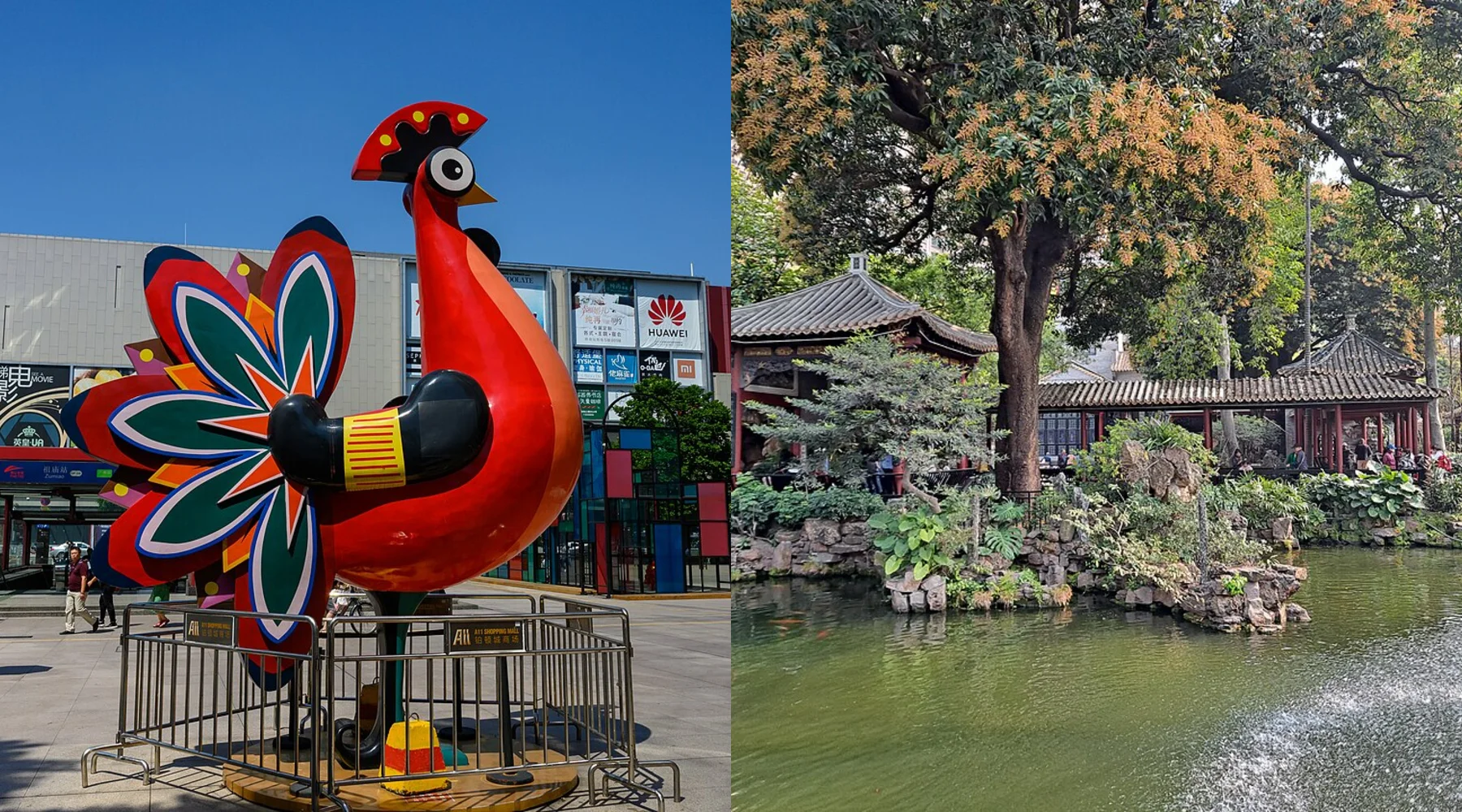
Chancheng or Shunde: Where Should You Start in Foshan?
Choosing between Chancheng and Shunde for a first Foshan trip? Compare heritage, food, neighbourhood pace, transport planning and where to stay.
 Explore Foshan
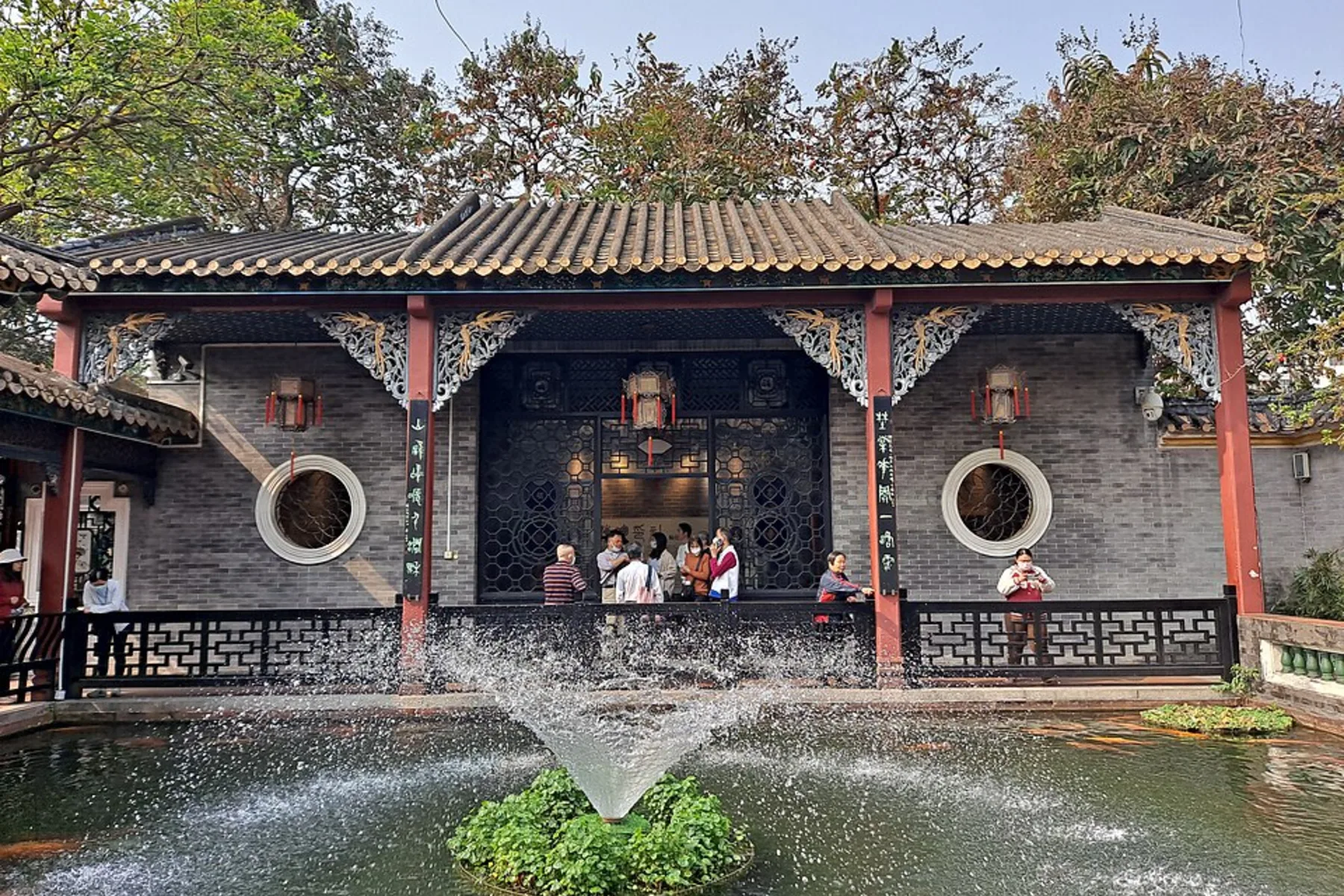
Understanding Foshan: A City of Five Districts
Learn how Foshan’s five districts differ, which areas suit culture, food, urban life or nature, and why every short trip needs a specific local base.
 Explore Foshan
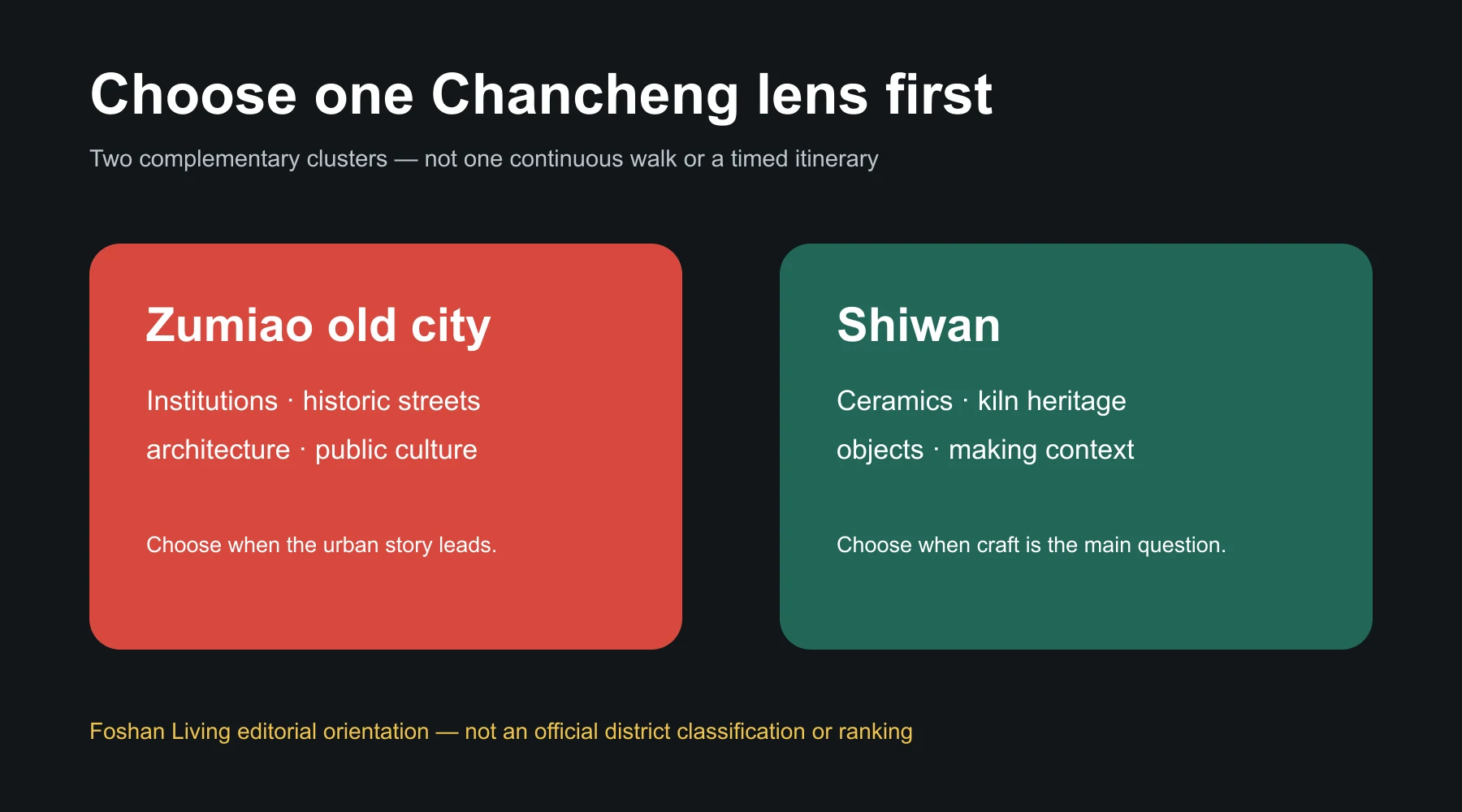
Zumiao Old City or Shiwan: How to Choose Your Chancheng Day
Compare Zumiao old city and Shiwan, choose one main Chancheng cluster, and add the other only after checking the complete route and current access.
 Explore Foshan
Chancheng: Foshan’s Historic Urban Core
Understand Chancheng through the Zumiao old city and Shiwan’s ceramic heritage, with guidance on walking scale, transport checks and where to base.
Plan your visitFirst Time in Foshan
Build a first trip around districts, transport, food and one deeper cultural interest.