Explore Foshan
Chancheng or Shunde: Where Should You Start in Foshan?
Chancheng offers the clearest introduction to Foshan’s heritage, while Shunde rewards travellers who plan around food, gardens and a specific town. Use this guide to choose one without turning a short trip into a cross-city race.

On this page
- The quick answer
- Choose Chancheng for a clear heritage-first introduction
- Build the day around one of two cultural clusters
- Chancheng suits you if
- The trade-off
- Choose Shunde for food, gardens and town life
- Daliang is the usual first research point
- Shunde suits you if
- The trade-off
- Plan one day around one cluster
- A Chancheng day
- A Shunde day
- If you still want both
- Use two days to compare, not to commute repeatedly
- Choose accommodation from the last important stop
- Know when neither district is the right first choice
- Check three things before you leave
- 1. The exact destination
- 2. The day’s operating information
- 3. The complete return chain
- Continue planning your Foshan trip
If this is your first trip to Foshan and you have only a day or two, the useful question is not which district is “better.” It is which district makes the better starting point for the trip you actually want.
Choose Chancheng first if you want a compact introduction to Foshan’s traditional cultural identity: historic architecture, southern lion and martial-arts associations, old-city streets and ceramic heritage. Choose Shunde first if the trip is driven by food, gardens and everyday town life—and then choose a specific Shunde town, usually Daliang for a first visit. With only one day, choosing one of the two is usually more satisfying than trying to sample both.
This guide gives you a decision, a realistic planning method and a short verification checklist. It does not rank restaurants or hotels, promise fixed journey times, or treat an entire district as one walkable neighbourhood.
The quick answer
| Your main priority | Start with | Why it fits |
|---|---|---|
| Historic architecture, martial-arts associations, lion dance and an old-city introduction | Chancheng | Several core Foshan cultural themes can be understood through a relatively focused urban visit |
| Ceramics, kilns and craft heritage | Chancheng | Shiwan offers a distinct heritage cluster beyond the Zumiao old-city area |
| Gardens, Shunde food and town-centre life | Shunde, usually Daliang | A cultural anchor, a proper meal and unhurried street time can form a coherent day |
| A specific Ronggui, Beijiao or other town interest | That Shunde town | “Shunde” is not a single attraction cluster; the town should determine the plan |
| A first cultural day trip from Guangzhou | Often Chancheng | The final choice still depends on your exact starting point and live transport options |
| You have already explored central Chancheng | Shunde or another Foshan district | A different base may add more than repeating the same cultural cluster |
This is editorial guidance for short first visits, not an official district ranking. Chancheng and Shunde solve different travel problems.
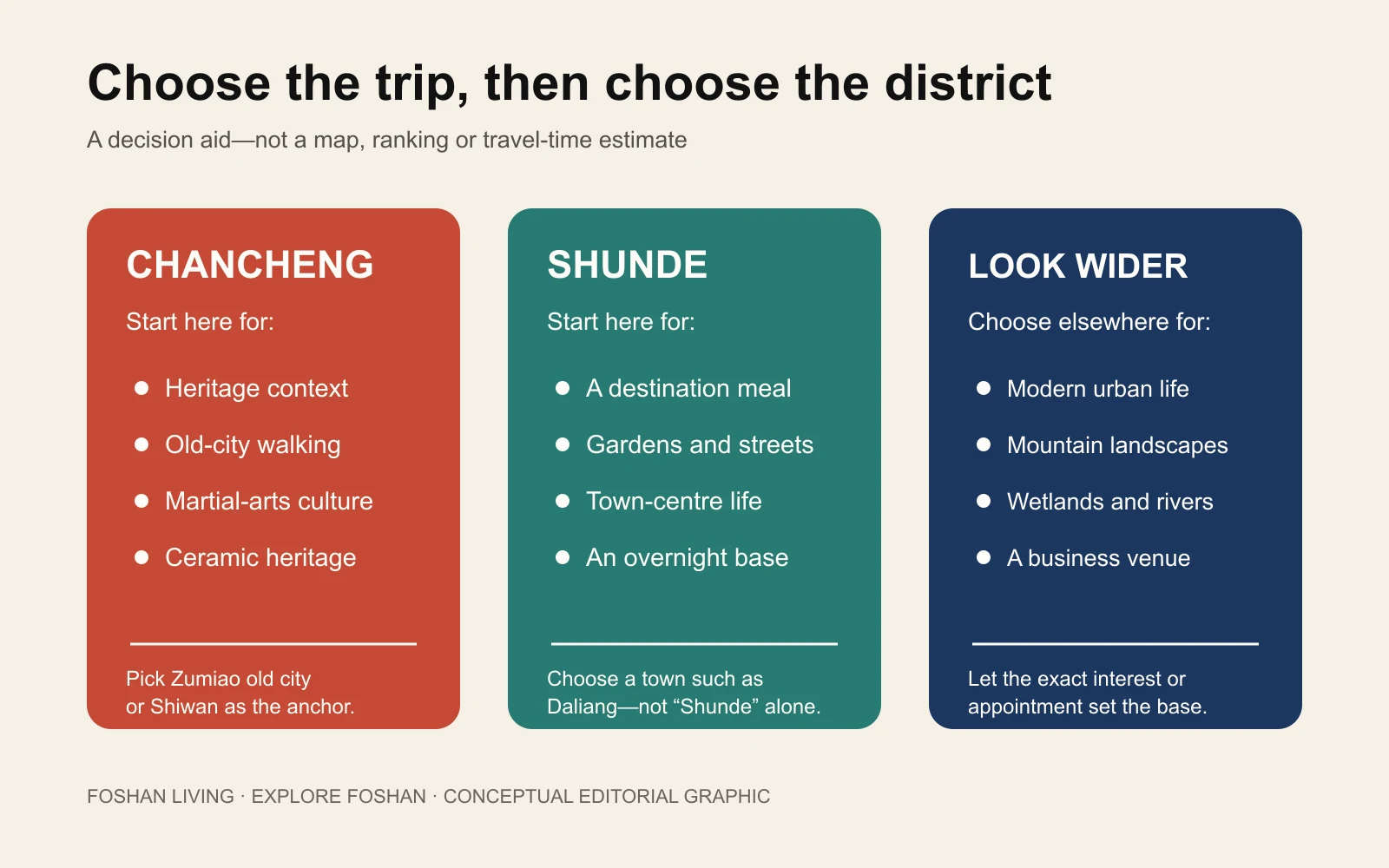
Choose Chancheng for a clear heritage-first introduction
Chancheng is the easier first answer when your goal is to understand why Foshan is associated with Lingnan culture, martial arts, southern lion traditions and ceramics. Its value is not that it contains every important Foshan attraction. Its value is that several themes can be connected without turning the day into a district-wide survey.
Build the day around one of two cultural clusters
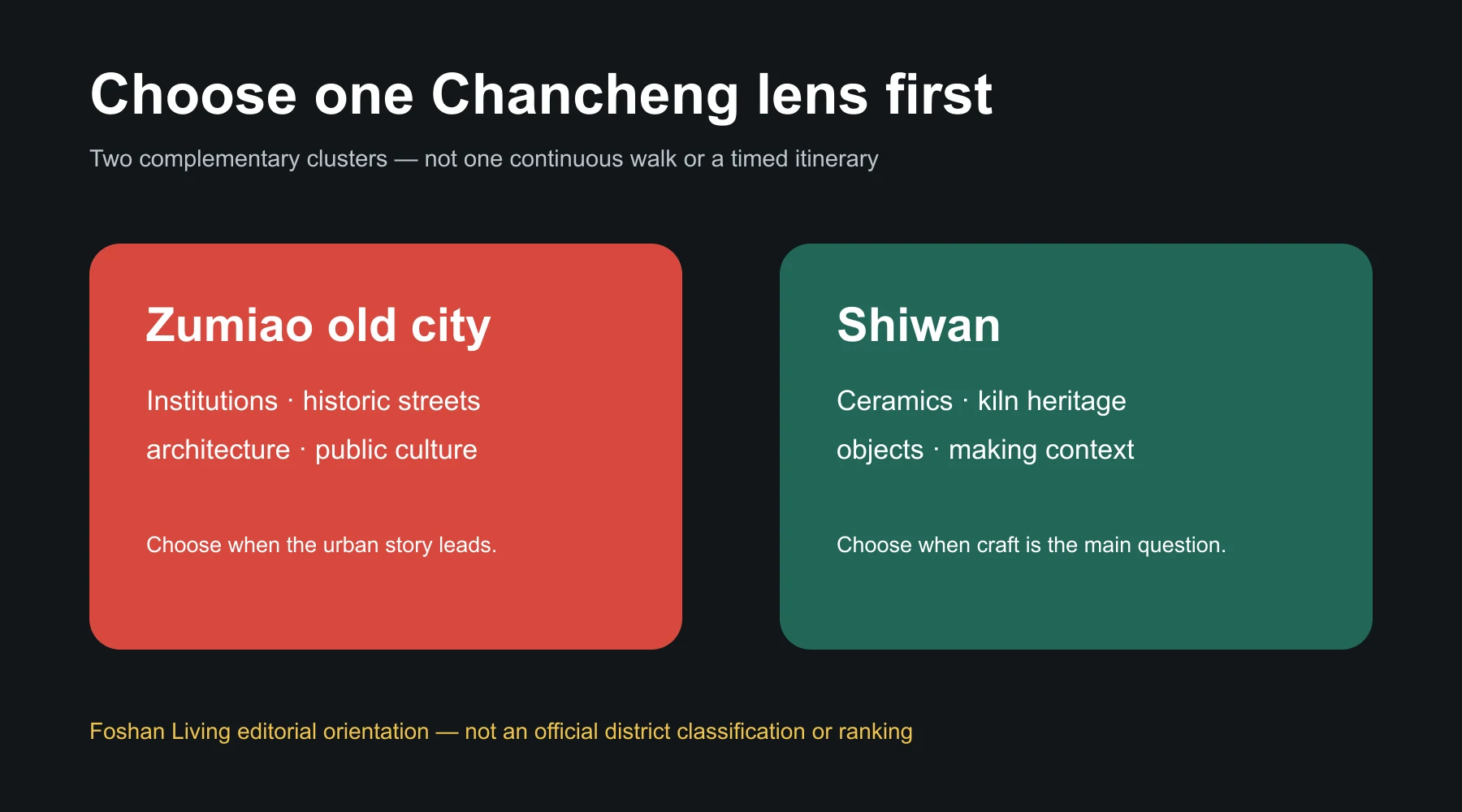
The Zumiao old-city area is the natural starting point for many first-time visitors. It brings historic architecture, folk traditions, martial-arts memory, lion-dance associations and Cantonese performance culture into one interpretive frame. Nearby streets and heritage sites can extend the old-city story, but they should support the main theme rather than become a checklist.
Shiwan offers a different Chancheng experience. Its subject is ceramic production, kiln heritage, craft and the relationship between traditional industry and contemporary making. It is not simply an extra stop attached to Zumiao. Treating Zumiao and Shiwan as two clusters helps you decide whether to explore one deeply or combine them after checking the day’s opening conditions and transport.
Chancheng suits you if
- this is your first Foshan visit and you have one day;
- you want cultural context before exploring the wider city;
- historic buildings, museums, craft and street walking matter more than planning a destination meal;
- you prefer a day with one or two clear cultural themes;
- your arrival point makes central Foshan the simpler live journey.
The trade-off
Starting in Chancheng can give you a strong introduction to “traditional Foshan,” but it does not explain the whole city. It will not substitute for Shunde’s town-based food culture, Nanhai’s contrasting urban and mountain areas, or the nature-oriented experiences of Gaoming and Sanshui. Chancheng is also more than the Zumiao area. If you visit only one landmark and leave, you may miss the ceramics and lived neighbourhood context that make the district more legible.

.jpg)
Choose Shunde for food, gardens and town life
Choose Shunde first when the trip is shaped by a proper meal, garden or water-town atmosphere, and time spent in a specific town centre. The crucial planning rule is that choosing “Shunde” is not enough. Shunde contains multiple towns and subdistricts with different centres and purposes. They are not one pedestrian attraction zone.
Daliang is the usual first research point
For a first visit centred on gardens, streets and food, Daliang is often the most practical town to investigate first. It can support a simple day: one cultural anchor, a complete meal and time to notice the surrounding urban life. That is an editorial planning pattern, not a claim that Daliang represents all of Shunde.
If your real interest is in Ronggui, plan around Ronggui rather than treating it as an afterthought to Daliang. If you have a specific modern business, design or Guangzhou South-side reason to be in Beijiao, make that the base of the route. Lunjiao, Chencun, Lecong and other towns likewise make more sense when tied to a defined theme.
Shunde suits you if
- understanding Shunde cuisine is a primary reason for the trip;
- you are willing to give a meal real time instead of racing through a snack list;
- gardens, neighbourhood life and town identity interest you more than a heritage overview;
- you can stay overnight in the town that anchors your evening;
- you have already chosen a specific destination rather than entering only “Shunde” into a map app.
The trade-off
Shunde rewards focus, but its name can encourage over-planning. A list containing Daliang, Ronggui and several other towns may look manageable until every transfer, meal and return connection is considered. Restaurant rankings, waiting times and opening arrangements are also highly changeable. This guide therefore recommends an area and planning method, not a permanent venue list.

Plan one day around one cluster
The most common first-trip mistake is trying to fit the Zumiao area, Shiwan, Daliang and several food stops into a single day. That itinerary may be possible under favourable conditions, but it makes the day dependent on transfers and removes the unstructured time that gives each place meaning.
Use one of these frameworks instead:
A Chancheng day
Choose the Zumiao old-city cluster as the main subject, then add nearby streets or another cultural stop only if the live opening information and your walking pace allow it. Alternatively, make Shiwan the main subject for a ceramics-focused visit. If combining both clusters, treat the second as optional rather than guaranteed.
A Shunde day
Choose one town—often Daliang for a first garden-and-food visit, or another town because of a specific interest. Build the day around one cultural or neighbourhood anchor and one unhurried main meal. Extra stops should stay within the same practical area unless you have checked the full transfer and return chain.
If you still want both
Accept that each district will be a preview. Start with exact addresses, not district names, and check live directions for every leg. Protect the return journey before adding another stop. Do not use a fixed journey-time claim from an old guide: the answer changes with your origin, destination, transfers and current service.
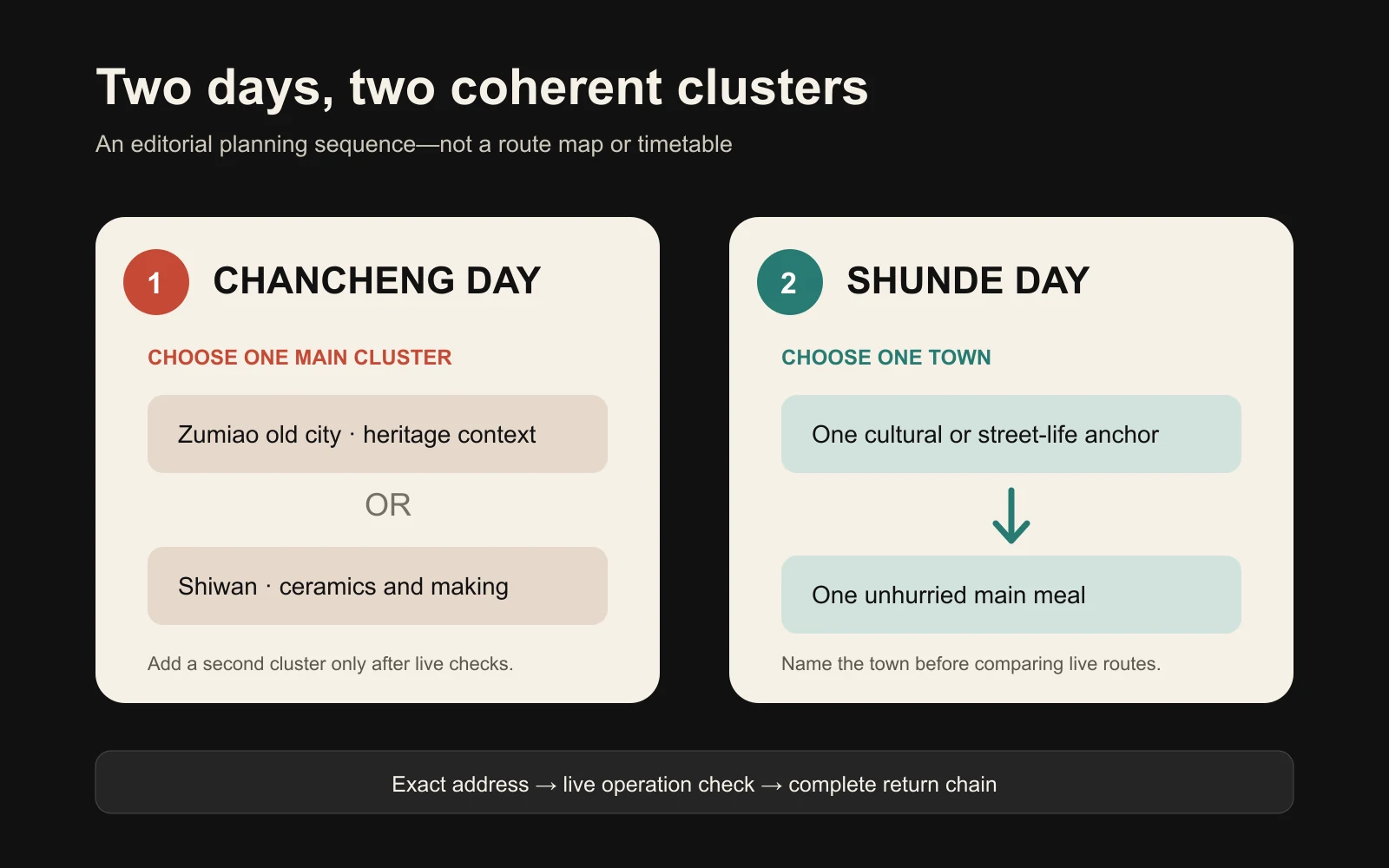
Use two days to compare, not to commute repeatedly
Two days make the choice easier:
- Give one day to Chancheng, focusing on the Zumiao old-city area or Shiwan.
- Give one day to a specific Shunde town, often Daliang for a first visit.
The benefit is not only fewer transfers. The two areas reward different rhythms. Chancheng works well when cultural themes explain one another. Shunde needs room for a meal, local streets and the spacing between town centres.
Choose accommodation from the last important stop
If both evenings finish around central Chancheng, a Chancheng base may reduce unnecessary late travel. If dinner or evening time repeatedly finishes in Daliang or Ronggui, stay in that town. Do not choose a hotel from a district-wide search result without checking its exact address against your planned evening.
For a two-day visit, changing hotels is rarely worthwhile unless the evening anchors are genuinely far apart for your live route. The separate Foshan accommodation-area guide should carry the detailed base-selection method; this article keeps the decision at district and town level.
Know when neither district is the right first choice
Chancheng and Shunde are common starting points, not universal defaults.
- For contemporary Guangzhou–Foshan urban life and public spaces, research Guicheng in Nanhai.
- For mountain and cultural landscape interests, research Xiqiao in Nanhai.
- For hiking, countryside or a slower nature-led trip, research Gaoming.
- For wetlands, river landscapes, family outings or village themes, research Sanshui.
- For furniture sourcing, a trade fair, a factory visit or another business appointment, organise the trip around the exact venue and town rather than a leisure district comparison.
The broader “Which Foshan District Should You Visit?” guide is the better next page when your interests fall outside heritage-first Chancheng and food-first Shunde.
Check three things before you leave
1. The exact destination
Do not search only for “Chancheng” or “Shunde.” Resolve every stop to a named area or a full address—such as the Zumiao area, Shiwan, Daliang or Ronggui—before comparing routes. A district label is too broad to predict a useful journey.
2. The day’s operating information
Opening, performance, ticketing, reservation and temporary-closure information belongs to the venue or operator. Check the official source close to the visit. An older itinerary can explain why a place matters, but it cannot confirm that you can enter today.
3. The complete return chain
For an evening return, check every transfer and the last workable connection, not only the first train or bus. Foshan Metro, intercity rail and national rail may appear together in a journey planner, but that does not make them one ticketing system. Use Foshan Metro and the relevant transport operator for current service information.
Continue planning your Foshan trip
Suggested Foshan Living internal links:
- Which Foshan District Should You Visit? — compare all five districts before choosing a base.
- First Time in Foshan: A 2–3 Day Planning Guide — turn the district choice into a short itinerary.
- Where to Stay in Foshan — choose an accommodation area from evening anchors and live transport.
- Guangzhou to Foshan — compare transport chains from your exact Guangzhou starting point.
- Foshan Metro Guide — understand the network and know which details to verify live.
- A First Day in Chancheng and One Day in Daliang — proposed downstream cluster guides.
For a short first visit, make one decision now: choose the heritage-first day in Chancheng or the town-and-food day in Shunde. Then name your exact first stop and confirm the live operating and return information. That small amount of focus will reveal more of Foshan than a longer list connected by constant transfers.
Image credits and disclosures
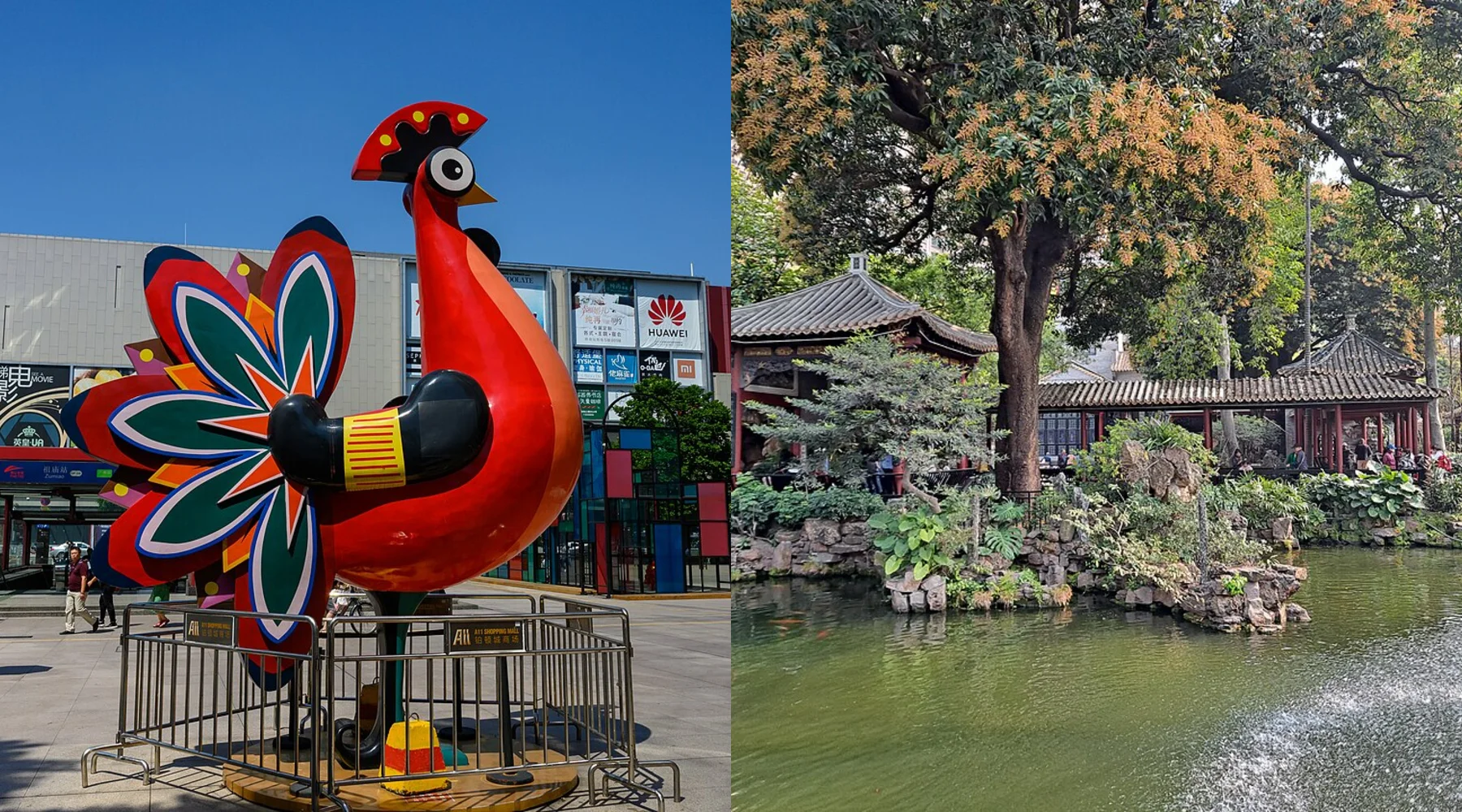
- hero.webp A real-place comparison of the Zumiao area in Chancheng and Qinghui Garden in Shunde. The split image is editorial, not a statement of distance or route. xiquinhosilva; EditQ · CC BY 2.0 and CC BY-SA 4.0; cropped composite distributed as CC BY-SA 4.0 · CC BY-SA 4.0
- body-01.webp Conceptual decision graphic. It is not a map and does not represent distance, travel time or administrative boundaries. Priya Nair / Foshan Living · Original project infographic
- body-02.webp Editorial planning diagram only. The order is a decision framework, not a route map, timetable or statement of travel duration. Priya Nair / Foshan Living · Original project infographic
- local-chancheng.webp Street-level context beside Zumiao Station in Chancheng. xiquinhosilva · CC BY 2.0; cropped and resized for web · CC BY 2.0
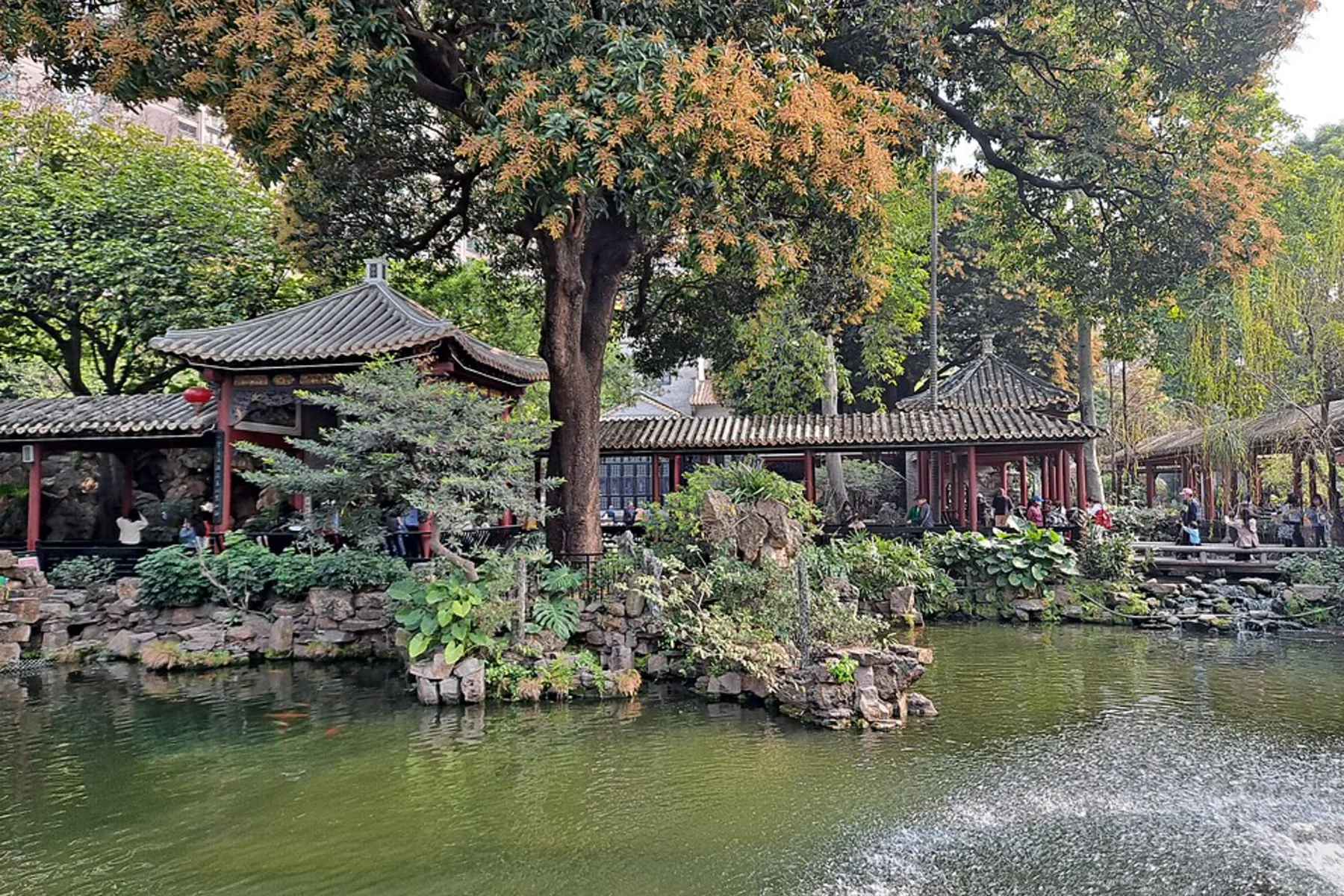
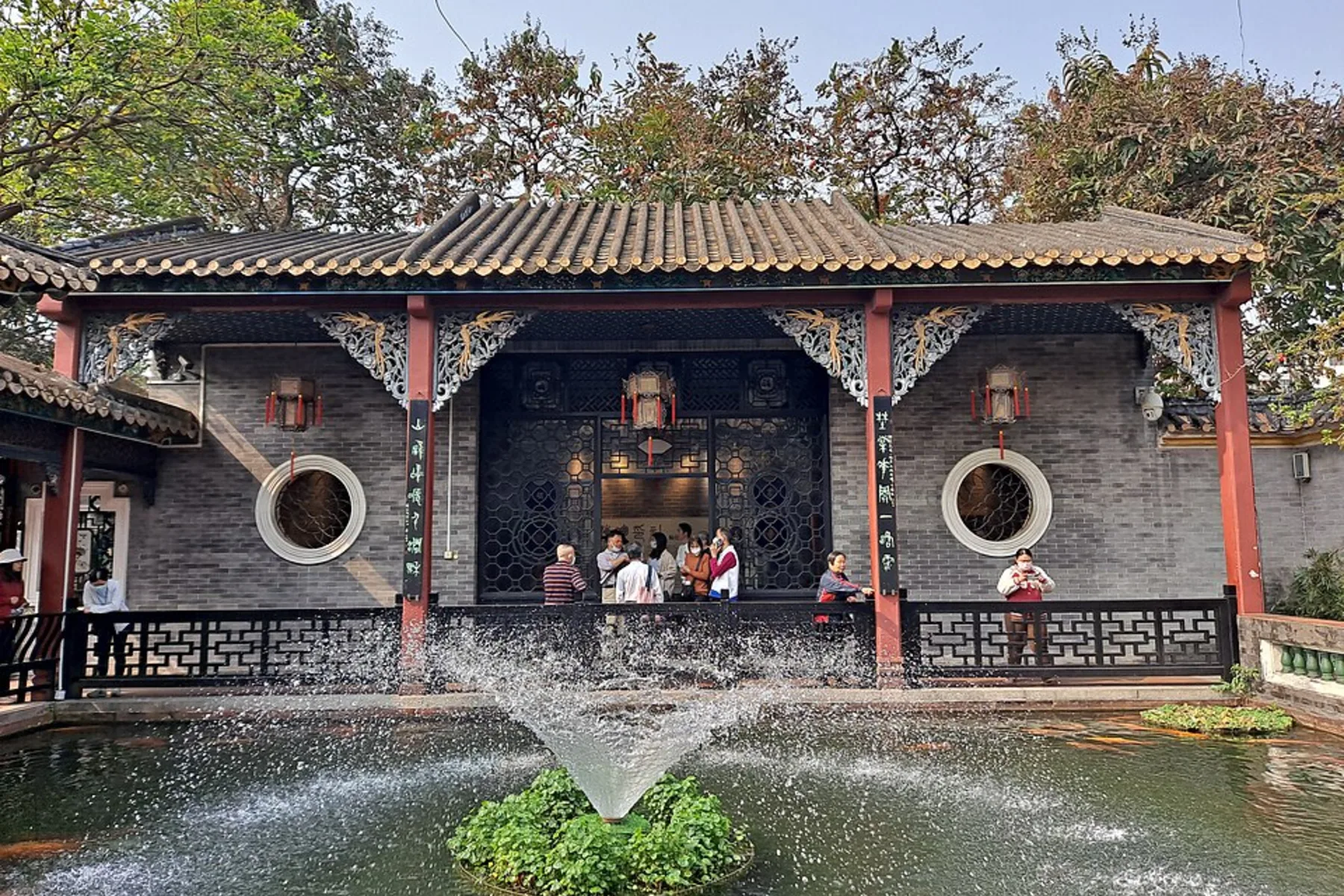
- local-shunde.webp Qinghui Garden provides a real Daliang cultural anchor for a garden-and-food day. EditQ · CC BY-SA 4.0; cropped and resized derivative · CC BY-SA 4.0
.jpg%20|%20https://commons.wikimedia.org/wiki/File:Qinghui_Garden_13.jpg)
Keep exploring
Related Foshan guides
 Explore Foshan
Understanding Foshan: A City of Five Districts
Learn how Foshan’s five districts differ, which areas suit culture, food, urban life or nature, and why every short trip needs a specific local base.
 Explore Foshan
Zumiao Old City or Shiwan: How to Choose Your Chancheng Day
Compare Zumiao old city and Shiwan, choose one main Chancheng cluster, and add the other only after checking the complete route and current access.
 Explore Foshan
Chancheng: Foshan’s Historic Urban Core
Understand Chancheng through the Zumiao old city and Shiwan’s ceramic heritage, with guidance on walking scale, transport checks and where to base.
 Food & drink
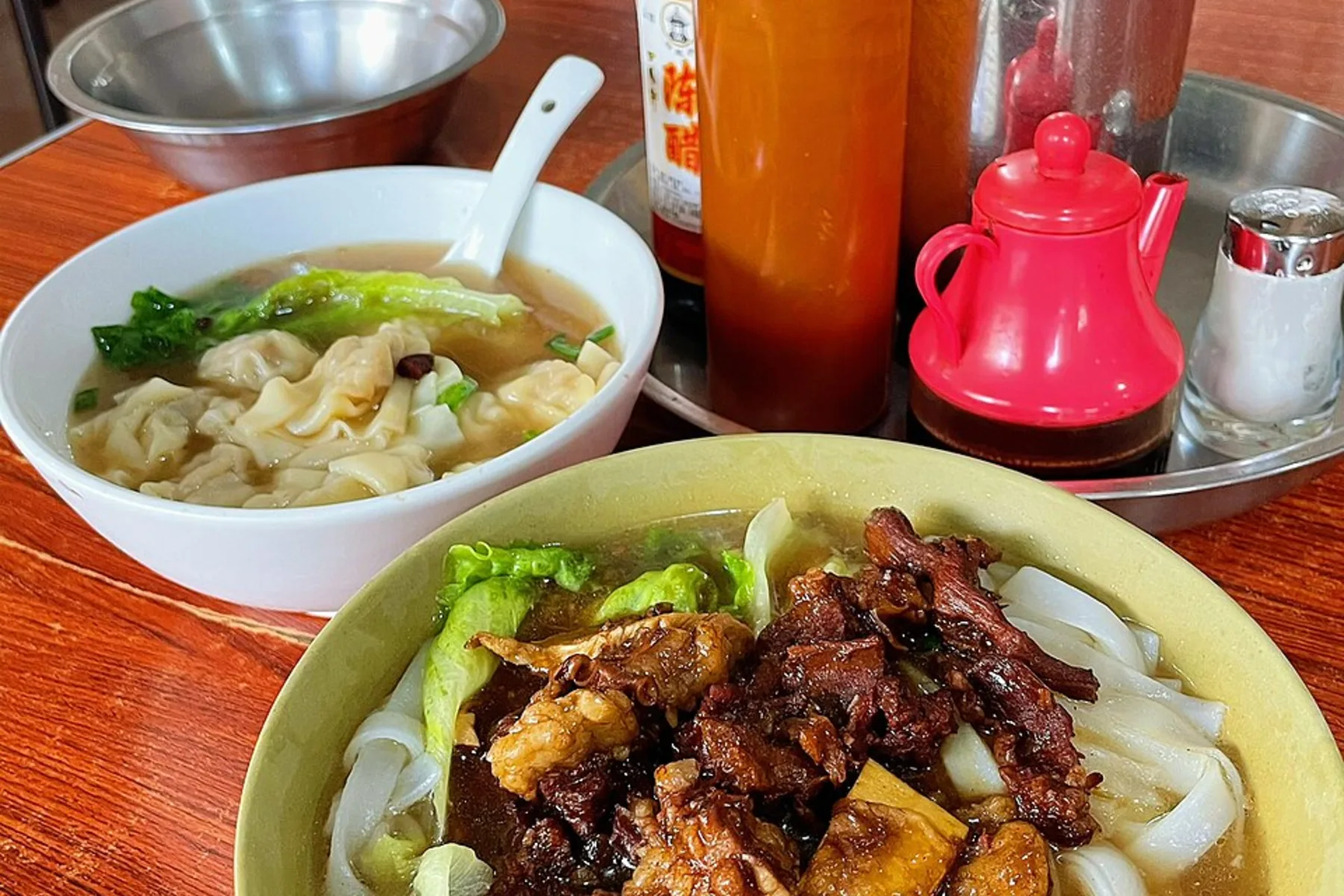
Shunde Food for First-Timers: A Practical Ordering Guide
Learn how to order a balanced Shunde meal, understand fish, milk and rice dishes, ask about market prices, and avoid freshwater raw-fish risk.
Plan your visitFirst Time in Foshan
Build a first trip around districts, transport, food and one deeper cultural interest.