Culture & history
Cantonese Opera in Foshan: The Basics
Start with story, sound, role, movement and stage design, then use Foshan’s museums and historic spaces to build context.
On this page
- Distinguish Cantonese opera from narrative singing
- Understand Foshan’s place in the story
- Watch Cantonese opera through five layers
- Follow the story before every word
- Listen for changes in sound
- Read role and movement together
- Use visual design as evidence
- Choose the right Foshan entry point
- Use a museum for material context
- Use a historic stage to read performance space
- Separate the troupe from the venue
- Start even if you do not speak Cantonese
- Choose a live performance carefully
- Short selections and full-length productions
- Verify the specific production
- Respect performance etiquette and access needs
- Continue exploring Foshan culture
- About the author
Cantonese opera is theatre told through voice, speech, music, movement, costume and stage space. A first-time viewer does not need to memorise role names or understand every sung line. Start with five layers—story, sound, role, movement and visual design—then use Foshan’s museum collections and historic stages to build context.
First, separate the art form from its neighbours. Cantonese narrative singing has a close musical relationship with Cantonese opera, but it is not another name for the same staged experience. A museum, a historic stage, a professional troupe and a modern theatre also serve different purposes. None of them guarantees that a live performance will be available when you visit.
Distinguish Cantonese opera from narrative singing
China’s national intangible-cultural-heritage system records Cantonese opera as traditional theatre and Cantonese narrative singing as a form of narrative or ballad singing. They share musical relationships, but the audience encounters them differently.
Cantonese opera combines singing, spoken delivery, acting, stylised movement, costume, makeup, props and stage organisation. Cantonese narrative singing centres more directly on voice and instrumental accompaniment. A programme described as a Cantonese-music evening, narrative-singing concert or opera selection should therefore not be assumed to offer a complete staged opera.
This is a minimum practical distinction, not a claim that either form has only one presentation style. Contemporary programmes may combine excerpts, commentary and different performance traditions. Read the programme type, performers and production description before deciding what you are buying.
Understand Foshan’s place in the story
Foshan cultural-history material connects the city with Qionghua Guild Hall and Red Boat memories. Qionghua Guild Hall is presented as an important early professional association, while the Red Boat evokes travelling companies moving through the Pearl River Delta’s waterways and performing for different communities.
These references explain why Foshan matters to Cantonese-opera memory. They do not prove that every detail of the form began at one place on one uncontested date. Origin stories vary in emphasis, and a visitor guide should attribute them rather than turn a cultural slogan into settled chronology.
Use three lines of inquiry:
- Community and profession: how performers organised, learned and remembered their work.
- Movement and audience: how travelling companies connected waterways, towns and performance sites.
- Objects and spaces: how scripts, instruments, costumes, recordings and stages preserve evidence beyond a spoken origin story.
This approach places Foshan within a wider Lingnan and Cantonese-speaking cultural region without reducing the form to a local ownership claim.
Watch Cantonese opera through five layers
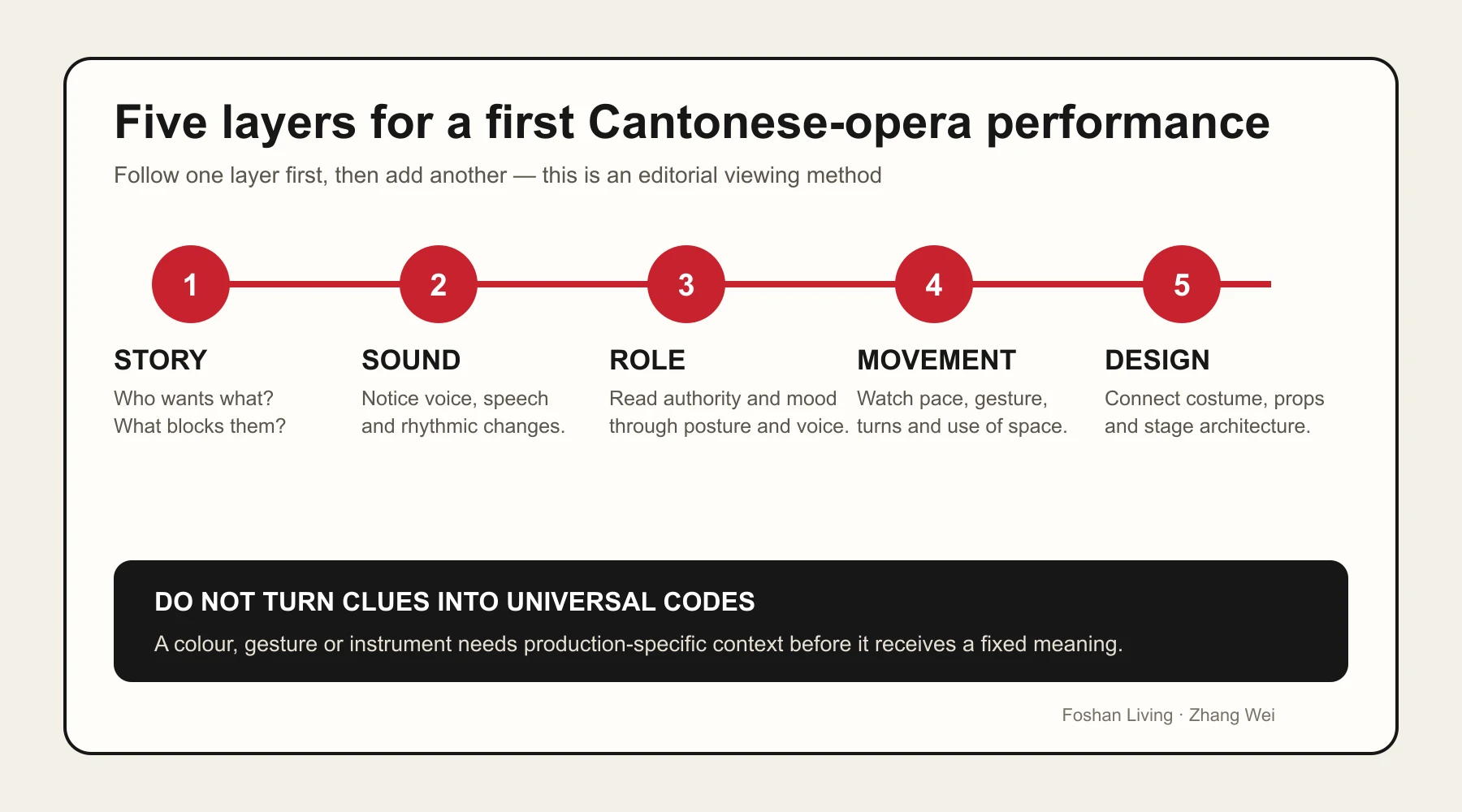
Story, sound, role, movement and visual design form a Foshan Living viewing method. They are not an official grading system. Follow one layer when the stage feels unfamiliar, then add another as your attention settles.
Follow the story before every word
Begin with relationships and conflict. Who wants something? Who prevents it? Has the scene moved from negotiation to separation, danger or reunion?
A reliable synopsis can be more useful than a glossary. If you know the central relationship and the purpose of the scene, tone and movement remain readable even when individual lines are not.
Do not assume a short excerpt is self-explanatory. An excerpt may showcase a famous scene while depending on earlier events. A full production may require more time but provide a clearer dramatic arc. The specific programme determines the experience.
Listen for changes in sound
The national heritage record identifies bangzi and erhuang as basic vocal systems within Cantonese opera and notes connections with other musical sources. It also records an early ensemble remembered as the “five-piece ensemble,” involving bowed, plucked and wind instruments.
A newcomer does not need to identify every mode or instrument. Listen for contrasts:
- sung passages and spoken delivery;
- sustained melody and percussion-led action;
- private emotion and public declaration;
- music that supports a voice and music that drives movement.
Modern stage instrumentation may differ from an early description. Variation alone does not prove that a production is more or less authentic.
Read role and movement together
Role categories give performers systems for voice, posture, gesture and movement. For a first viewing, it is more useful to observe how a character is constructed than to memorise a full list of category names.
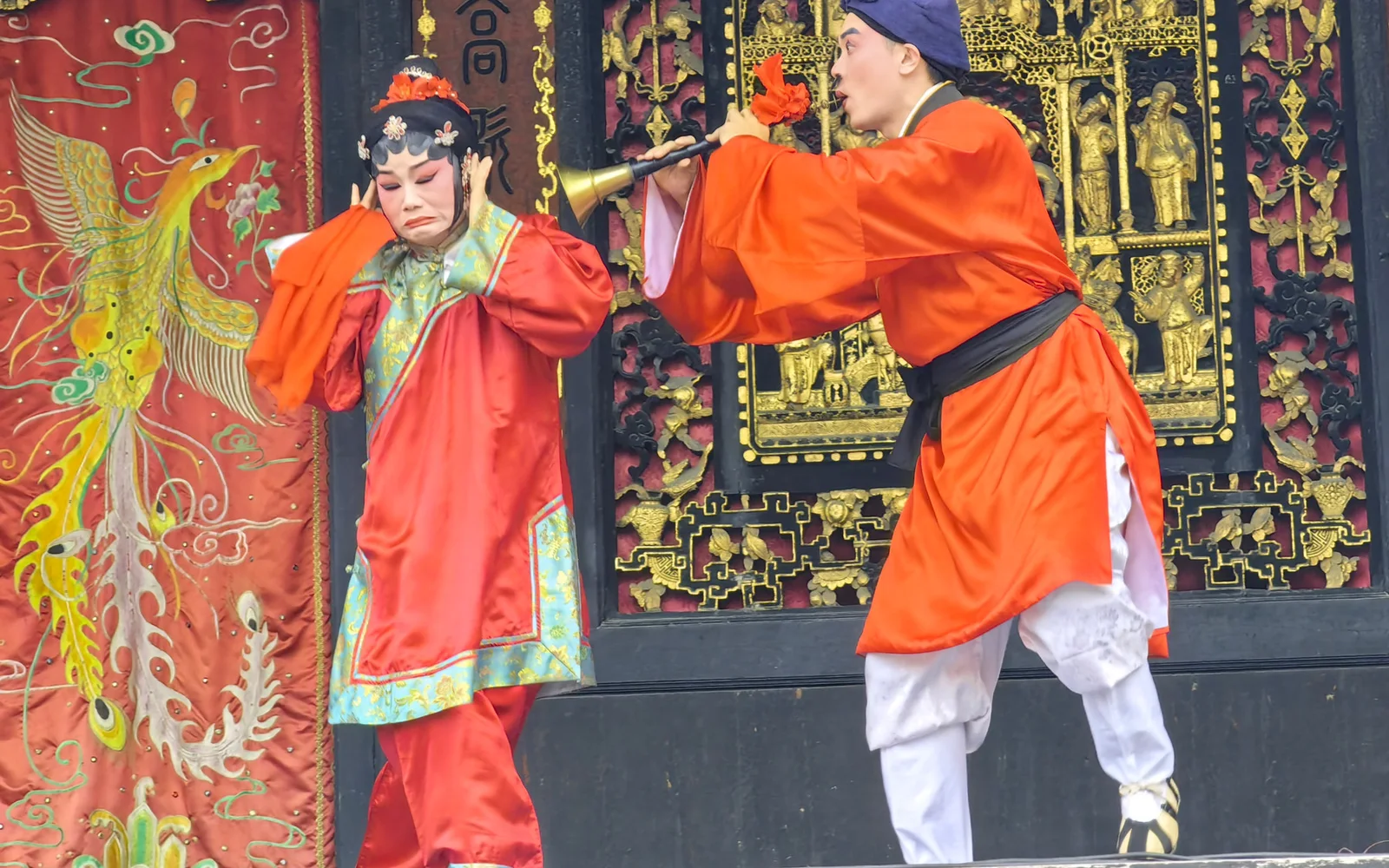
Watch how stance changes authority, how pace changes mood and how a turn or pause redirects attention. A table, chair, sleeve, fan or weapon may support actions that the stage does not represent literally.
Stylisation is not failed realism. Ask what the movement communicates: distance, rank, conflict, hesitation, travel or a change of place.
Use visual design as evidence
Costume, headwear, makeup, props and stage architecture help establish identity and situation. Colour is only one clue. Shape, textile, ornament, footwear, how an object is handled and how a performer occupies space can matter just as much.
Choose one character and follow the relationship between voice, clothing and movement. This produces a clearer reading than treating the stage as a series of colourful photographs.
Visual interpretation also needs restraint. Do not assign a fixed symbolic meaning to every colour or ornament without a reliable source for the production and role.

Choose the right Foshan entry point
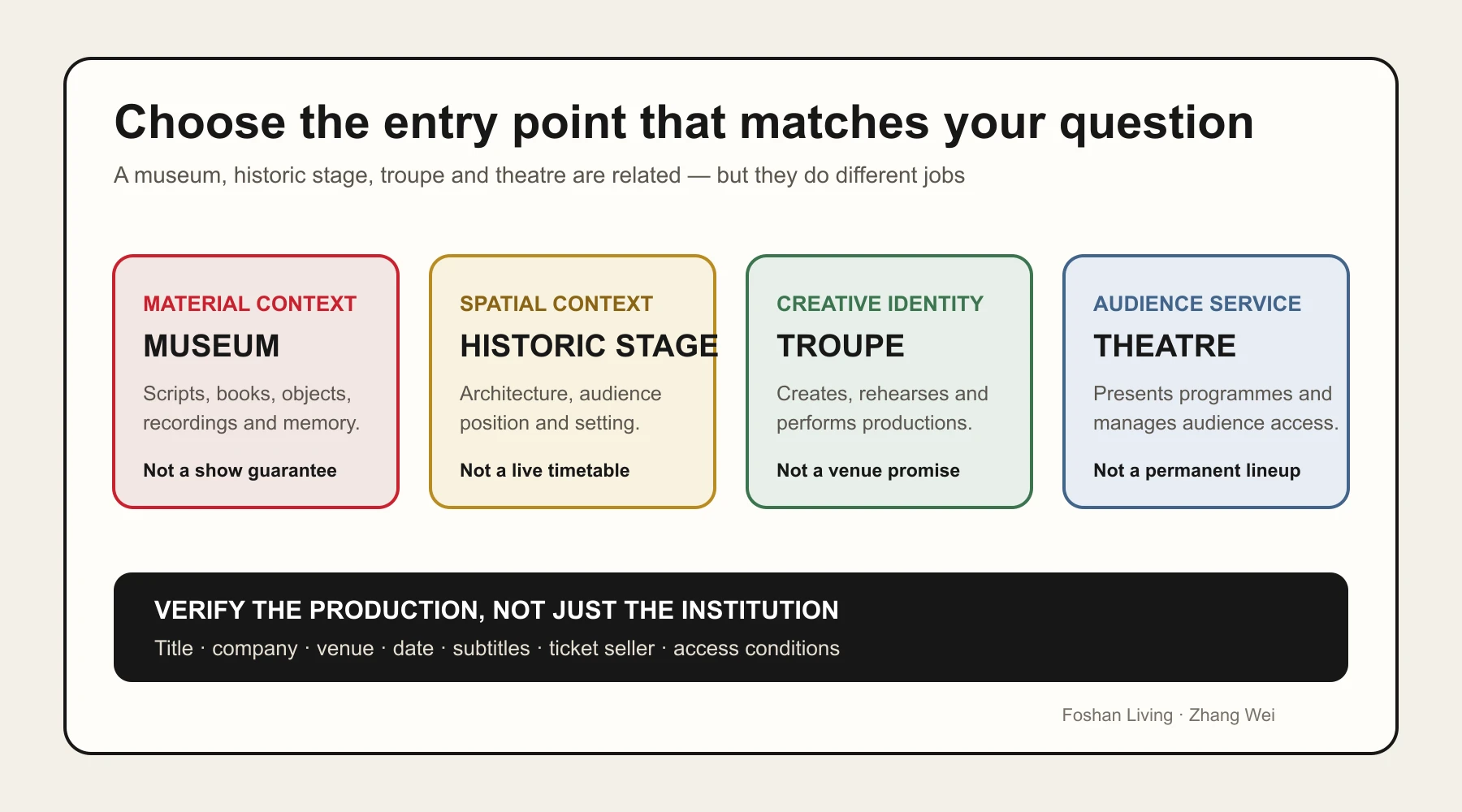
Use a museum for material context
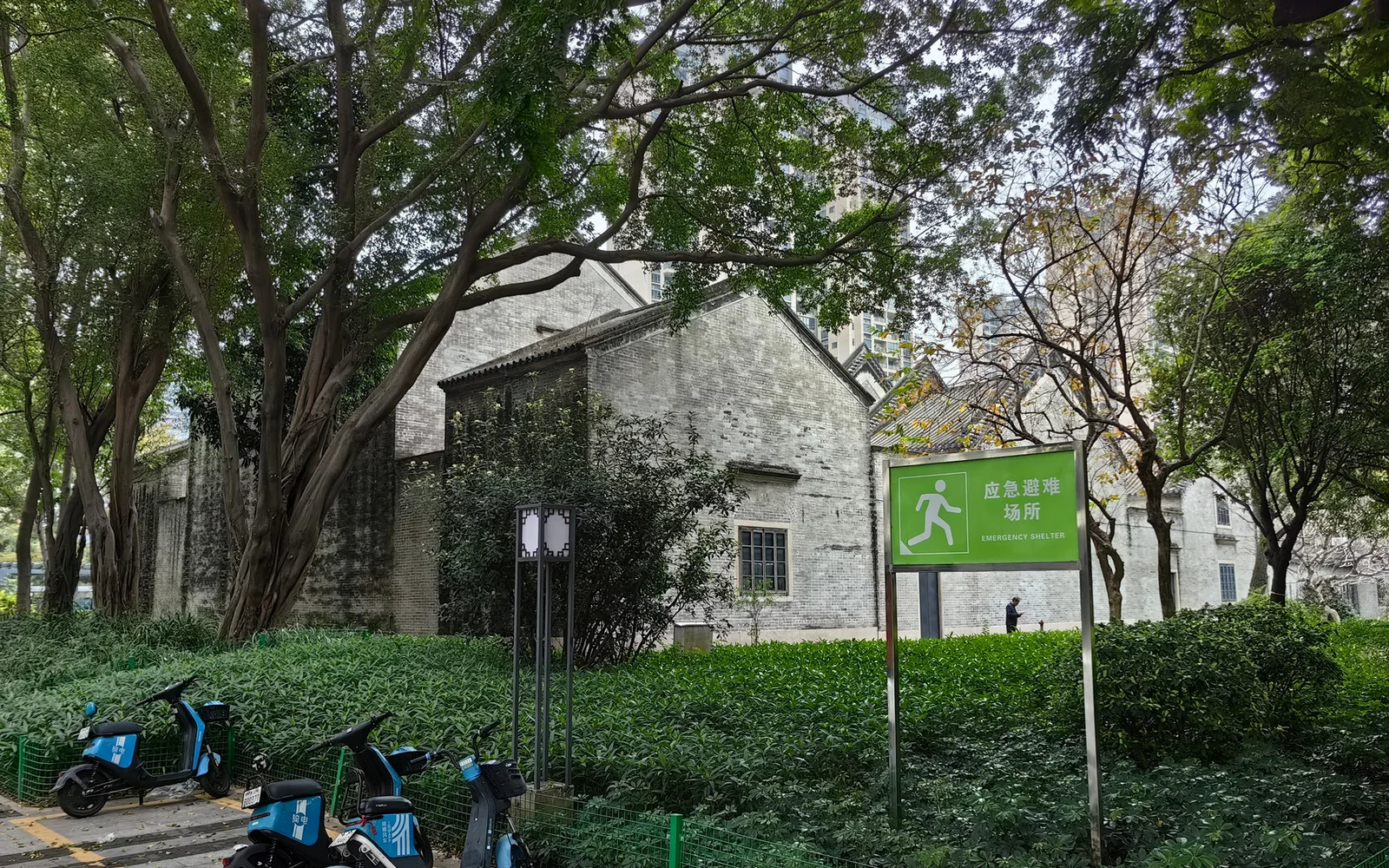
Chinese public-cultural sources describe the Guangdong Cantonese Opera Museum through scripts, books, costumes, instruments, records and audiovisual holdings. These categories help a newcomer ask how a performance is written, made, heard, recorded and remembered.
The museum role is interpretive. Historical source pages cannot prove which object will be on display when you visit, whether a gallery is open or whether interpretation is available in a particular language. Verify current access through the responsible institution.

Use a historic stage to read performance space
Wanfutai at Foshan Ancestral Temple provides a way to examine a traditional stage within an architectural and ritual setting. Its dedicated guide owns the detailed reading of the stage opening, audience area, decoration and visible movement routes; this parent page only explains why a historic stage is one possible entry into the art form.
Seeing the stage is not the same as attending a performance. Do not repeat old schedules or assume that arrival will coincide with opera, lion dance or another programme. The Ancestral Temple Museum’s current information controls access and events.
Wanfutai is also a useful starting point for reading ancestral halls and historic fabric, but that architectural context should remain a separate research task until Foshan Living has a published, verified architecture guide to link here.
Separate the troupe from the venue
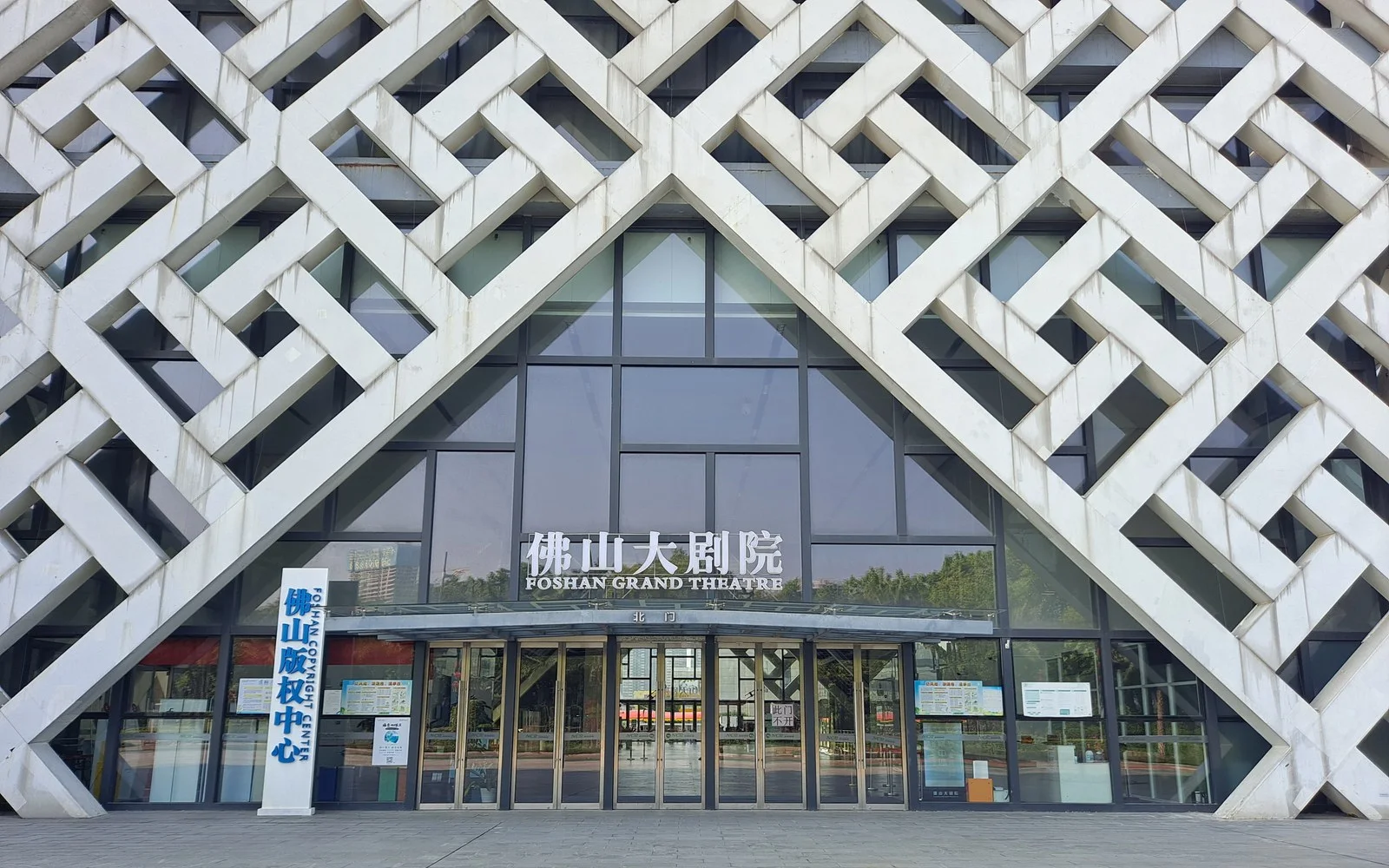
A Guangdong Cantonese-opera industry portal describes Foshan’s professional opera company, while Foshan Grand Theatre’s operator presents a general performance venue. Those sources support a practical distinction: a company creates and performs work, while a venue presents programmes and audience services. They do not establish where a particular production will appear.
Institutional identity is relatively stable. Programme, cast, venue, date and ticket seller are live facts. Never infer one from the other.

Start even if you do not speak Cantonese
Not speaking Cantonese changes preparation, not whether you can engage with the form.
Before choosing a show, look for a clear synopsis, named scenes, role information, programme notes, a pre-show talk or explicitly listed subtitles. Do not assume that every modern theatre provides subtitles or that a traditional setting never does.
Before the curtain, remember three things:
- the main characters;
- their relationship;
- the central conflict of the scene or production.
During the performance, return to the five layers. Sound, movement and visual design can carry emotional and dramatic information beyond literal translation. The separate Cantonese Opera Roles, Music and Stage Vocabulary for Beginners guide owns the deeper role, bangzi/erhuang, percussion, gesture, prop and stage-language glossary; it should be linked here only after that package is published.
Language support is production-specific. Confirm the subtitle language, position and visibility on the official programme page or with the venue. A platform tag or an old audience comment is not enough.
Choose a live performance carefully
Short selections and full-length productions
A selection programme can introduce several roles, musical textures or styles in one sitting. A full-length production can make character and story development easier to follow across time.
Neither format is automatically more accessible. A short selection may depend on missing plot context. A full production may provide strong subtitles and programme notes. Choose from the actual information available, not from the assumption that shorter always means simpler.
Verify the specific production
Before paying, confirm:
- title, version and whether it is selections or a complete production;
- performing company, organiser and current cast announcement;
- date, start time, expected duration and interval;
- venue, auditorium, entrance and ticket collection;
- spoken and sung language, subtitles, synopsis and guide material;
- child admission, late seating and accessibility arrangements;
- photography, recording, food, storage and phone rules;
- authorised ticket seller, refund, postponement and cancellation terms.
These details never belong to the permanent cultural layer. Save the confirmation, and recheck the organiser or venue before travelling.
Respect performance etiquette and access needs
Rules differ by production and venue, but a careful starting practice is simple: arrive with time for entry, silence your phone, avoid bright screens and do not photograph or record unless permission is explicit. Follow staff directions if you arrive late.
Applause is not an examination. Follow the room rather than worrying about a perfect response. In a historic or outdoor setting, keep passages, ritual areas and performer preparation spaces clear.
Families should confirm admission, length, sound conditions and whether leaving and returning is allowed. Anyone needing step-free access, wheelchair seating, hearing support or assistance should confirm the complete route and service before purchase. A lift symbol or modern building exterior does not answer every access question.
For the broader relationship between performance, place and community, read the Foshan Culture Framework.
Continue exploring Foshan culture
Use the Wanfutai guide for one historic stage and the forthcoming roles-and-music guide for specialist vocabulary. This article remains the foundational cultural and viewing layer; current programmes belong in dated production or venue pages.
About the author
Zhang Wei is Foshan Living’s culture, history and kung fu correspondent. He separates documented history, inherited cultural memory and screen mythology so readers can approach Foshan’s traditions without flattening them into slogans. See all articles by Zhang Wei.
Image credits and disclosures
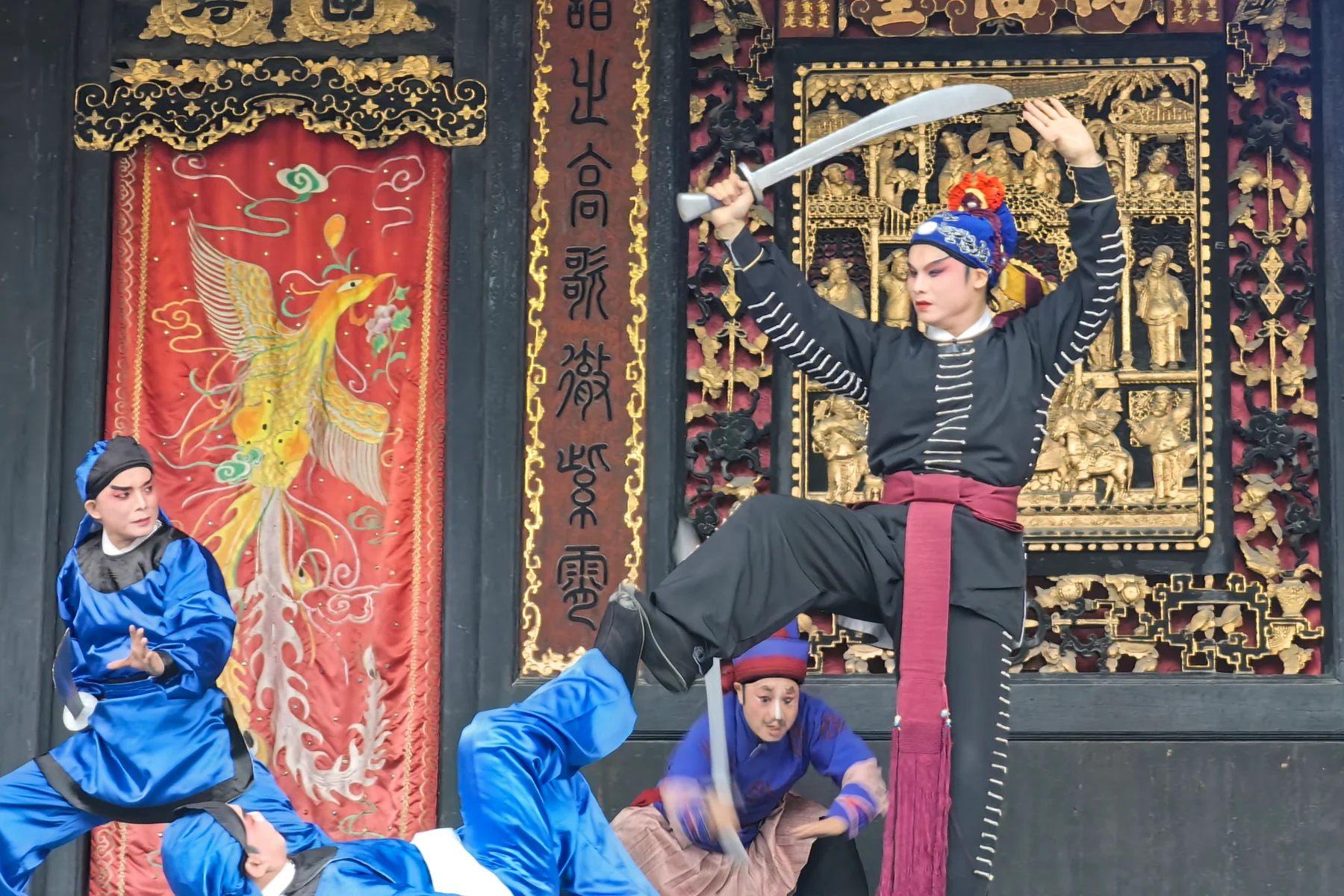
- hero.webp This 2024 photograph documents Foshan Cantonese Opera Troupe performing Lin Chong's Night Escape at Wanfutai; it does not confirm a current programme, cast or recurring event. Uuongkinghe · CC BY-SA 4.0; resized and converted to WebP · CC BY-SA 4.0
- body-01-performance.webp A dated scene from Pulling the Flute shows role, movement, costume and stage interaction without defining a universal code or current programme. Uuongkinghe · CC BY-SA 4.0; cropped, resized and converted to WebP · CC BY-SA 4.0
- body-02-museum.webp This February 2024 southwest view documents the historic-building context associated with the Guangdong Museum of Cantonese Opera; it does not confirm today's entrance, opening or displays. Uuongkinghe · CC BY-SA 4.0; cropped, resized and converted to WebP · CC BY-SA 4.0
- body-03-theatre.webp This September 2022 exterior documents one Foshan performance venue; it does not prove a Cantonese-opera programme, present operator, ticket seller or access condition. 钉钉 · CC BY-SA 4.0; cropped, resized and converted to WebP · CC BY-SA 4.0
- body-04-five-layers.webp Foshan Living's editorial viewing method helps first-time viewers follow one layer at a time; it is not an official taxonomy or universal code. Zhang Wei / Foshan Living · Original editorial infographic
- body-05-entry-points.webp The diagram separates material context, spatial context, creative identity and audience service while keeping live production facts outside the evergreen layer. Zhang Wei / Foshan Living · Original editorial infographic


Keep exploring
Related Foshan guides
 Explore Foshan
Chancheng or Shunde: Where Should You Start in Foshan?
Choosing between Chancheng and Shunde for a first Foshan trip? Compare heritage, food, neighbourhood pace, transport planning and where to stay.
 Explore Foshan
Understanding Foshan: A City of Five Districts
Learn how Foshan’s five districts differ, which areas suit culture, food, urban life or nature, and why every short trip needs a specific local base.
 Explore Foshan
Zumiao Old City or Shiwan: How to Choose Your Chancheng Day
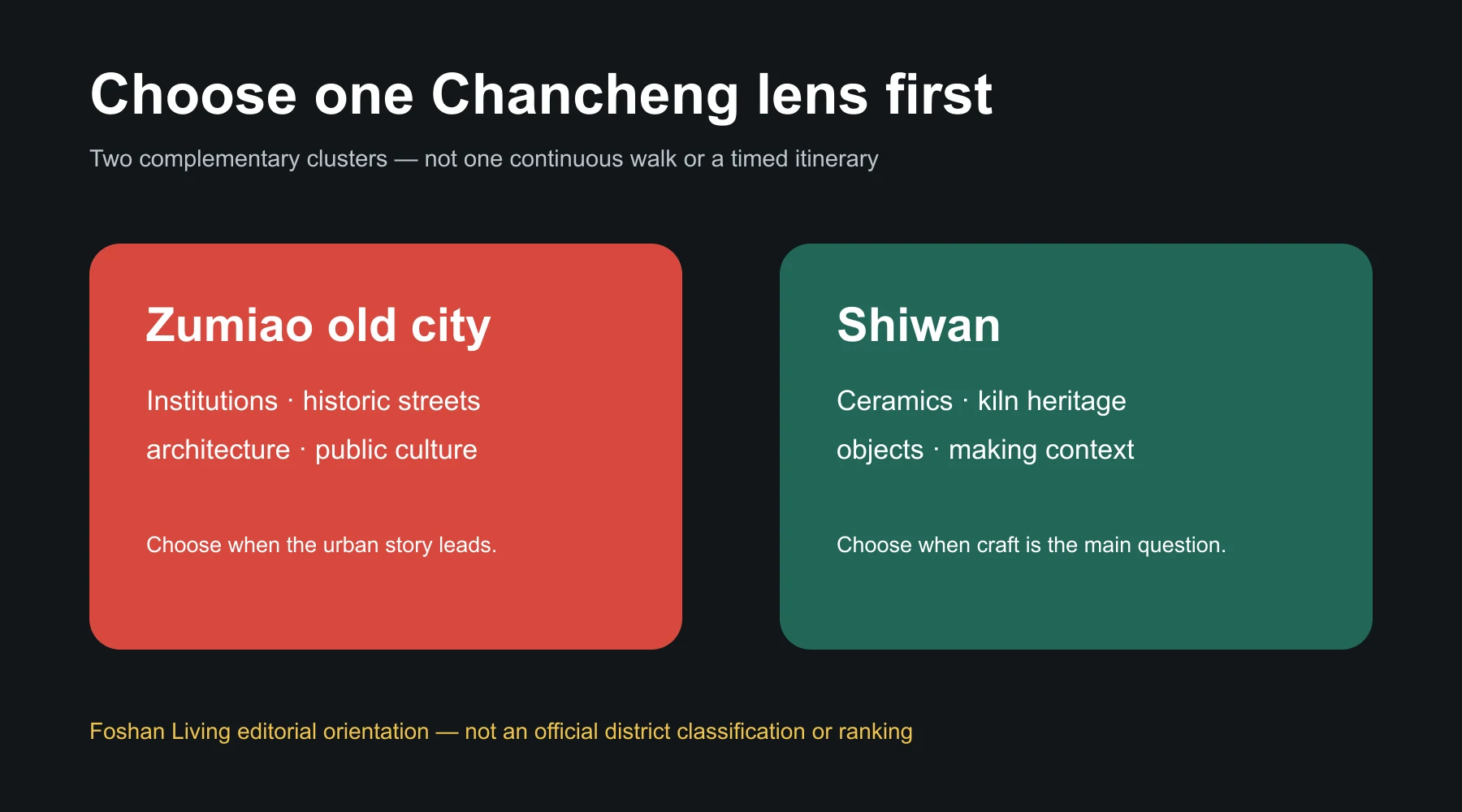
Compare Zumiao old city and Shiwan, choose one main Chancheng cluster, and add the other only after checking the complete route and current access.
 Explore Foshan
Chancheng: Foshan’s Historic Urban Core
Understand Chancheng through the Zumiao old city and Shiwan’s ceramic heritage, with guidance on walking scale, transport checks and where to base.
Plan your visitFirst Time in Foshan
Build a first trip around districts, transport, food and one deeper cultural interest.