Culture & history
Foshan Culture: A First Framework
A six-lens framework for understanding Foshan through place, belief, craft, performance, martial arts and community traditions.
On this page
- Begin by separating four kinds of cultural evidence
- Read Foshan through six connected lenses
- Lens one: place and historic urban form
- Lens two: belief and community institutions
- Lens three: craft and production
- Lens four: performance and voice
- Lens five: martial arts and embodied tradition
- Lens six: festivals and public memory
- Use museums to choose a question
- Connect the lenses without flattening them
- Keep culture separate from live visitor operations
- Build your first cultural route
- Continue with a focused Foshan guide
- About Zhang Wei
Foshan culture is easier to understand as a set of connected systems than as a list of famous attractions. Historic neighbourhoods, ancestral and temple spaces, ceramic production, Cantonese opera, martial arts, lion dance and community festivals each reveal a different relationship between place, work, belief and public life.
This guide offers six editorial lenses for a first reading. They are not an official classification and do not claim that one place or tradition represents all of Foshan.
Begin by separating four kinds of cultural evidence
Cultural stories often become confusing because different kinds of evidence are blended into one smooth narrative. Foshan Living uses four labels.
Local fact means a claim supported by an accountable official source. For example, the Guangdong government’s approval of Foshan’s Historic and Cultural City Conservation Plan identifies Foshan Old City and Shunde Old City as distinct historic urban areas. It does not tell you which lane is open today.
Lineage or transmission account means a story preserved by a school, family, troupe or community. It shows how a tradition explains itself and should be attributed, not presented as the only proven origin. Different Wing Chun branches may preserve different accounts.
Screen narrative means a story reshaped for entertainment. Movies about Wong Fei-hung or Ip Man have introduced global audiences to Foshan, but a dramatic fight, relationship or chronology is not biographical evidence.
Editorial framework means the six lenses used here. It belongs to Foshan Living, not to an official heritage classification or local community.
Keeping these labels visible allows cultural complexity to remain useful rather than becoming vague.
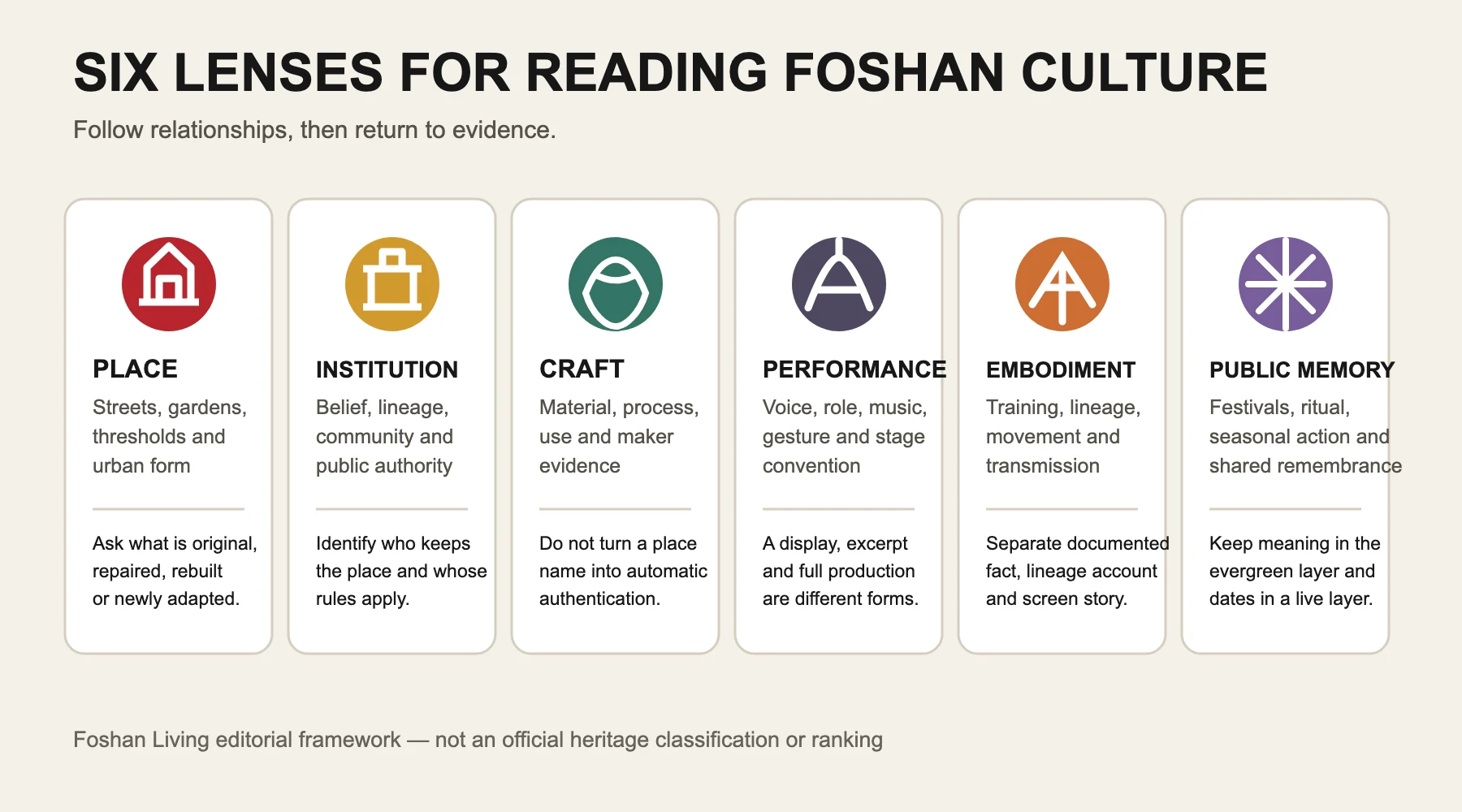
Read Foshan through six connected lenses
Lens one: place and historic urban form
Begin with the shape of the city. The official conservation framework distinguishes Foshan Old City from Shunde Old City. They are not one continuous historic quarter and should not be compressed into a single walk.
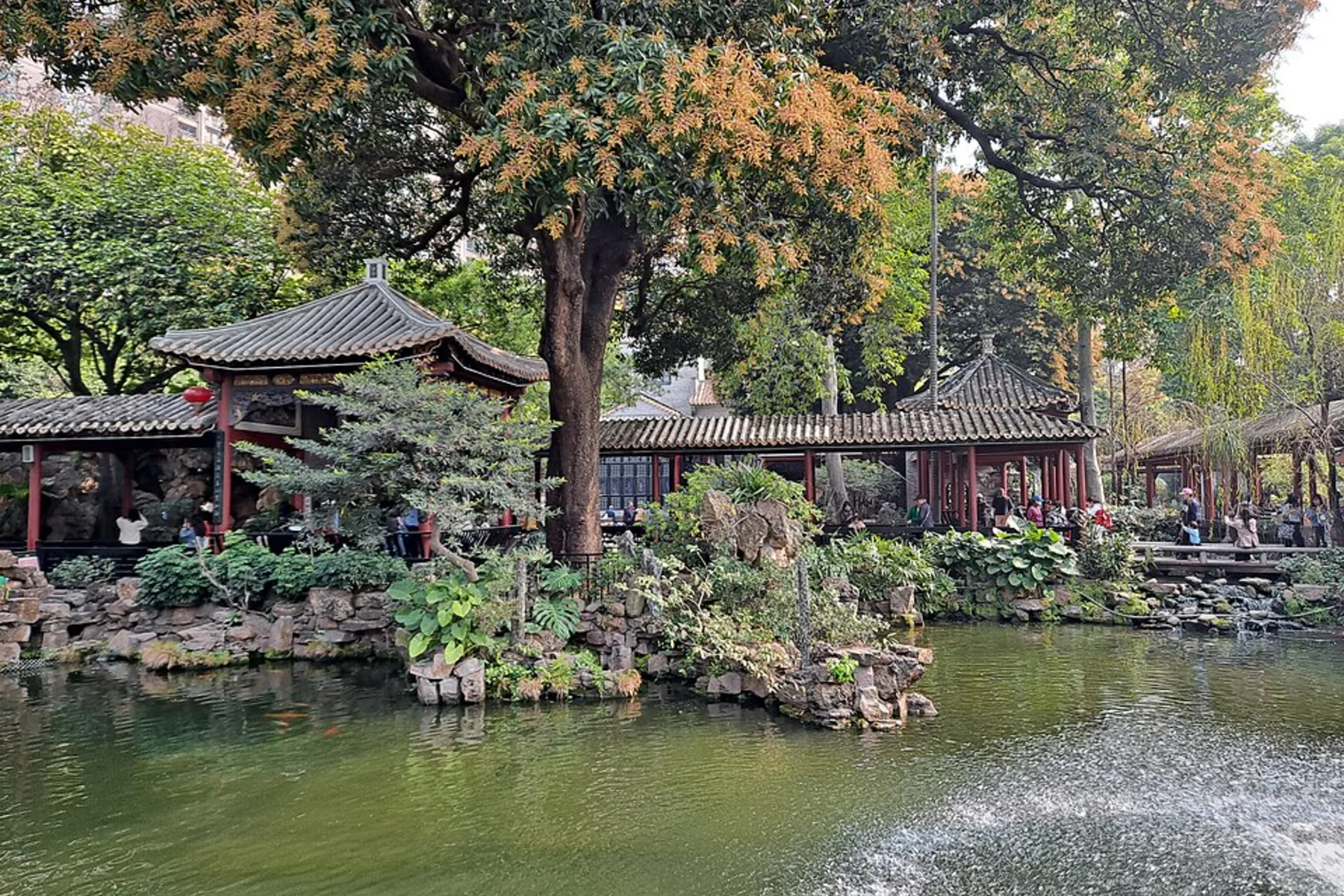
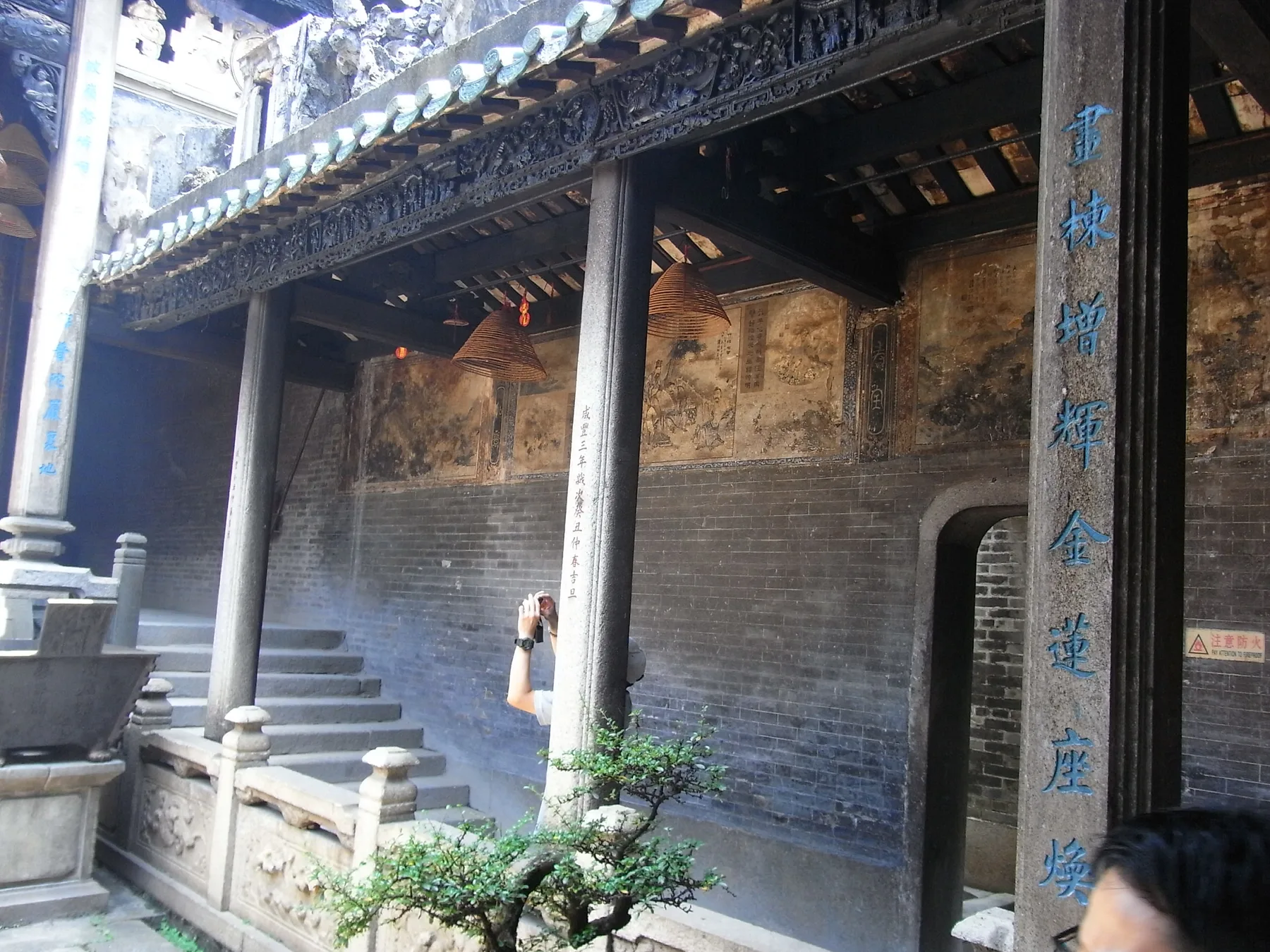
In and around Foshan Old City, temples, traditional neighbourhood fabric, gardens and commercial buildings offer different spatial evidence. A temple complex may organise courtyards, stages and ritual movement. A residential lane may reveal street width, thresholds, party walls and rooflines. A garden creates another sequence through water, halls, corridors and framed views.
The same method applies in Shunde, but its history and setting differ. Treating every grey-brick wall as interchangeable “Lingnan style” misses those distinctions.

A deeper spatial reading should distinguish an original structure, a repair, a reconstruction and a new building designed to coordinate with historic surroundings.
Lens two: belief and community institutions
Temple and ancestral-hall spaces are more than collections of carved beams and ceramic roof figures. Depending on the place, they may hold ritual, lineage, charitable, theatrical, educational or neighbourhood functions.
The Foshan Ancestral Temple Museum is a strong first orientation point because its complex brings architecture, folk belief, a historic stage and martial-arts commemoration into one institution. It still cannot stand for every community tradition in Foshan. A district temple, a lineage hall and a museum-managed national heritage site have different authorities, users and visitor expectations.
Read social function as carefully as the façade. Ask who maintains the place and which activities belong to worship or community life. Follow on-site rules for incense, clothing and photography.

Lens three: craft and production
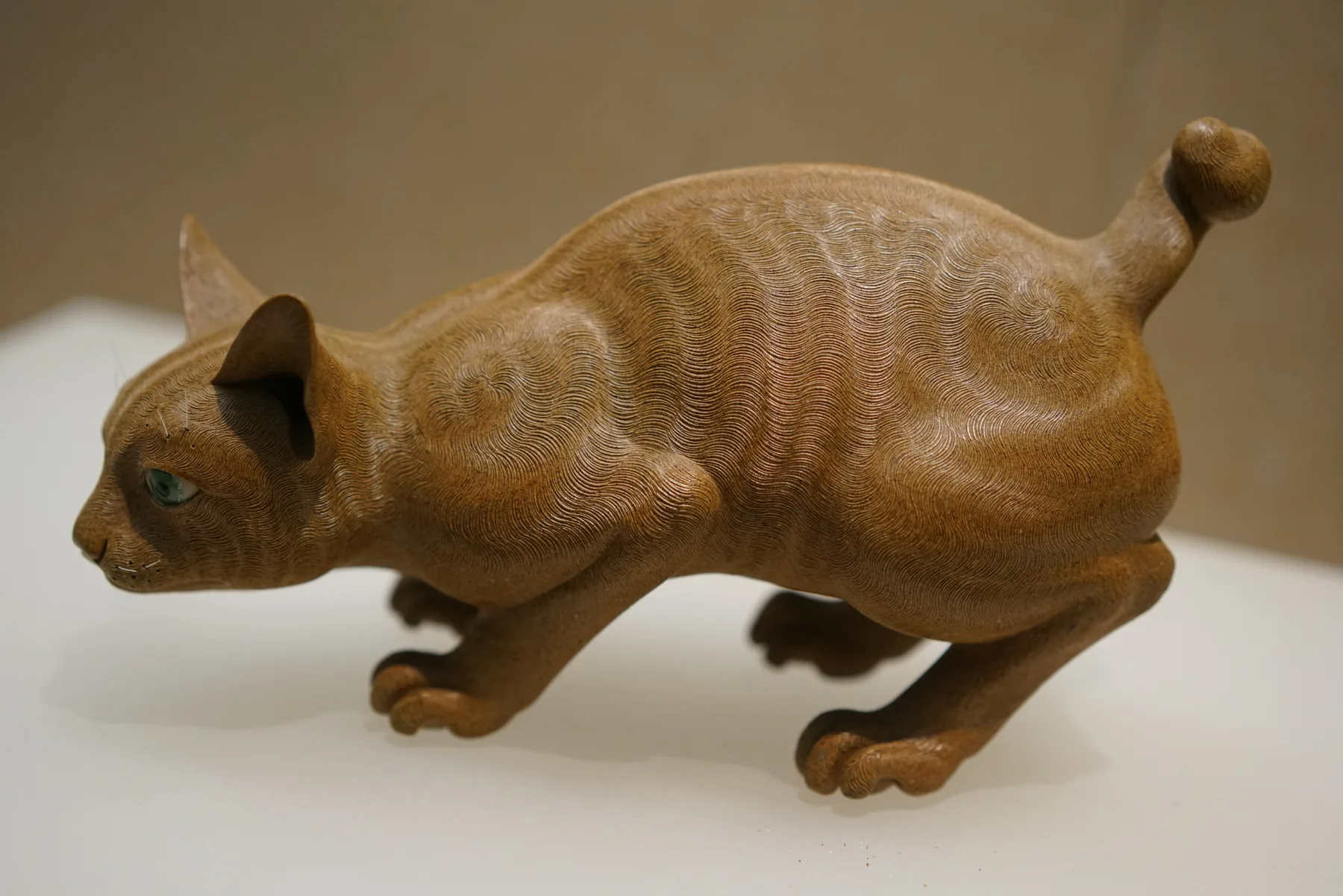
Shiwan ceramics show why craft should be read as a production system, not simply a souvenir style. The national intangible-cultural-heritage record for Shiwan ceramic sculpture connects forms including figures, animals, vessels, miniature sculpture and ceramic ridge decoration with a sequence of design, clay preparation, forming, decoration, glazing and firing.
Ceramics appear in daily objects, sculpture, gardens and architecture. Kilns, museums, studios and shops represent different stages. Shiwan heritage does not authenticate every product carrying the place name.
When looking at an object, ask four questions: What was it made for? Which material and firing choices are visible? Was it designed to be handled, displayed or attached to architecture? What evidence identifies the maker, period or technique?

Lens four: performance and voice
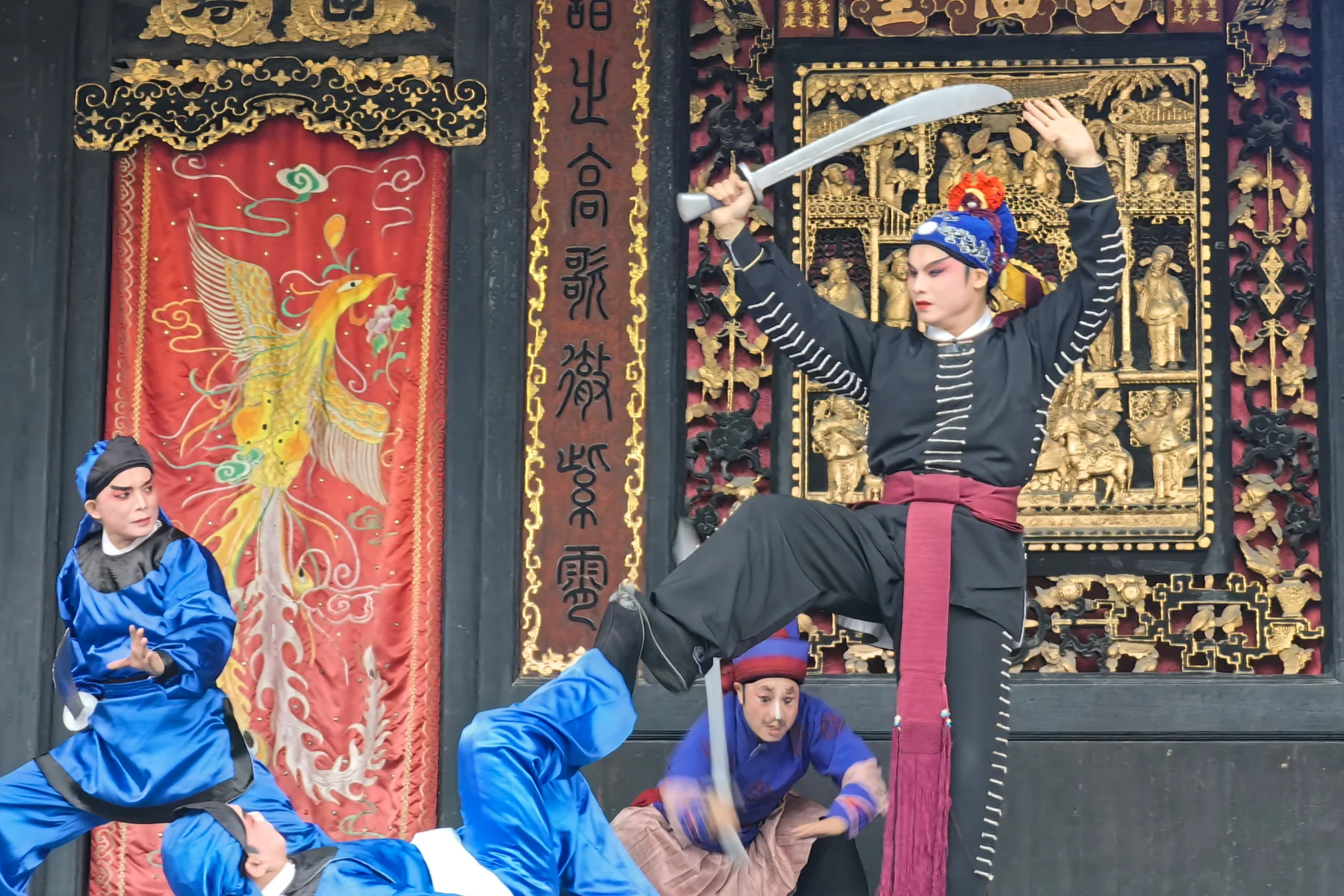
Cantonese opera and Cantonese narrative singing are related, but they are not the same cultural form. The national heritage record for Cantonese opera in Foshan describes a theatrical tradition involving roles, music, movement, costume and stage practice. The separate record for Cantonese narrative singing places singing and accompaniment at the centre of a narrative form.
That distinction changes the visitor’s question. A museum display can explain scripts, costumes, instruments and recorded history. A traditional stage can reveal how architecture frames performance. A full opera production brings character types, gesture, singing, percussion, costume and dramatic time together. A narrative-singing event asks the listener to attend differently.
Do not judge the whole tradition from one format. A display case is not a performance; a short demonstration is not a full play; a theatre programme is not the same as a community occasion.

Lens five: martial arts and embodied tradition
Foshan’s martial culture includes Wing Chun, Hung Kuen, Choy Li Fut and other traditions. It should not be reduced to a single school or cinematic hero. The national heritage entry for Foshan Wing Chun establishes an official project identity; it does not settle every origin narrative preserved by different lineages.
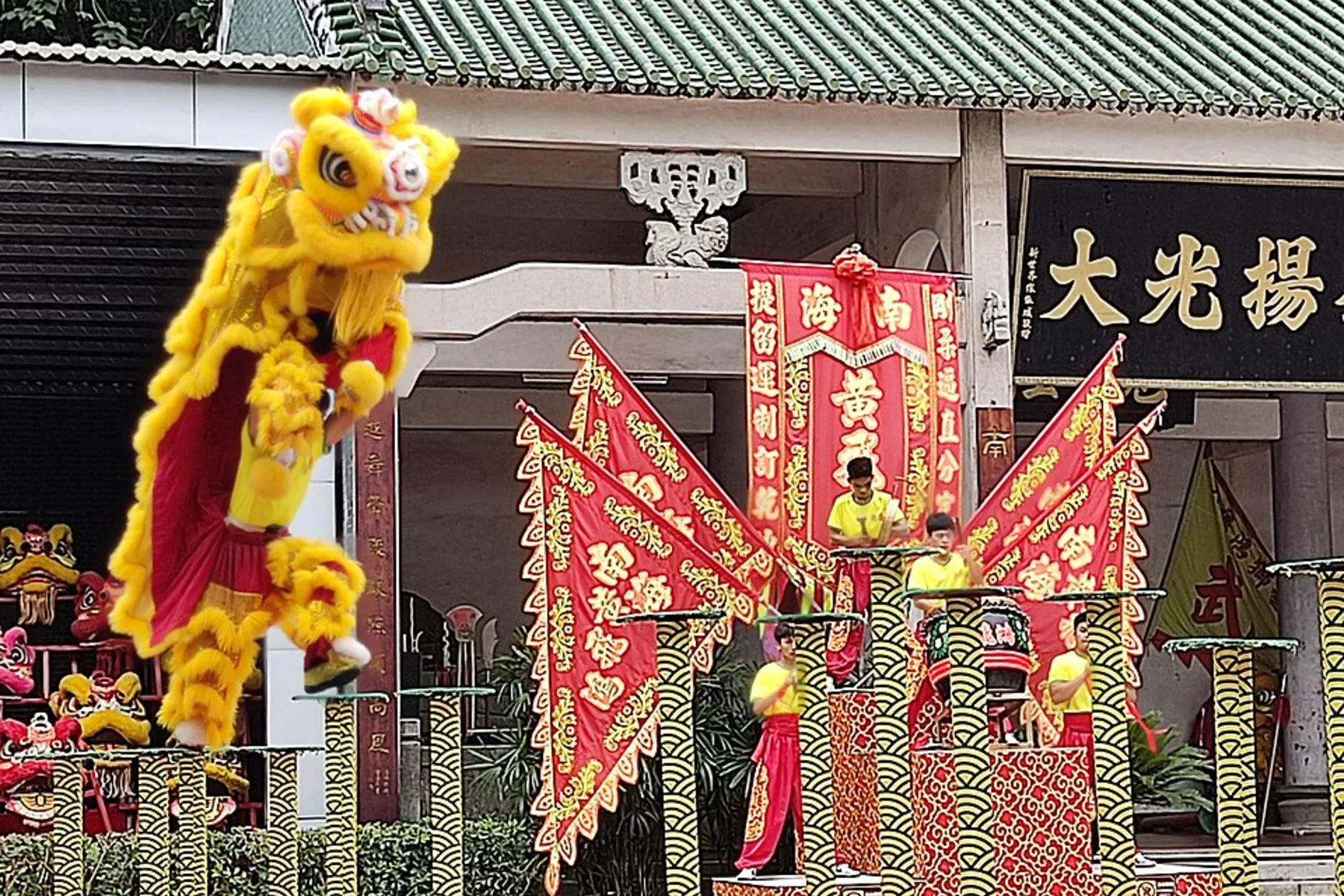
Guangdong lion dance adds another layer. Its national heritage record classifies Guangdong lion dance as traditional dance. Research and community practice also show deep relationships between lion dance, southern martial-arts organisations, physical training and local social life. Relationship does not mean identity: a lion-dance sequence should not be translated mechanically into a set of combat techniques.
Use three labels when reading martial culture:
- documented heritage fact for official project identity and accountable institutional evidence;
- attributed transmission account for a school or lineage’s explanation;
- screen story for film and television.
This prevents admiration from becoming false certainty. The published Foshan Kung Fu guide applies the same method to schools, figures and museum interpretation.

Lens six: festivals and public memory
Festivals turn cultural memory into public action. Processions, temple fairs, seasonal displays, music, performance and community gathering can connect several of the earlier lenses at once.
The national heritage records for Foshan Autumn Colours and the Foshan Ancestral Temple Fair support stable cultural background. They do not prove that an event will run on the same Gregorian date, route or scale every year.
This is the essential evergreen distinction: cultural meaning may persist while operations change. Describe what the tradition is and why it matters here; publish dates, procession routes, viewing areas, reservations and traffic controls only from the current organiser and authorities.
Use museums to choose a question
A museum is most useful when you arrive with a theme. Choose the Foshan Museum for a broad city-history orientation; the Ancestral Temple Museum for architecture, belief, folk culture and martial commemoration; the Guangdong Shiwan Ceramics Museum for ceramic categories and material history; or the Guangdong Cantonese Opera Museum for scripts, costume, instruments and recorded performance culture.
District museums offer other scales. Nanhai, Shunde and Sanshui have their own historical and collection contexts. They should not be treated as smaller copies of one city museum.
Ask what the institution collects, which geography it represents and whether you need objects, architecture or performance context. Current exhibitions, reservations and gallery closures remain separate checks.
Connect the lenses without flattening them
The six lenses overlap because culture is lived through systems. Ceramic sculpture can be craft, architectural ornament and festival display. A temple stage can connect belief, neighbourhood organisation and opera. Lion dance can connect embodied training, ceremony and public celebration.
The overlap is the insight, but it is also the danger. Do not use one connection to erase the differences between forms. A roof figure is not evidence for every ceramic workshop. A martial-arts memorial display is not proof of a film scene. A festival appearance does not make every performance a ritual.
Move from relationship to evidence: name the object or activity, identify the institution or community, then state what the source actually supports.
Keep culture separate from live visitor operations
This article covers durable meaning. Opening hours, tickets, performances, annual festival dates, exhibitions, workshops, temporary closures and photography rules belong to a live layer.
Before a visit, check the responsible museum, venue, troupe, organiser or district authority. Before a festival, confirm the current year, public date, route, access controls, transport changes and weather plan. Before a performance, verify the production, venue, language support, duration, admission and recording policy.
An old page can remain historically useful while being operationally unsafe. Never carry its timetable forward merely because the cultural tradition continues.
Build your first cultural route
Choose one primary lens and one supporting lens. For example:
- Place plus belief: historic urban fabric and a temple or ancestral-hall institution.
- Craft plus place: Shiwan material culture and its kiln or architectural context.
- Performance plus museum: opera objects first, then a separately verified performance.
- Martial arts plus public memory: museum interpretation followed by a documented lion-dance or community context.
Keep the route geographically coherent. Foshan Old City, Shiwan and Shunde Old City are separate contexts, even when they illuminate related ideas. Two well-read stops usually teach more than a rushed list of names.
Continue with a focused Foshan guide
Use this framework as a hub. Continue with Foshan Kung Fu when martial traditions are your main question, or use Things to Do in Foshan to choose between museums, streets, making, performance and seasonal traditions. Use Foshan’s five districts to keep the next visit geographically coherent.
The best first lesson is not that Foshan has many traditions. It is that each tradition carries a different kind of evidence, community authority and relationship to place.
About Zhang Wei
Zhang Wei covers Foshan’s culture, history, martial arts and performing traditions. He focuses on separating documented local evidence from transmission accounts and screen narratives, so international readers can approach living heritage with curiosity and precision. Visit his author page to see all of his Foshan Living articles.
Image credits and disclosures
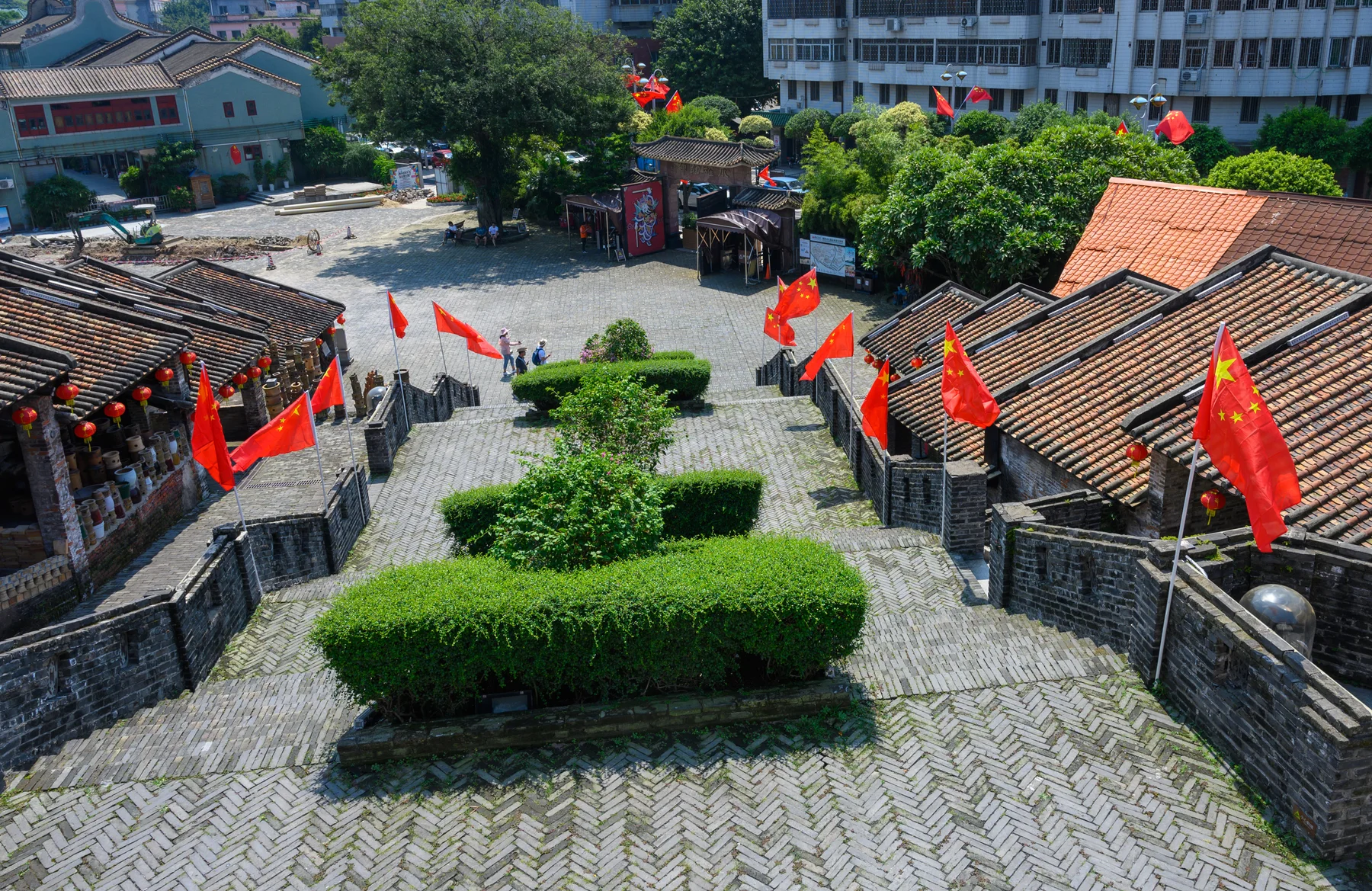
- hero.webp Nanfeng Kiln provides one real Shiwan setting where architecture and ceramic production history meet. This dated photograph does not confirm current access, firing, ticketing or visitor conditions. xiquinhosilva · CC BY 2.0; resized and converted to WebP · CC BY 2.0
- body-01-place.webp Qinghui Garden provides one real Shunde context for reading rooms, corridors, water and framed views. It does not represent every Lingnan garden or confirm current opening. EditQ · CC BY-SA 4.0; cropped and resized derivative · CC BY-SA 4.0
- body-02-institution.webp Lubao Ancestral Temple provides one real Sanshui setting for thinking about belief, place and community authority. The photograph does not confirm a current event, route, programme or opening condition. ITammyT16 · CC BY-SA 3.0; resized derivative · CC BY-SA 3.0
- body-03-shiwan-object.webp This finished Shiwan ware object can prompt questions about surface, form and use. It was photographed in the Guangdong Museum and is not evidence of a Foshan workshop, making process, maker attribution or bookable session. Augustohai · CC BY-SA 4.0; resized derivative · CC BY-SA 4.0
- body-04-opera.webp This 2024 photograph documents Foshan Cantonese Opera Troupe performing at Wanfu Stage. It does not confirm a current programme, cast, show time, admission condition or annual recurrence. Uuongkinghe · CC BY-SA 4.0; resized and converted to WebP · CC BY-SA 4.0
- body-05-lion.webp A documented lion-dance performance in Xiqiao shows trained movement, costume and spatial awareness. It does not confirm a current programme, team, visitor access or show time. Lukwo RuoShuma Simonz · CC BY-SA 4.0; cropped and resized derivative · CC BY-SA 4.0
- body-06-framework.webp Foshan Living's six-lens framework helps readers follow cultural relationships and then return to evidence. It is not an official heritage classification or ranking. Zhang Wei / Foshan Living · Original editorial infographic created for this article
.jpg)

Keep exploring
Related Foshan guides
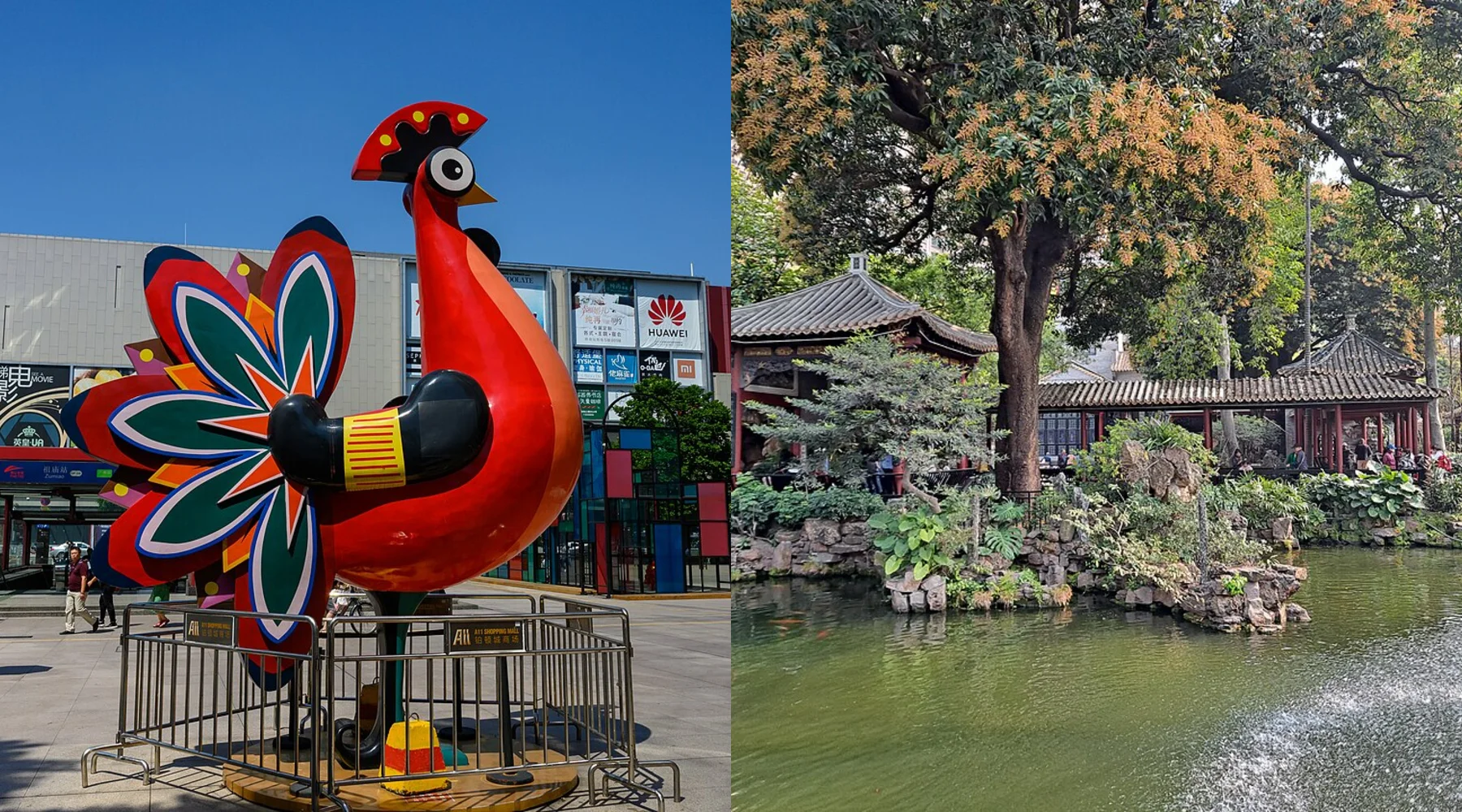 Explore Foshan
Chancheng or Shunde: Where Should You Start in Foshan?
Choosing between Chancheng and Shunde for a first Foshan trip? Compare heritage, food, neighbourhood pace, transport planning and where to stay.
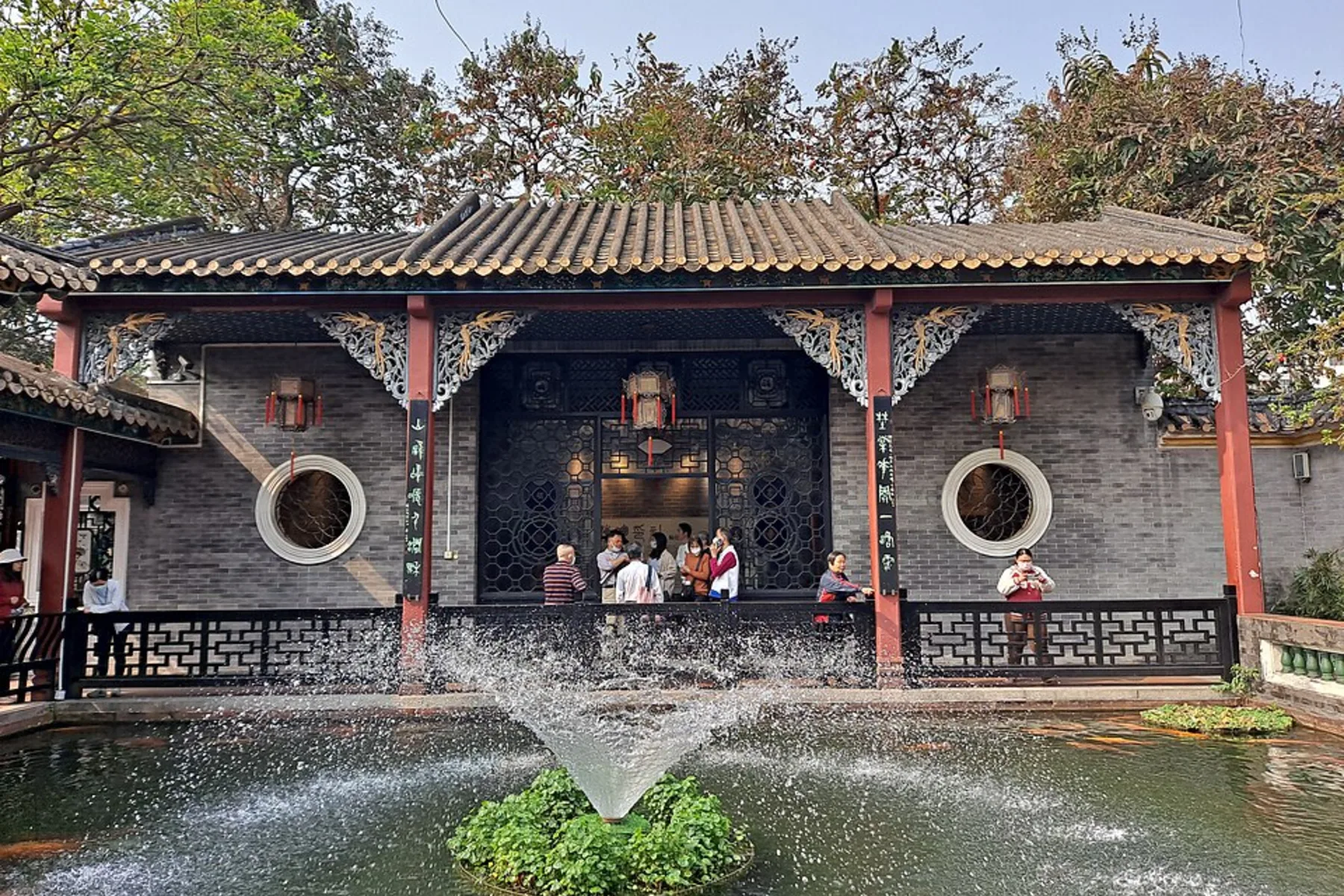 Explore Foshan
Understanding Foshan: A City of Five Districts
Learn how Foshan’s five districts differ, which areas suit culture, food, urban life or nature, and why every short trip needs a specific local base.
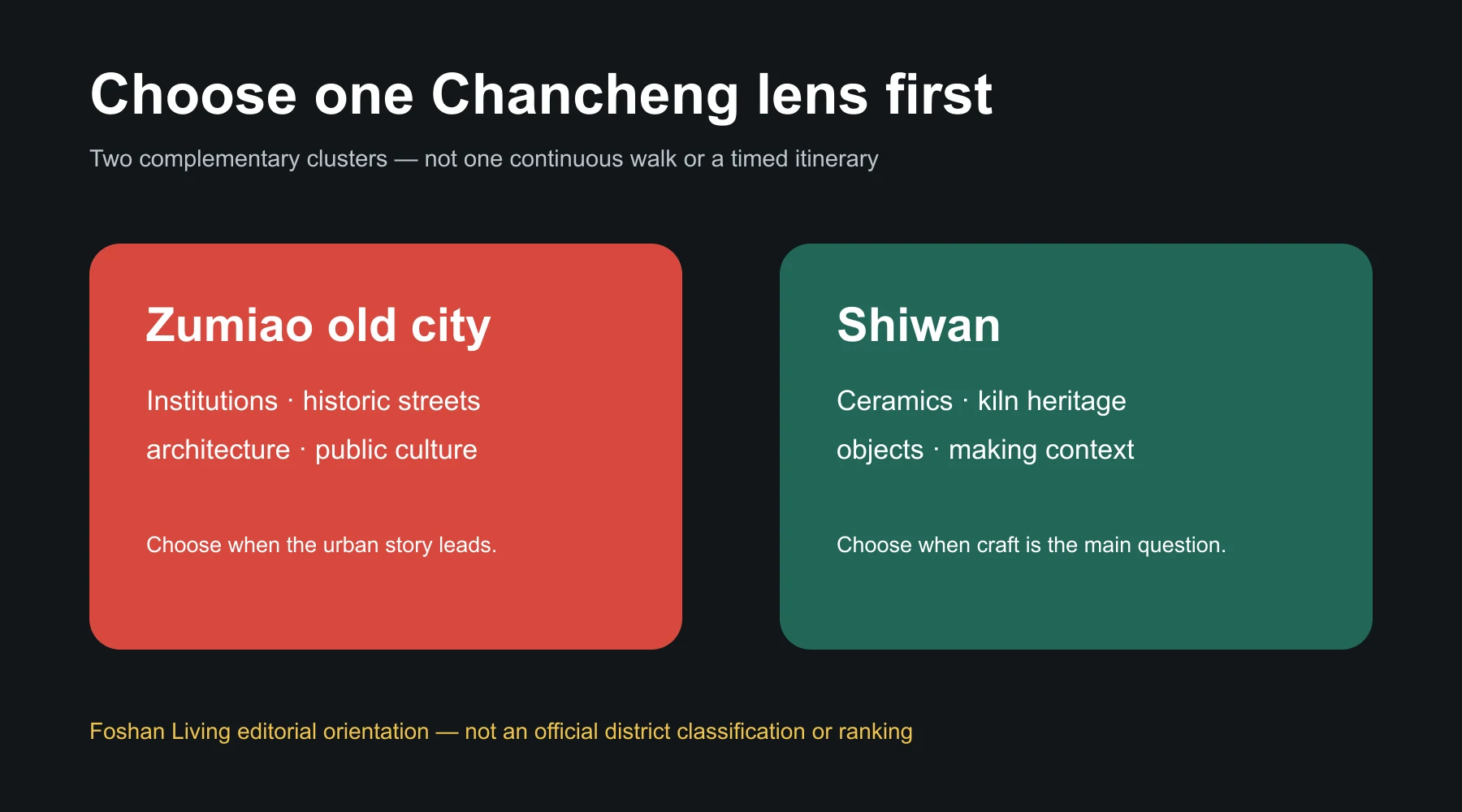 Explore Foshan
Zumiao Old City or Shiwan: How to Choose Your Chancheng Day
Compare Zumiao old city and Shiwan, choose one main Chancheng cluster, and add the other only after checking the complete route and current access.
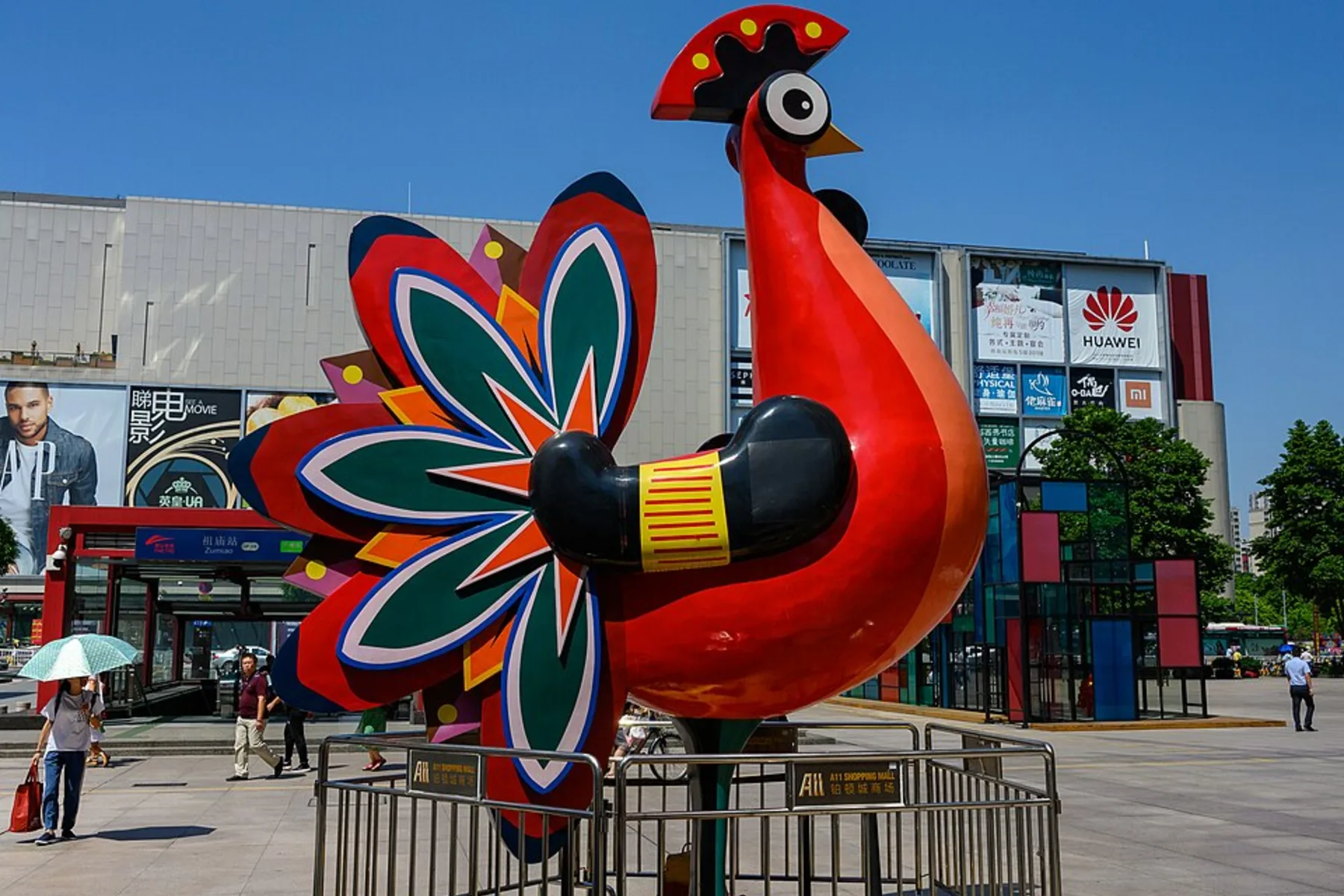 Explore Foshan
Chancheng: Foshan’s Historic Urban Core
Understand Chancheng through the Zumiao old city and Shiwan’s ceramic heritage, with guidance on walking scale, transport checks and where to base.
Plan your visitFirst Time in Foshan
Build a first trip around districts, transport, food and one deeper cultural interest.