Culture & history
Nanfeng Ancient Kiln: Reading a Historic Pottery Landscape
Read Nanfeng Ancient Kiln as protected heritage, production infrastructure and part of Shiwan’s pottery landscape—then verify today’s access separately.

On this page
- Start with the protected name
- Use the Ming-period attribution carefully
- Read a dragon kiln as a spatial system
- Follow the slope before the details
- Look for work around the kiln body
- Separate visible fabric from reconstruction
- Place firing inside a larger pottery process
- Connect the kiln to Shiwan’s pottery ecology
- Distinguish four kinds of evidence on site
- Do not turn heritage into a continuous-operation claim
- Plan today’s visit without freezing it into history
- Use a five-part kiln-reading note
- Keep this page separate from craft and experience guides
- Continue exploring Foshan culture
- About the author
Nanfeng Ancient Kiln is more than an old structure used as a backdrop for ceramic tourism. It is a named heritage site through which visitors can ask how a kiln body, sloping ground, working space, pottery process and production community once fitted together.
The first step is to keep four evidence layers separate:
- protected identity: what the national heritage list formally names;
- attributed history: what a government cultural reference says about the kiln’s period;
- cultural interpretation: how the visible kiln and its setting help explain Shiwan pottery;
- current operation: what the responsible operator confirms for the day of a visit.
This guide explains the first three and shows how to verify the fourth. It does not promise that a firing, demonstration, class or particular area will be available.
- Start with the protected name
- Use the Ming-period attribution carefully
- Read a dragon kiln as a spatial system
- Follow the slope before the details
- Look for work around the kiln body
- Separate visible fabric from reconstruction
- Place firing inside a larger pottery process
- Connect the kiln to Shiwan’s pottery ecology
- Distinguish four kinds of evidence on site
- Do not turn heritage into a continuous-operation claim
- Plan today’s visit without freezing it into history
- Use a five-part kiln-reading note
- Keep this page separate from craft and experience guides
- Continue exploring Foshan culture
- About the author
Start with the protected name
The State Council’s fifth batch of Major Historical and Cultural Sites Protected at the National Level includes one entry naming Nanfeng Ancient Kiln and Gaozao Pottery Kiln. That wording matters.
It confirms a national protected-heritage identity. It also prevents a common simplification: Nanfeng and Gaozao should not be described as two names for one kiln without evidence. They are named together in the protected entry, but the listing does not erase their identities as separate kiln structures.
Start any visit or piece of research with three questions:
- Which kiln is being described or photographed?
- Is the statement about Nanfeng, Gaozao or the protected entry as a whole?
- Does the source describe legal heritage status, local history or present-day operation?
The national list is strong evidence for the protected name. It is not a visitor timetable, an engineering description or permission to use photographs from the site.
.jpg)
This distinction is useful beyond Nanfeng. Heritage designation tells you that a protected object has public significance and a formal identity. It does not tell you that every surrounding shop, workshop, performance or product shares that status.
Use the Ming-period attribution carefully
A cultural reference from the Counsellors’ Office of the People’s Government of Guangdong Province attributes the construction of Nanfeng Kiln to the Zhengde period of the Ming dynasty.
That is the responsible level of precision for this guide. The source gives a reign-period attribution; it does not require us to invent one exact construction year.
Avoid converting the period into a rolling age such as “more than 500 years old.” The number changes every year, encourages false precision and often travels alongside promotional claims about being the world’s oldest or never having stopped firing. Those claims require their own definitions and independent evidence.
A more useful historical question is:
> What does a Ming-period attribution help us notice about the relationship between surviving kiln infrastructure and the longer history of pottery production in Shiwan?
The answer is not found in age alone. It comes from reading the protected structure, the physical setting, accountable interpretation and the wider ceramic tradition together.
Read a dragon kiln as a spatial system
“Dragon kiln” can sound like a poetic name, but a visitor should first treat it as a form of production infrastructure. The kiln body, ground, openings and surrounding work areas belong to a connected system.
This article does not reconstruct the kiln’s engineering or firing regime. It offers a careful visual method that produces questions without claiming facts that cannot be seen.
Follow the slope before the details
Begin with the widest lawful viewpoint. Look at how the kiln body relates to the slope and how its length is organised across the site.
Do not begin with a close-up of one opening. A close photograph can make a detail vivid while hiding its position in the whole. Record:
- the direction of the slope;
- the visible length and profile of the kiln body;
- the relationship between lower and upper parts;
- nearby retaining, circulation or working surfaces;
- where modern visitor paths or barriers alter your view.
These observations do not explain airflow, temperature or firing sequence. They simply preserve spatial context before interpretation.
.jpg)
Look for work around the kiln body
A kiln is not only a chamber in which objects become hot. Pottery production also involves preparing objects, moving them, organising fuel and tools, loading, monitoring and later handling fired work. Which of those activities occurred in a particular place requires historical or archaeological evidence.
On site, ask how people could have approached the structure and where interpretation identifies working relationships. Look for labels, plans or accountable guides that connect a visible feature to a documented function.
Use precise language:
- “an opening is visible” is an observation;
- “the site label identifies this as…” is attributed interpretation;
- “this may suggest…” is a question;
- “this definitely served…” requires evidence.
The difference protects old fabric from imaginative storytelling.
Separate visible fabric from reconstruction
Historic production sites change. They may contain repaired surfaces, conserved fabric, replaced elements, visitor paths, barriers, signage and contemporary buildings.
Do not assume every old-looking brick belongs to the same period. Do not assume a neat surface is original, or that a damaged surface is older. Appearance alone cannot establish date, authenticity or conservation history.
When information is available, record whether a feature is described as:
- protected historic fabric;
- repaired or conserved;
- reconstructed for interpretation;
- contemporary visitor infrastructure;
- unidentified.
“Unidentified” is a legitimate result. It is better than turning visual impression into a heritage claim.
Place firing inside a larger pottery process
The national intangible-cultural-heritage record for Shiwan ceramic sculpture describes a broad sequence: concept creation, clay preparation, forming, decoration, glazing and dragon-kiln firing.
That sequence gives the kiln a clear place, but it also sets a limit. Firing is one stage in a larger process. The kiln should not swallow the histories of clay preparation, making, decoration, labour, objects and use.
At Nanfeng, use the process sequence as a set of questions:
- What had to happen before an object reached the kiln?
- Which choices were already fixed through forming and decoration?
- What kinds of preparation would firing require?
- Which results could only be known after the kiln process?
- What evidence on site answers these questions, and what remains unknown?
This page does not teach firing technique. It does not publish temperatures, recipes, fuel schedules, loading diagrams or a universal account of Shiwan production. Those require more specialised sources and, in some cases, practitioner or technical review.
Nor does a visible kiln prove that firing is taking place today. Heritage infrastructure, interpretation and current production are different claims.
Connect the kiln to Shiwan’s pottery ecology
The Guangdong culture and tourism authority describes Shiwan pottery within a wider cultural ecology connecting place, makers, public culture and contemporary use.
That frame helps explain why Nanfeng matters. The kiln can be read as part of a landscape in which raw material, skilled work, production, exchange, architecture, everyday objects and cultural memory developed relationships over time.
But “cultural ecology” should not become a vague label attached to everything nearby. It does not prove that:
- every shop represents the recognised heritage project;
- every studio uses a historical method;
- every class teaches Shiwan ceramic sculpture;
- every object was fired in an ancient kiln;
- every current commercial claim has institutional endorsement.
Instead, ask what kind of authority each place has. A protected kiln, a museum display, a maker’s studio, a retail shop and a hands-on class can all contribute to present-day Shiwan, but they answer different questions.
.jpg)
The kiln page stays with place and heritage. Object design, material observation and visitor participation belong to separate specialist guides.
Distinguish four kinds of evidence on site
A careful visitor may encounter four evidence types in the same afternoon.
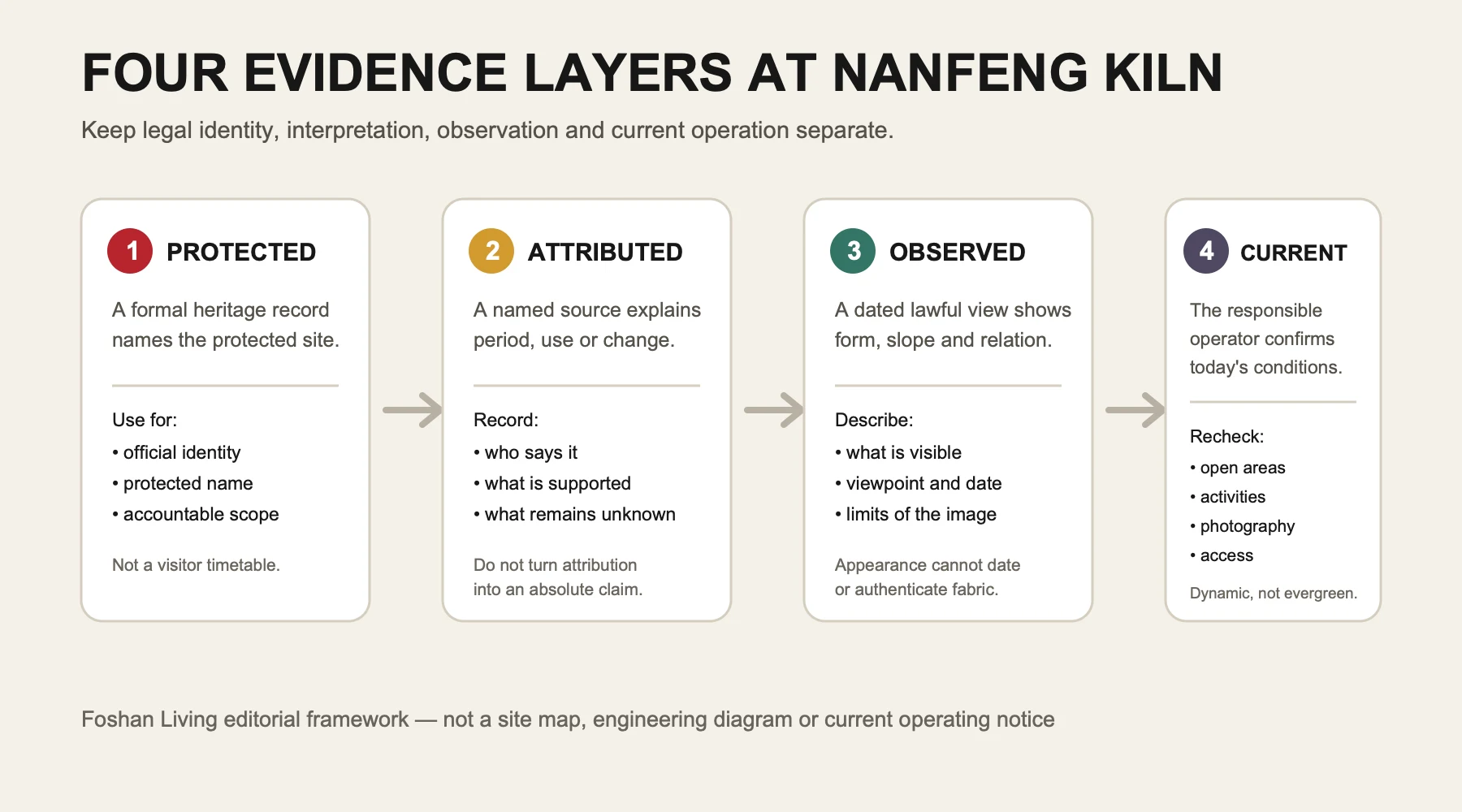
Protected identity comes from the State Council list and accountable heritage records. It names the protected object.
Historical interpretation comes from government cultural references, site interpretation, scholarship and documented conservation work. It may explain period, use or change, but each statement still needs attribution.
Visible observation comes from what you can lawfully see: slope, form, surface, opening, relationship and later visitor infrastructure. Observation can generate questions but cannot date fabric or reconstruct a firing method.
Current operation comes from the responsible operator: what is open, where visitors may go, whether a demonstration is scheduled, whether photography is permitted and what services exist today.
Keep these layers in separate notes. For example:
- protected: the national list names Nanfeng and Gaozao pottery kilns;
- attributed: the provincial cultural reference places Nanfeng’s construction in the Ming Zhengde period;
- observed: the kiln body follows a visible slope;
- current: the operator’s notice states which areas and activities are available on the visit date.
Only the first three can form the stable core of this article, and even observation must be tied to a dated, rights-cleared record before publication.
Do not turn heritage into a continuous-operation claim
Kiln publicity often celebrates continuity. Yet words such as “continuous,” “never extinguished” or “still firing” can hide several different questions:
- Is the claim about physical survival?
- Regular production?
- Ceremonial firing?
- Demonstration?
- A local craft tradition continuing around the site?
- An uninterrupted operational record?
These are not interchangeable.
This guide therefore does not describe Nanfeng as the world’s oldest continuously firing kiln or claim an unbroken number of years. A current firing event, if one exists, belongs to the dated operator layer. A historical claim about continuity requires a defined period and evidence designed to support it.
Removing the superlative does not make the site less important. It makes the interpretation more reliable. The protected identity, attributed Ming-period history and relationship to Shiwan pottery already provide a substantial reason to study the site.
Plan today’s visit without freezing it into history
Use the Nanfeng Ancient Kiln operator website as the starting point for current visitor information, then confirm any detail that matters to your visit.
Check:
- the exact destination name and entrance;
- current opening and any closed areas;
- ticket or reservation requirements;
- whether the kiln body can be viewed from the intended route;
- whether a guide, demonstration, firing or workshop is actually scheduled;
- photography and publication restrictions;
- accessibility from arrival through the complete visit;
- heat, weather, rest and toilet conditions;
- current transport and the return journey.
Do not let an old article, social post or archived event page override the current responsible operator. A page describing a firing tradition does not promise a firing on your date. A course page does not prove that the course is still offered, suitable for your group or included in admission.
If access to one feature changes, the visit can still focus on the larger questions: protected identity, kiln form, spatial relationship and Shiwan pottery context—where lawful viewing and current interpretation permit.
Use a five-part kiln-reading note
Create one note with five fields.
1. Identity
- Exact Chinese and English site name
- Which kiln is shown: Nanfeng, Gaozao or both
- Heritage-list wording and source
2. Space
- Slope and overall kiln profile
- Visible openings and circulation
- Relationship to surrounding working or visitor space
3. Interpretation
- Label or guide responsible for each function/date claim
- Historic, conserved, reconstructed, contemporary or unknown
- Questions that the evidence does not answer
4. Pottery context
- Which stage of the larger ceramic process is being discussed
- What had to happen before and after firing
- How the site relates to—not replaces—the wider Shiwan ecology
5. Current layer
- Visit date and operator notice
- Open areas, activities and photography rules
- Access and return checks
This note keeps culture and logistics connected without letting temporary details rewrite history.
Keep this page separate from craft and experience guides
Zhang Wei’s Culture & history page owns the named site, protected identity, attributed history and cultural interpretation of kiln space.
Ana Ribeiro’s design and craft coverage owns the detailed path from clay to object, visible material decisions, object types and contemporary design reading. This site page mentions the broad process only to explain where firing belongs.
Mei-lin Cheung’s Things to do coverage owns the choice between observation, demonstration, short making and fuller study, including questions about supervision, materials, firing, collection and suitability. This page does not recommend or evaluate a workshop.
Priya Nair’s Explore coverage owns whether Shiwan is the right area for a day and how it fits a wider route. This page does not prescribe a half-day or walking sequence.
Clear boundaries let the same place support several useful articles without repeating one generic pottery guide.
Continue exploring Foshan culture
Place the kiln within the Foshan culture framework. If you are still deciding where to spend a Chancheng day, choose Zumiao old city or Shiwan. For a broader choice of participation types, start with Things to Do in Foshan.
At Nanfeng, begin with the protected name, then widen your view from a brick detail to the kiln body, the slope, the surrounding work landscape and the larger history of Shiwan pottery. Check today’s operation last.
About the author
Zhang Wei writes about Foshan’s culture, history, architecture, martial traditions and performance. He separates public records, attributed interpretation, visible evidence and present-day operation so that historic places remain understandable without becoming legends or visitor promises. See all articles by Zhang Wei.
Image credits and disclosures
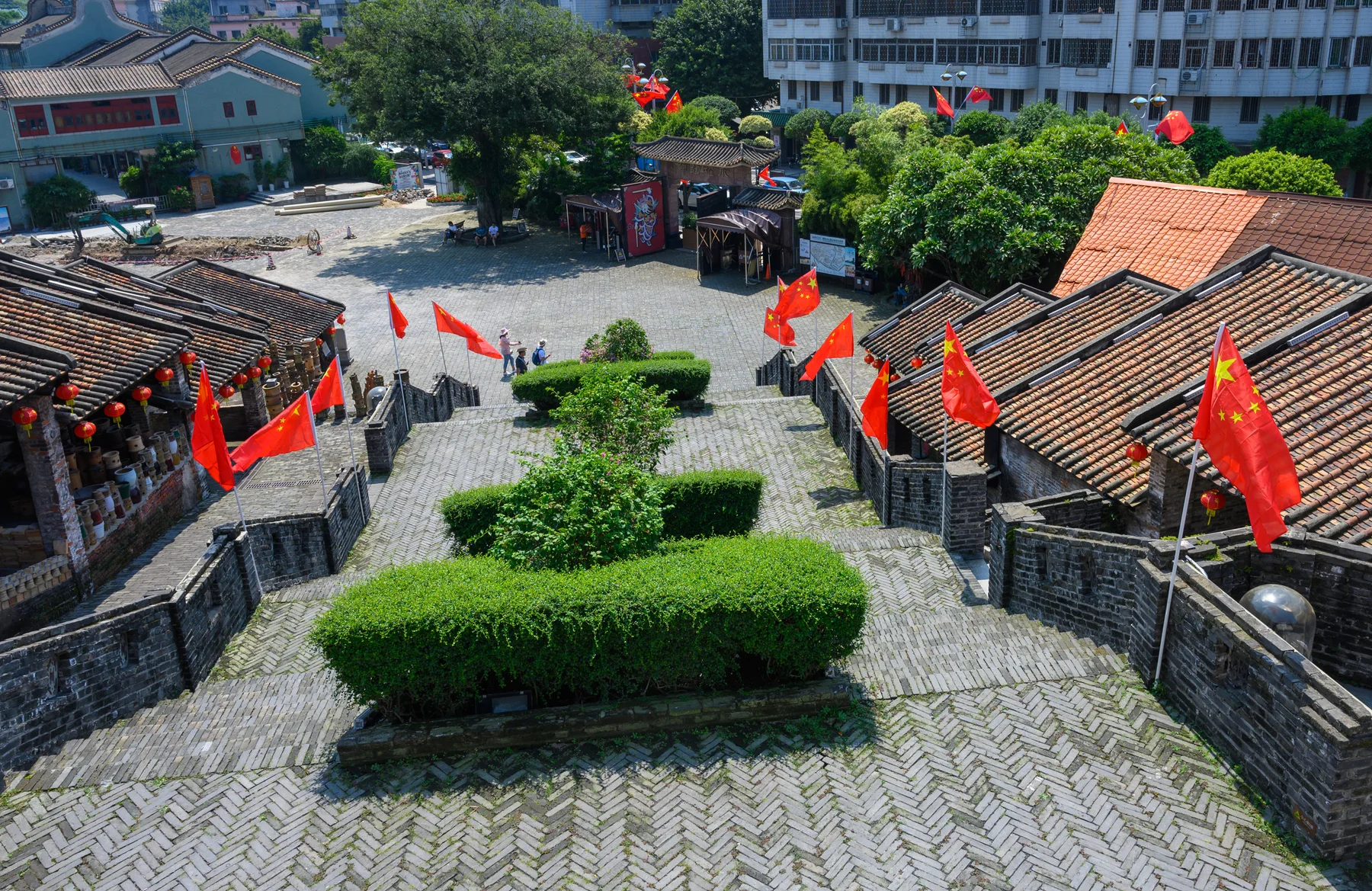
- hero.webp This dated 2019 photograph records one elevated view across the Nanfeng Kiln site. It does not confirm current access, firing, ticketing, conservation condition or visitor routes. xiquinhosilva · CC BY 2.0; exact approved derivative reused from an accepted Foshan Living package · CC BY 2.0
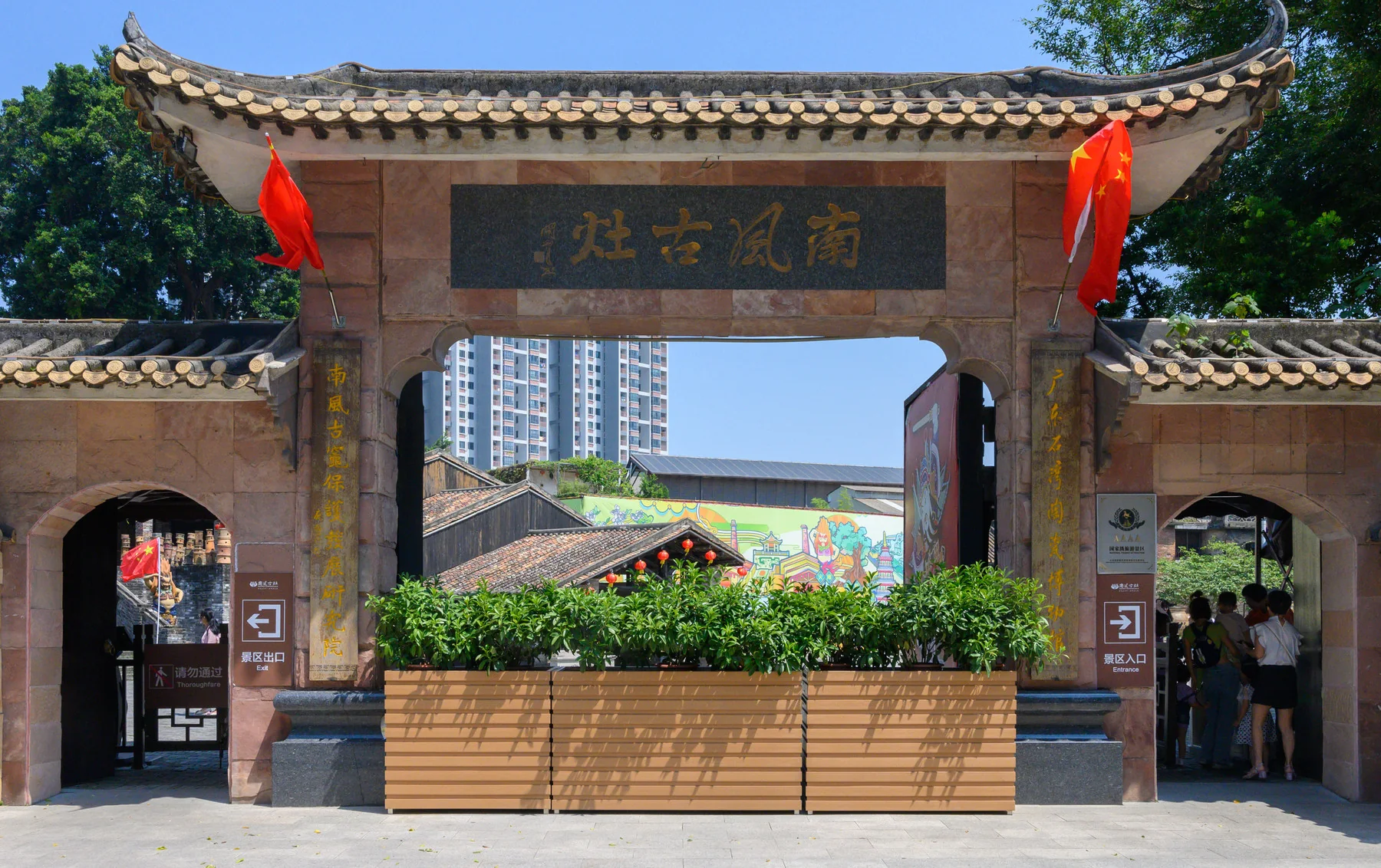
- body-01-entrance.webp This 2019 photograph records the entrance and its immediate built context. It helps identify the named place, but it does not define the protected boundary or confirm current access. xiquinhosilva · CC BY 2.0; Commons file page and Flickr licence review verified · CC BY 2.0
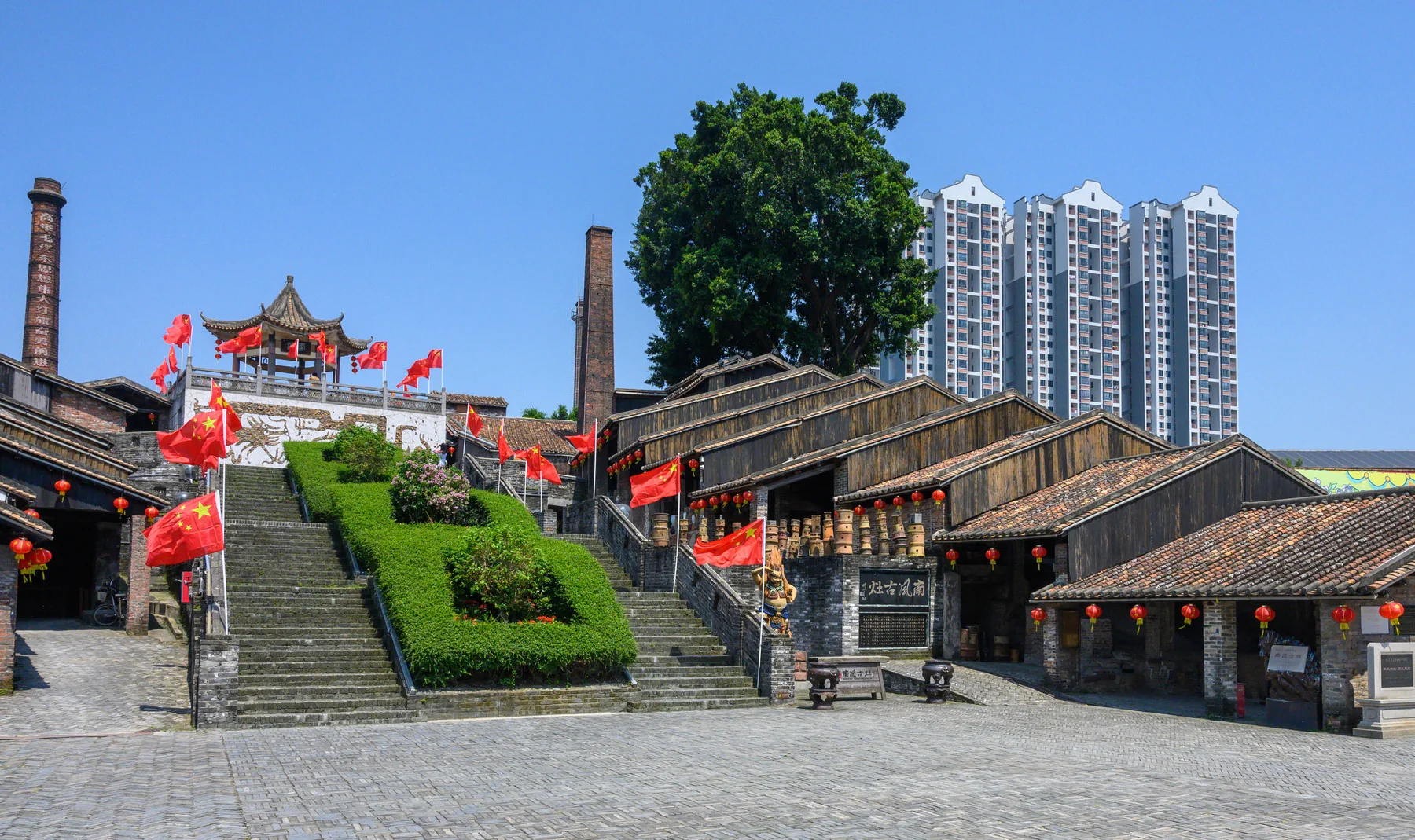
- body-02-slope.webp A 2019 wide view records visible changes in level and the relationship among roofs, steps and surrounding buildings. It is not an engineering diagram and does not establish firing direction, airflow, construction date or present visitor circulation. xiquinhosilva · CC BY 2.0; Commons file page and Flickr licence review verified · CC BY 2.0
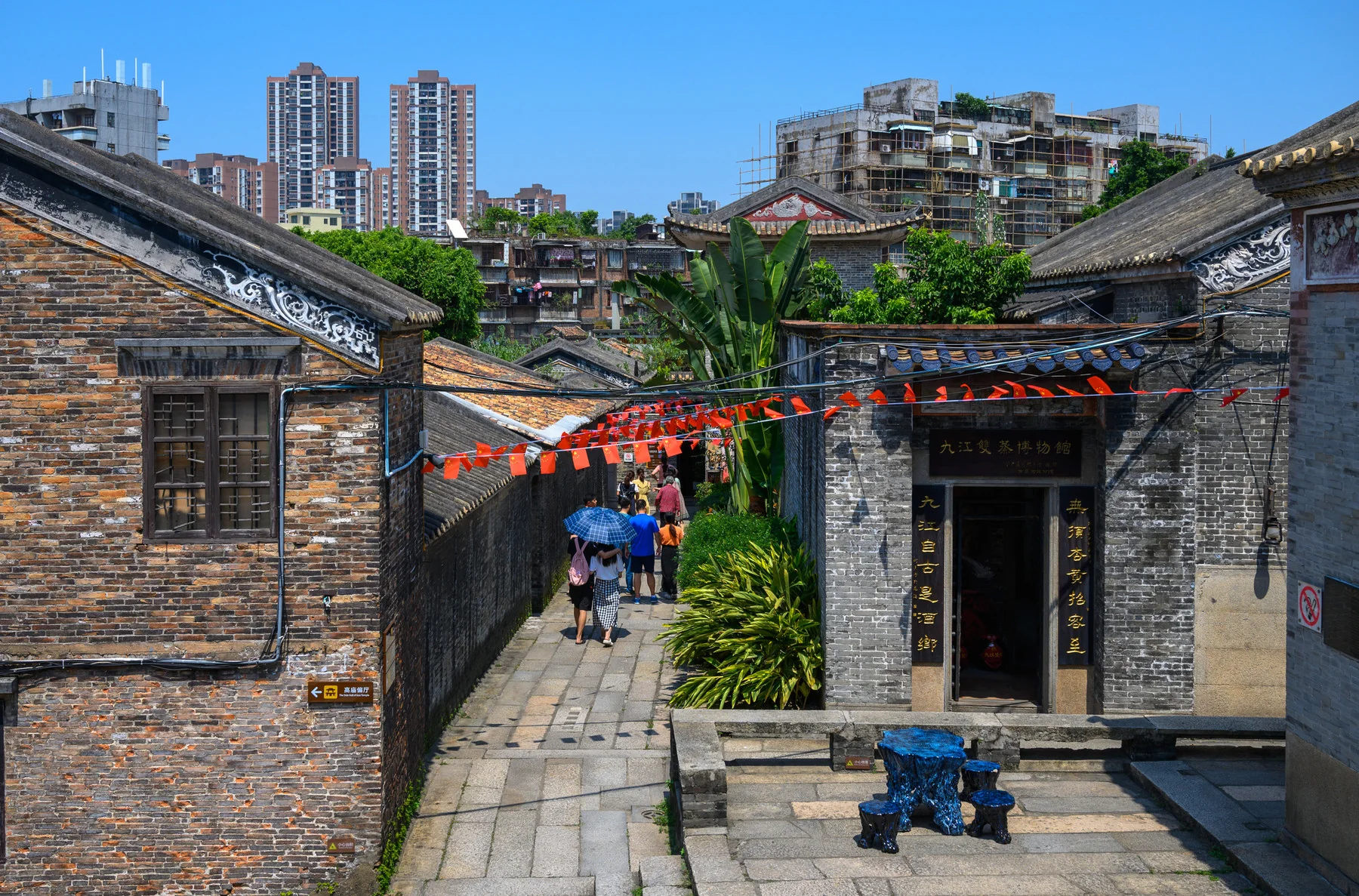
- body-03-lane.webp This 2019 photograph records one lane, adjoining buildings and a courtyard relationship within the named site. It does not prove the age, authenticity, function or protected status of every visible structure, nor does it describe current access. xiquinhosilva · CC BY 2.0; Commons file page and Flickr licence review verified · CC BY 2.0
- body-04-evidence-layers.webp Foshan Living’s four-layer framework keeps a protected name, attributed history, dated observation and current operator information from becoming one unsupported claim. It is not a site map, engineering diagram or operating notice. Zhang Wei / Foshan Living · Original editorial infographic created for this article
.jpg)

Keep exploring
Related Foshan guides
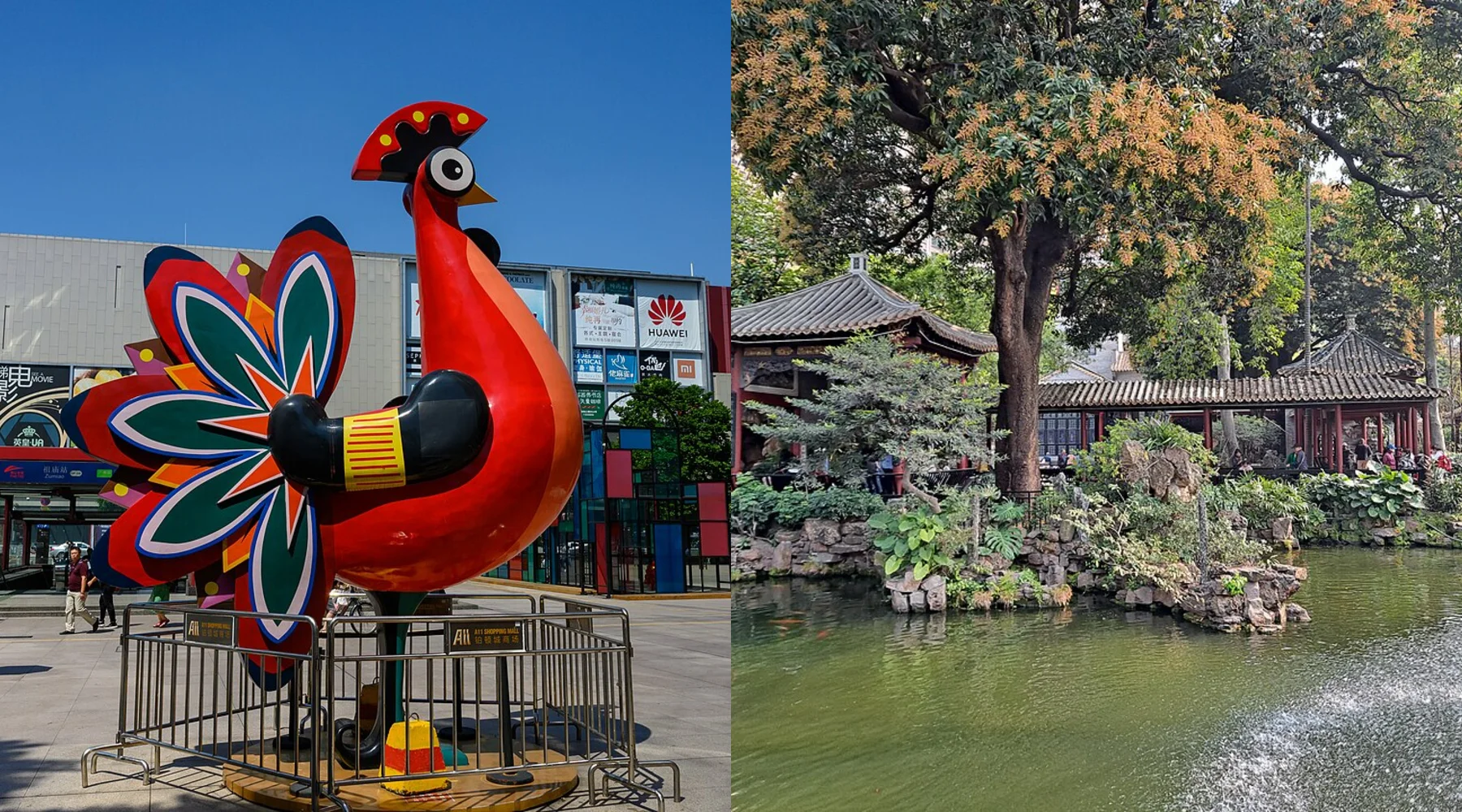 Explore Foshan
Chancheng or Shunde: Where Should You Start in Foshan?
Choosing between Chancheng and Shunde for a first Foshan trip? Compare heritage, food, neighbourhood pace, transport planning and where to stay.
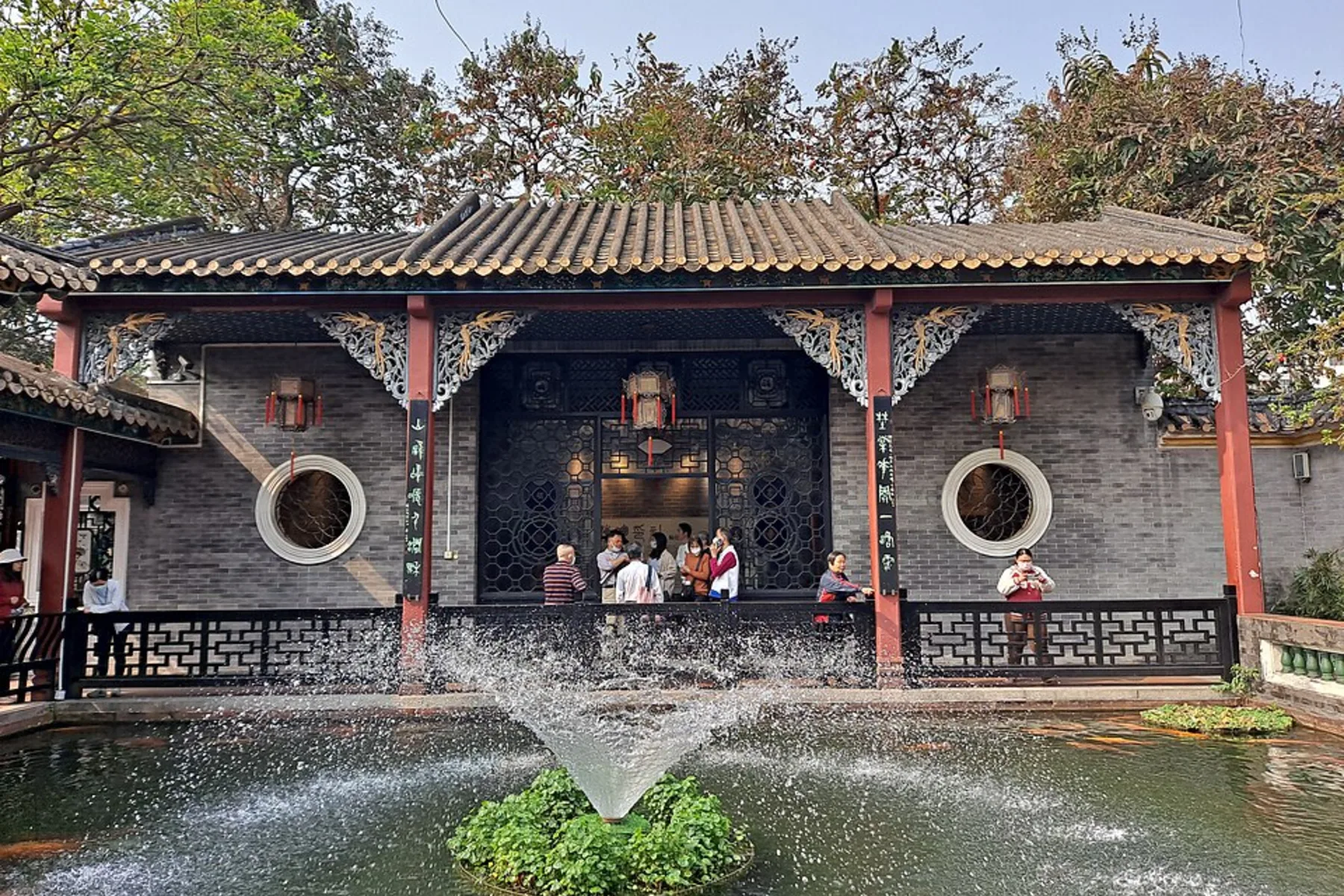 Explore Foshan
Understanding Foshan: A City of Five Districts
Learn how Foshan’s five districts differ, which areas suit culture, food, urban life or nature, and why every short trip needs a specific local base.
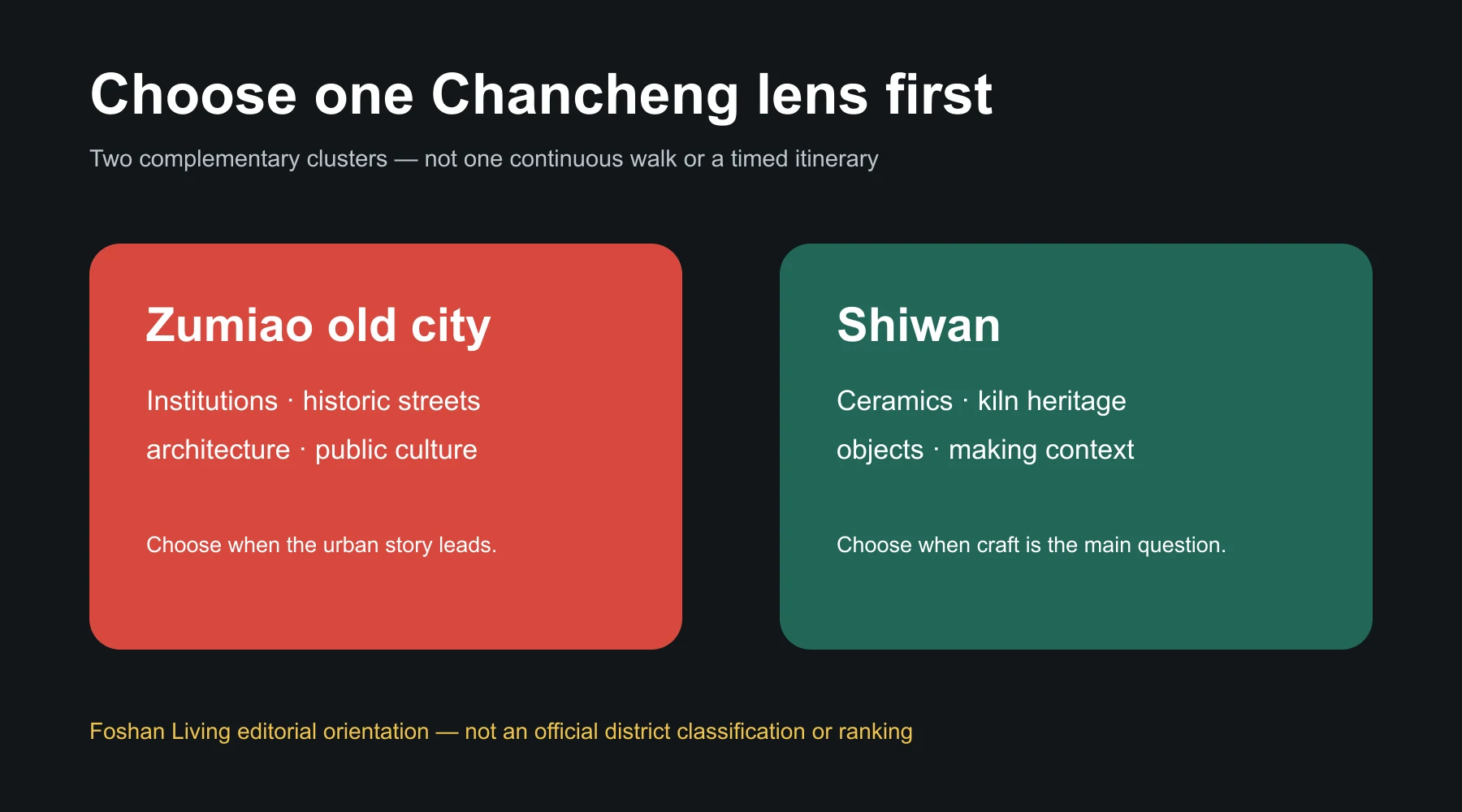 Explore Foshan
Zumiao Old City or Shiwan: How to Choose Your Chancheng Day
Compare Zumiao old city and Shiwan, choose one main Chancheng cluster, and add the other only after checking the complete route and current access.
 Explore Foshan
Chancheng: Foshan’s Historic Urban Core
Understand Chancheng through the Zumiao old city and Shiwan’s ceramic heritage, with guidance on walking scale, transport checks and where to base.
Plan your visitFirst Time in Foshan
Build a first trip around districts, transport, food and one deeper cultural interest.