Culture & history
How to Read an Ancestral Hall in Foshan
Identify the official name and role, follow the spatial sequence, record materials and ornament, then separate historic fabric from conservation and new use.

On this page
- Start with a four-layer field record
- Read the official name before the façade
- Treat the threshold as a change of space
- Follow the spatial sequence
- Separate structure, surface and applied craft
- Structure
- Surface
- Applied craft
- Read ceramic ridge work without dating it
- Handle plaques, inscriptions and ritual objects carefully
- Recognise conservation and later use as separate layers
- Compare sites without inventing a universal type
- Respect current use, access and photography
- Know where observation must stop
- About the author
An ancestral hall is easy to reduce to a façade: a gate, grey brick, carved timber and a roof crowded with ceramic figures. That view misses the harder questions. What does the site call itself? Who explains or manages it? How do visitors move from street to threshold, courtyard and hall? Which observations are visible, and which historical claims require evidence?
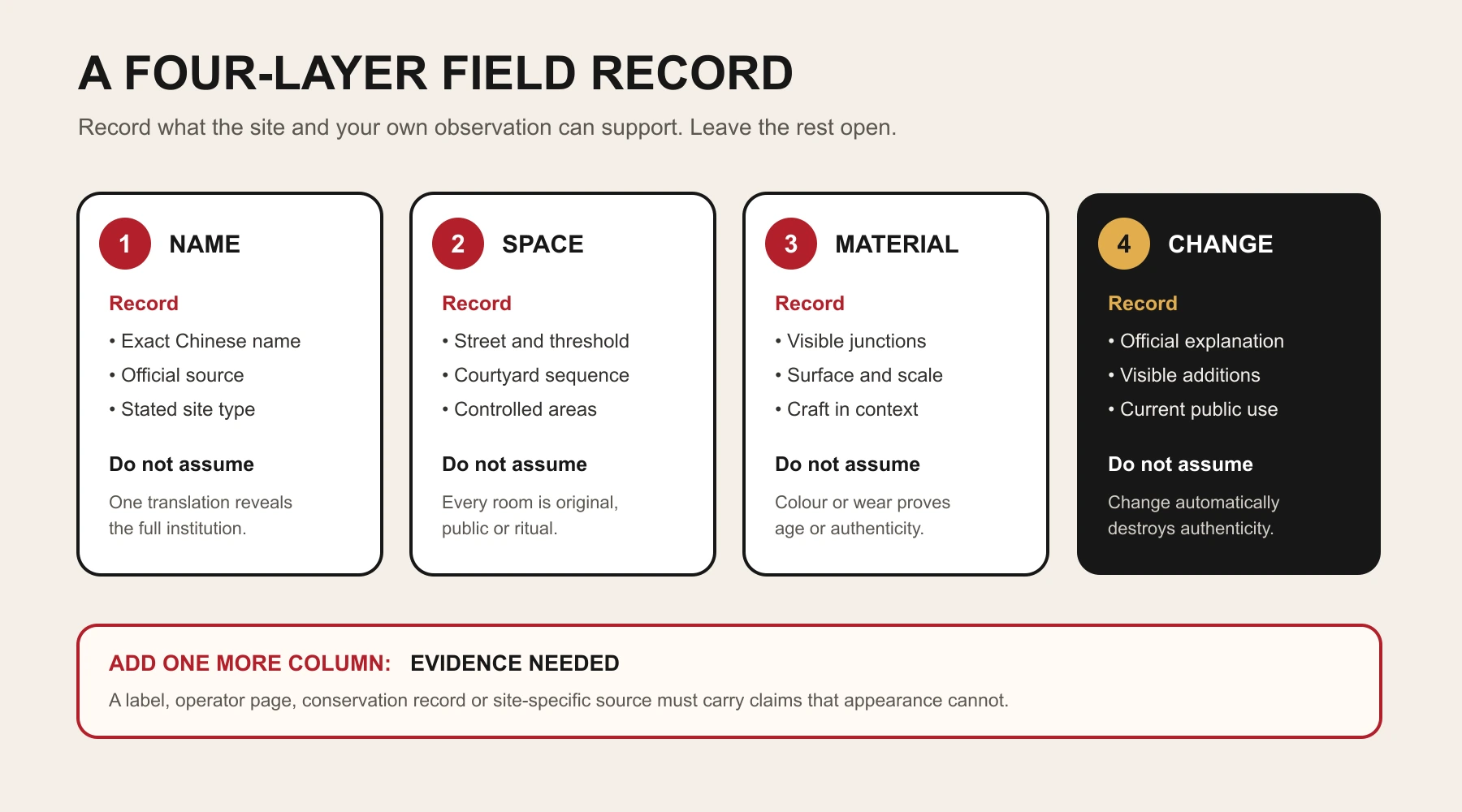
Use four layers: name and institution, spatial sequence, material and craft, and later change. This method helps you look carefully without pretending that appearance alone can reveal a building’s date, lineage, ritual status or authenticity.
Start with a four-layer field record
Create a small record before taking detailed photographs:
| Layer | Record | Do not assume |
|---|---|---|
| Name and institution | Official Chinese name, source, responsible organisation, stated site type | Similar English translations mean the same institution |
| Spatial sequence | Street, forecourt, gate, courtyard, hall, side space and controlled areas | Every space is original, public or ritual |
| Material and craft | Brick, stone, timber, plaster, ceramic, metal and visible junctions | Colour or wear proves age |
| Later change | Repair, conservation interpretation, museum use, services and additions | Change automatically destroys authenticity |
Add a fifth column for evidence needed. If you notice an inscription, repaired roof line or new display, record the observation first. Find the official explanation later.
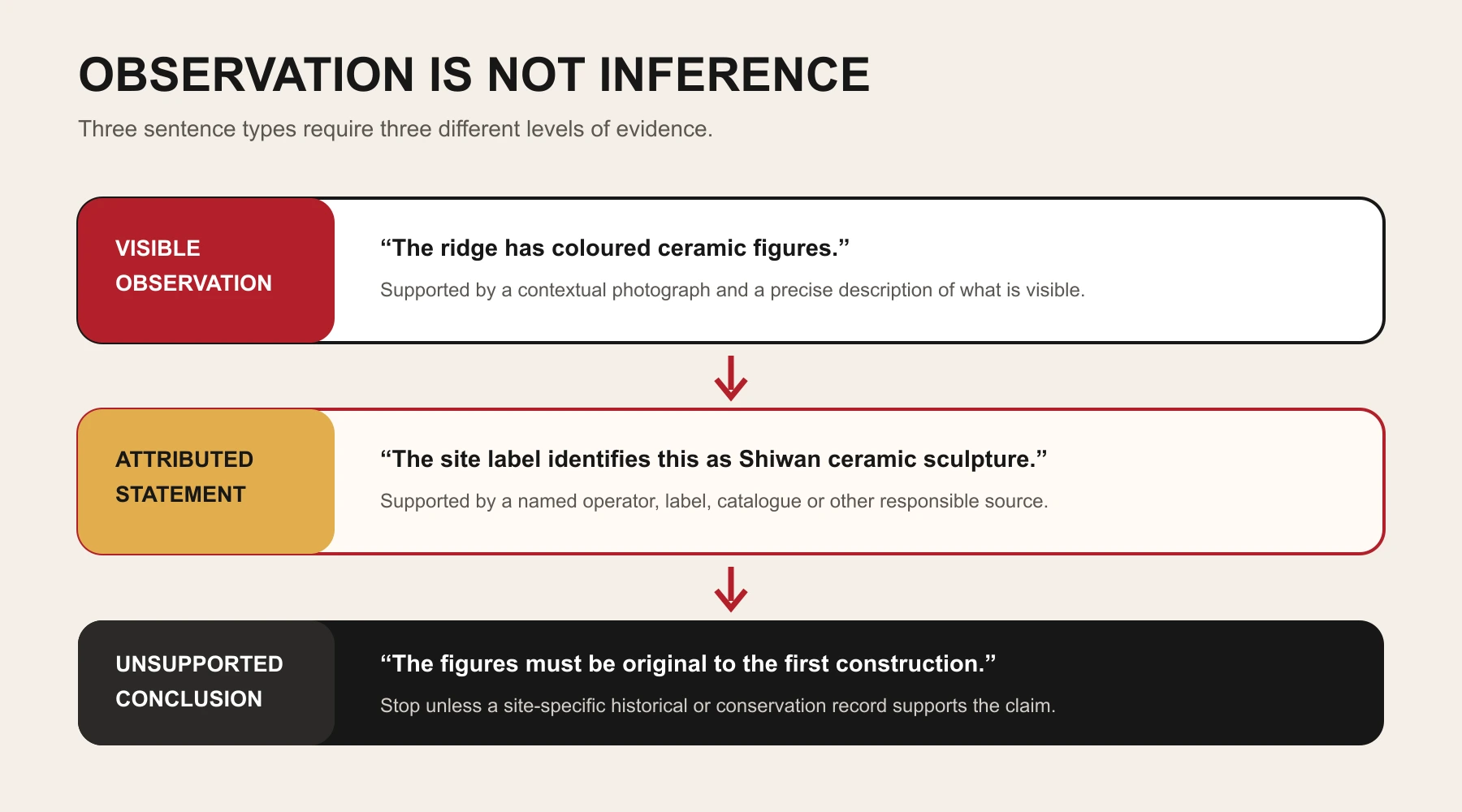
This discipline separates three sentences:
- “The ridge has coloured ceramic figures” is an observation.
- “The site label identifies this work as Shiwan ceramic sculpture” is a sourced statement.
- “The figures must be original to the first construction” is an unsupported conclusion unless a site record proves it.
Read the official name before the façade
English uses “ancestral hall,” “clan hall,” “temple” and “ancestral temple” loosely. Chinese site names may include terms such as 祠, 宗祠, 家庙, 祖庙 or 庙, but a visitor should not assign a complete institutional history from one character.
Record the exact Chinese name from an official sign, designation, museum page or responsible institution. Then ask:
- How does the source classify the site?
- Is the name historical, administrative, devotional or museological?
- Does the present institution describe lineage memory, worship, community activity, public culture or several roles?
- Is the site one building or a complex?
- Which parts does the description actually cover?
Foshan’s Ancestral Temple complex, for example, is now also a museum and public-cultural entry point. The Greater Bay Area cultural profile describes several architectural and commemorative components. That combination makes it useful for learning, but it does not make the complex a template for every lineage hall.
The Sanshui government description of Xijiang Ancestral Temple presents another combination of temples within a wider complex. Liang Garden’s museum history, meanwhile, records a historical composition involving residence, ancestral hall and garden. These examples demonstrate variety, not a fixed taxonomy.
Treat the threshold as a change of space
Stand back before entering. Record the relationship between the hall and its surroundings:
- Is the entrance aligned with a lane, square, forecourt or later street?
- Does the building meet the street directly?
- Is there a wall, gate, step, platform or change of paving?
- Can the whole frontage be seen, or is it embedded in dense urban fabric?
- What signage belongs to visitor management rather than historic fabric?
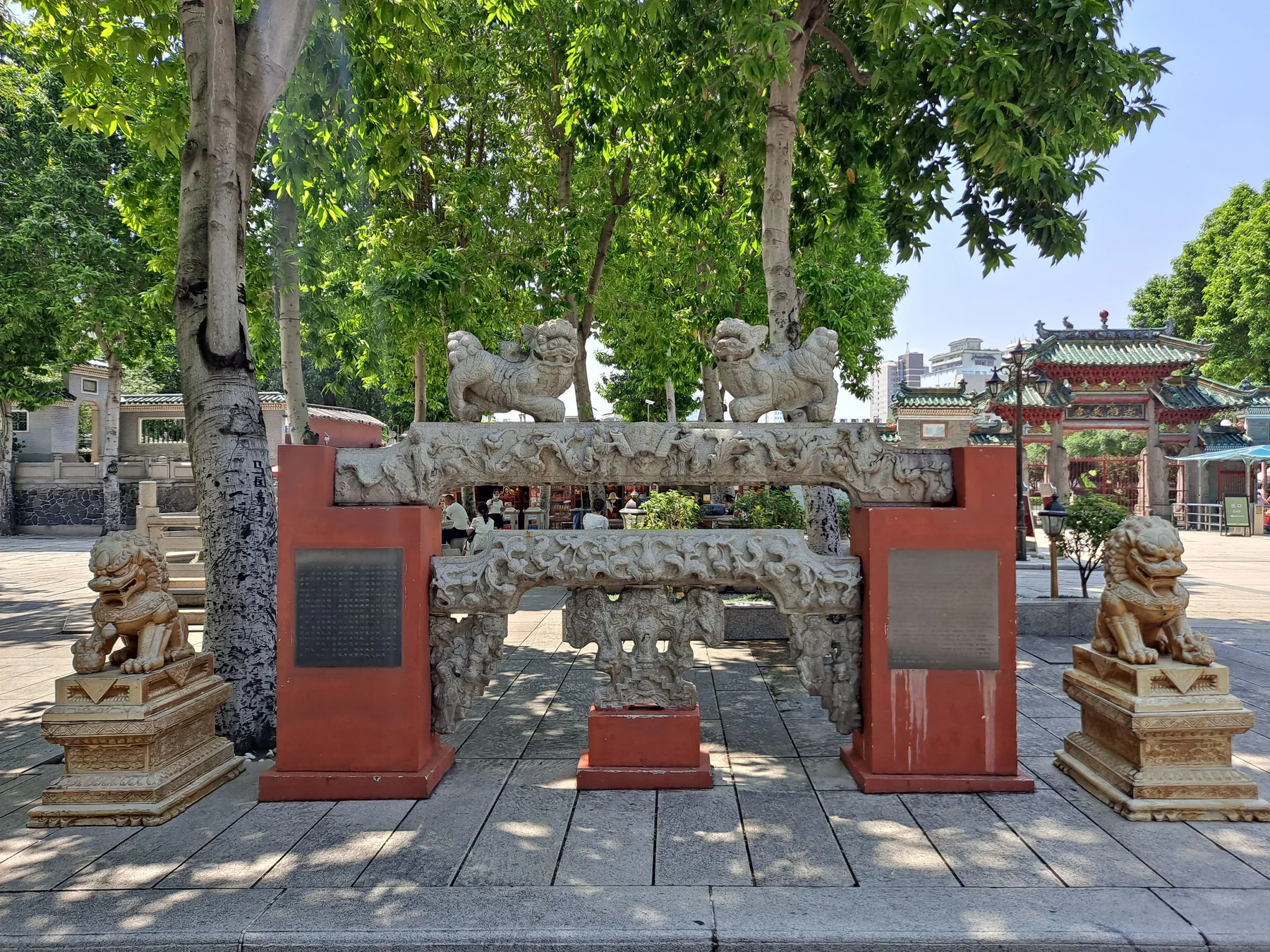
The threshold is both physical and social. It may mark a shift from ordinary street movement to a controlled, ceremonial, community or museum space. The present rule may be visible through barriers, ticketing, notices or staff instructions.
Do not interpret a closed door as abandonment. It may mark a restricted room, a current use, a conservation condition or simply the moment of your visit. Record “closed during visit,” then check the operator.
Photography should preserve context. A tight image of a door carving is less useful if it loses the relationship between doorway, wall and forecourt.

Follow the spatial sequence
Move through the site in the order allowed by the operator. Sketch the sequence rather than forcing it into a universal plan.
Possible elements include:
- street or forecourt;
- principal gate or entrance bay;
- first internal threshold;
- courtyard or light well;
- principal hall;
- side bays or subsidiary rooms;
- rear hall, garden or service space.
Not every site contains every element. Some surviving buildings are incomplete. Others form part of a museum, garden or reused urban block.
At each transition, note:
- direction of movement;
- change in width or height;
- light and shade;
- enclosure and opening;
- visible roof layers;
- doors, screens or controlled boundaries;
- where people pause;
- which view is deliberately framed.
These observations help explain how architecture organises approach and attention. They do not prove a specific ritual procession.
If a site has an official plan, compare it with your route. Mark inaccessible or missing areas rather than imagining them.
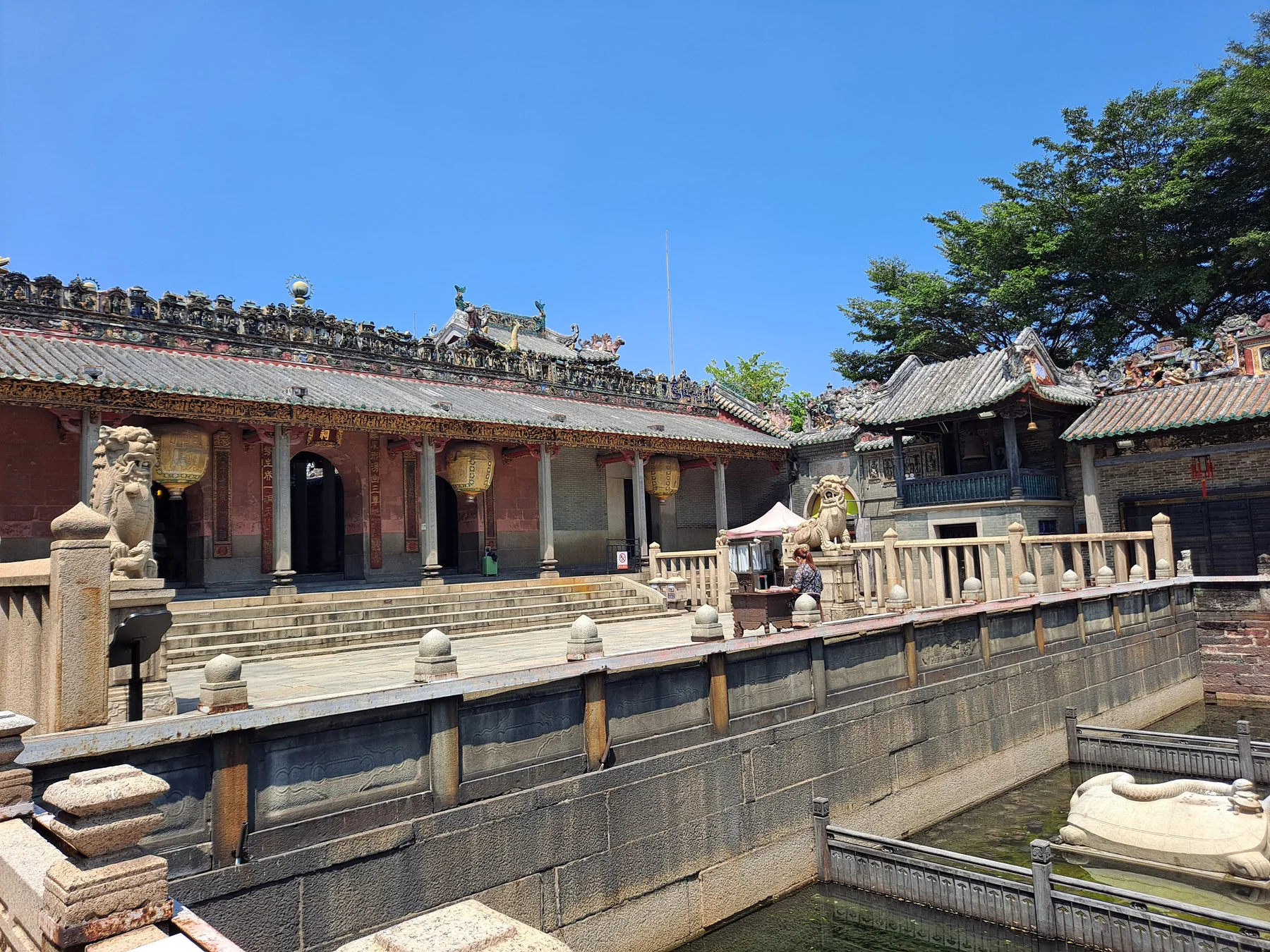

Separate structure, surface and applied craft
A richly decorated building can make every visible element seem equivalent. Divide your record into three categories.
Structure
Look for the visible system that carries or organises space: columns, beams, roof frame, load-bearing walls, platforms and openings. Do not infer hidden structure.
Surface
Record brick bonds, plaster, painted finishes, stone paving and areas of repair. Surface wear can show exposure or use, but it does not provide a date by itself.
Applied craft
Record carved timber, stone carving, ceramic ornament, metalwork, painted panels and other applied elements. Photograph the junction between craft and building, not just an isolated motif.
Use neutral descriptions:
- material or apparent material;
- location;
- scale;
- relationship to an opening, beam, roof or circulation path;
- visible condition;
- source needed for maker, date, subject or technique.
If you cannot determine the material, write “appears to be” and seek a site label or conservation record.
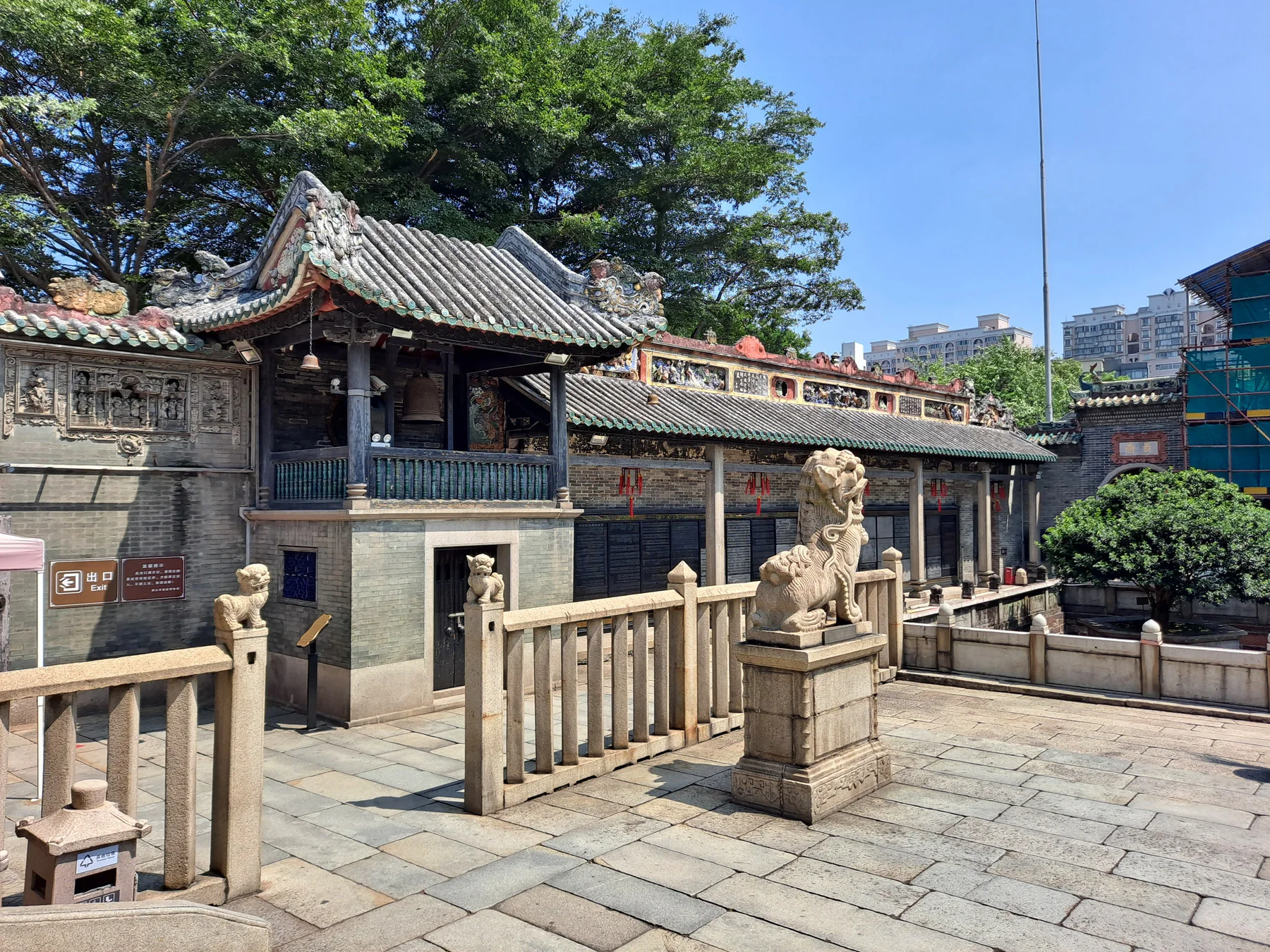

Read ceramic ridge work without dating it
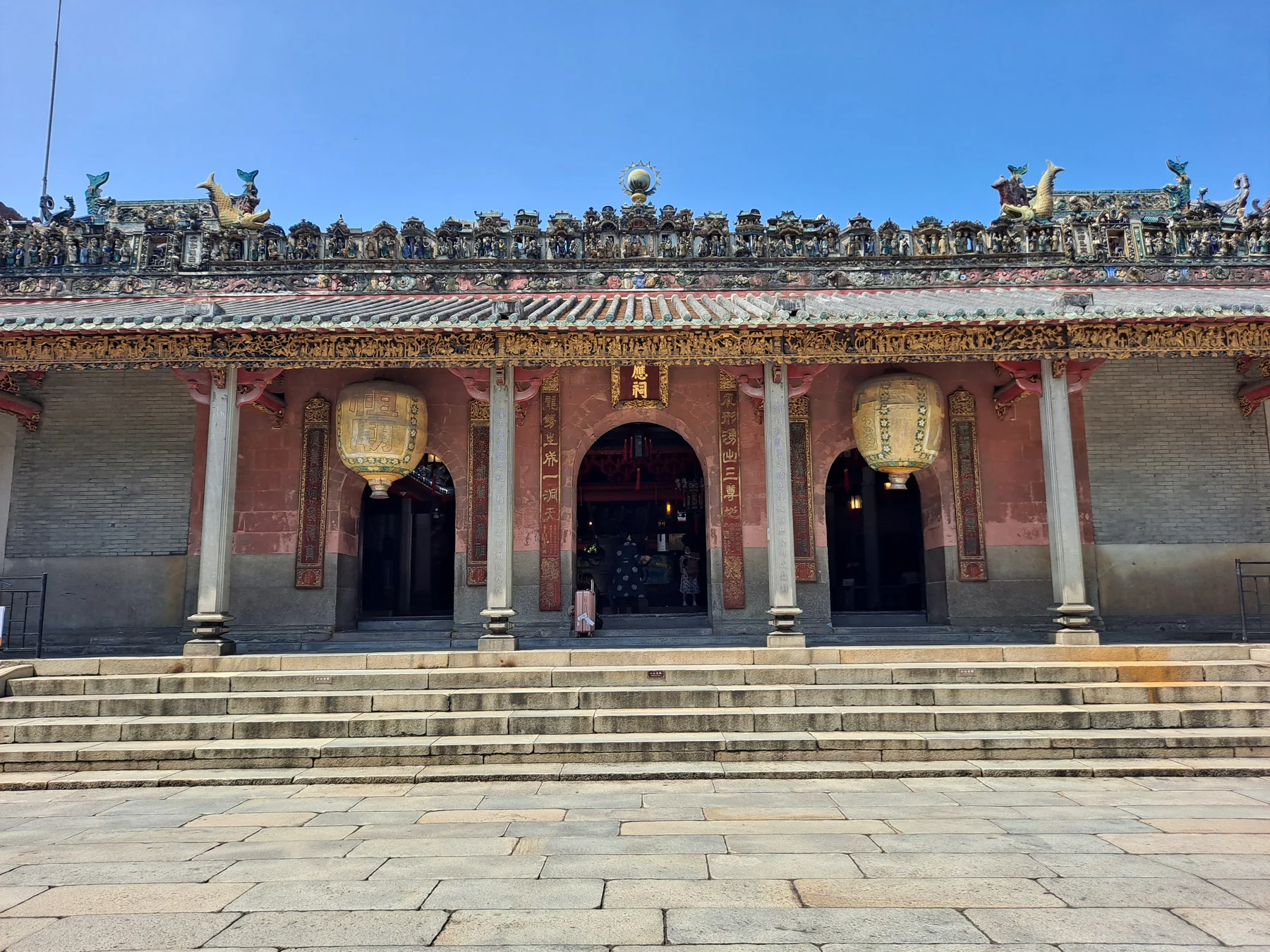
Shiwan ceramic sculpture is part of Foshan’s recognised craft tradition, and national intangible-cultural-heritage material includes architectural ridge sculpture among its forms. That supports a craft connection. It does not allow every colourful roof scene to be dated or attributed on sight.
Use three viewing distances:
- Whole roof: Where does the ornament sit in the roof composition?
- Scene or group: How are figures, animals, plants or architectural forms arranged?
- Surface detail: What modelling, glaze, colour and weathering can be observed?
Then separate visible content from interpretation.
You may observe:
- repeated figure groups;
- changes in scale;
- openwork silhouettes;
- contrast between ridge and sky;
- coloured glaze;
- replacement or repair that appears visually different.
You should not conclude:
- a story or character identity without a reliable label;
- that weathered work is older than bright work;
- that a different colour proves replacement;
- that every element was made at the same time;
- that the work is original to the building.
For a named pottery landscape where architecture and ceramic production history meet, continue to Nanfeng Ancient Kiln.
Handle plaques, inscriptions and ritual objects carefully
Plaques, couplets, tablets and objects may contain names, dedications, dates or institutional language. They are also easy to misread.
Record:
- where the object sits;
- whether it is permanent, displayed or in active use;
- exact visible characters only if you can transcribe them accurately;
- the source of any translation;
- whether photography is permitted;
- whether the operator provides interpretation.
Do not translate a partial inscription with an automated tool and publish it as a historical fact. Do not infer a complete genealogy from a surname plaque.
An object’s presence today does not prove it has always occupied that location. Museum display, conservation and current community use can all change context.
Where worship or private remembrance is active, behaviour matters more than completing a photographic checklist. Follow posted instructions and staff guidance.
Recognise conservation and later use as separate layers
Foshan’s official historic-city framework and provincial housing material describe conservation alongside continued use and adaptive reuse. A visitor may therefore encounter historic fabric, repair, reconstruction, protective intervention, modern services and new public functions in one place.
Look for evidence, not verdicts:
- official conservation plaques;
- interpretive panels;
- visible junctions between materials;
- accessible routes, lighting or fire equipment;
- museum cases or visitor barriers;
- reused rooms;
- a new structure set beside older fabric.
Record what the site or authority says about the intervention. Avoid using “original,” “restored,” “reconstructed” or “new” as casual visual labels.
Adaptive use is not simply visual contamination. It may be part of keeping a building in public or community use. Equally, a polished surface does not prove a successful conservation outcome.
Compare sites without inventing a universal type
Comparison becomes useful when the same questions are asked at two or more places.
Build a table:
| Question | Site A | Site B |
|---|---|---|
| Official name and classification | ||
| Responsible institution | ||
| Relationship to street or forecourt | ||
| Number and form of accessible thresholds | ||
| Courtyard and hall sequence | ||
| Visible materials and crafts | ||
| Current public or community use | ||
| Documented conservation layer | ||
| Questions still unresolved |
The goal is not to decide which is “more authentic.” It is to see how institutional history, urban setting, surviving fabric and current use produce different experiences.
Foshan Ancestral Temple, Xijiang Ancestral Temple and the ancestral-hall layer within Liang Garden can support different questions. Each needs its own source register before detailed publication.
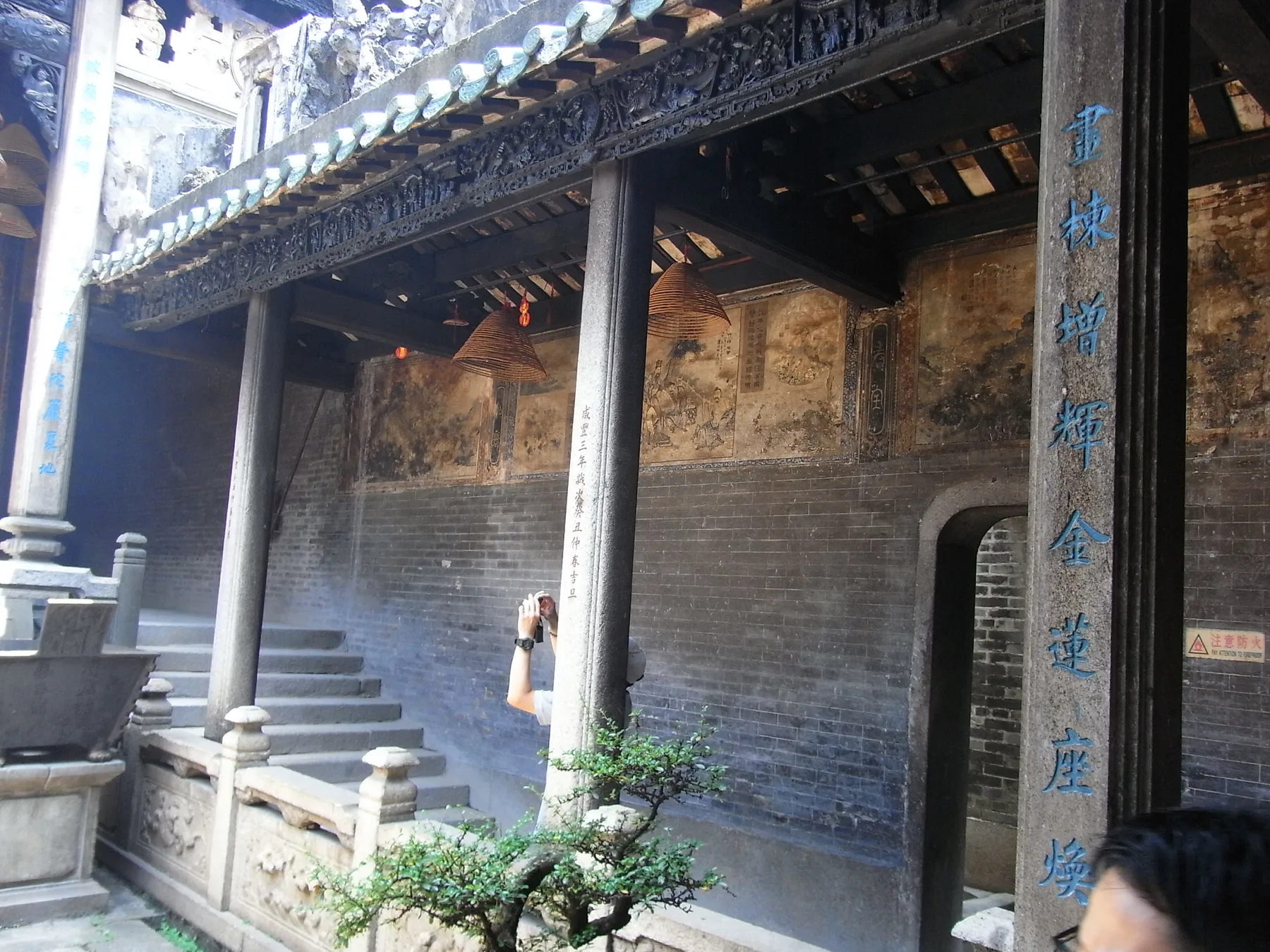

Respect current use, access and photography
Before visiting, use the current operator or government page to check:
- whether the site is open to visitors;
- which areas are accessible;
- whether an event, worship activity or conservation work affects access;
- personal-photography rules;
- whether tripods, lighting or commercial/editorial photography require permission;
- how to request publication rights.
Personal permission to take a photograph does not automatically grant Foshan Living the right to publish it. Publication requires rights from the photographer and any relevant site or depicted-person permissions.
Do not photograph people in worship, private rooms, restricted objects or security arrangements without explicit consent. Do not treat a cultural space as an empty set.
Opening, tickets, events, construction and photography rules are dynamic. They do not belong in the evergreen core of this article.
Know where observation must stop
Pause and seek a site-specific source when a sentence claims:
- a construction or repair date;
- a named lineage or patron;
- a deity, ritual or ceremonial route;
- the identity of a roof figure or story;
- originality or replacement;
- a conservation phase;
- a building’s former or current institutional role.
Use The Ancestral Temple, Explained for a named-site example and Foshan Culture: A First Framework for the distinction among official history, community memory, heritage transmission and screen stories.
A careful visit produces better questions, not instant authority. Record what you can see, attribute what the responsible source explains, and leave the rest unresolved until the evidence is strong enough.
About the author
Zhang Wei covers Foshan’s culture, history, martial arts and performance traditions. His work separates documented history, community transmission, museum interpretation and contemporary visitor experience.
View all articles by Zhang Wei
Image credits and disclosures
- hero.webp This photograph, made on 3 September 2022, records one hall facade and its roof decoration inside the named complex. It does not identify every construction phase, confirm current room access or show that the visible condition is unchanged. 钉钉 · CC BY-SA 4.0; exact approved derivative reused byte-for-byte · CC BY-SA 4.0
- body-01-threshold.webp This 2022 photograph records stone elements, trees and a framed threshold inside Foshan Ancestral Temple. It does not establish the age, authorship or original function of every visible object. 钉钉 · CC BY-SA 4.0; exact approved derivative reused byte-for-byte · CC BY-SA 4.0
- body-02-courtyard.webp A 2022 courtyard view inside Foshan Ancestral Temple shows how halls, roofs, stone railings and water relate in one visible sequence. It does not identify or date every structure or confirm today's route. 钉钉 · CC BY-SA 4.0; exact approved derivative reused byte-for-byte · CC BY-SA 4.0
- body-03-material-context.webp This 2022 view places brick, timber, tile, stone and applied decoration within a larger building relationship. It does not authenticate a material, assign a construction phase or label a repair. 钉钉 · CC BY-SA 4.0; exact approved derivative reused byte-for-byte · CC BY-SA 4.0
- body-04-second-site.webp A 2012 view inside Lubao Ancestral Temple in Sanshui provides a second Foshan setting for comparison. Incidental visitors are not identified, and the image does not confirm current use, access, ritual status or conservation condition. ITammyT16 · CC BY-SA 3.0; exact approved derivative reused byte-for-byte · CC BY-SA 3.0
- body-05-field-card.webp Use the same four layers at every site, then add an evidence-needed column. This is an editorial field method, not an official architectural classification. Zhang Wei / Foshan Living · Project-original SVG rendered locally to WebP
- body-06-observation-inference.webp A visible observation can be recorded directly; an attributed statement needs a named responsible source; a historical or conservation conclusion needs site-specific evidence. Zhang Wei / Foshan Living · Project-original SVG rendered locally to WebP


Keep exploring
Related Foshan guides
 Explore Foshan
Chancheng or Shunde: Where Should You Start in Foshan?
Choosing between Chancheng and Shunde for a first Foshan trip? Compare heritage, food, neighbourhood pace, transport planning and where to stay.
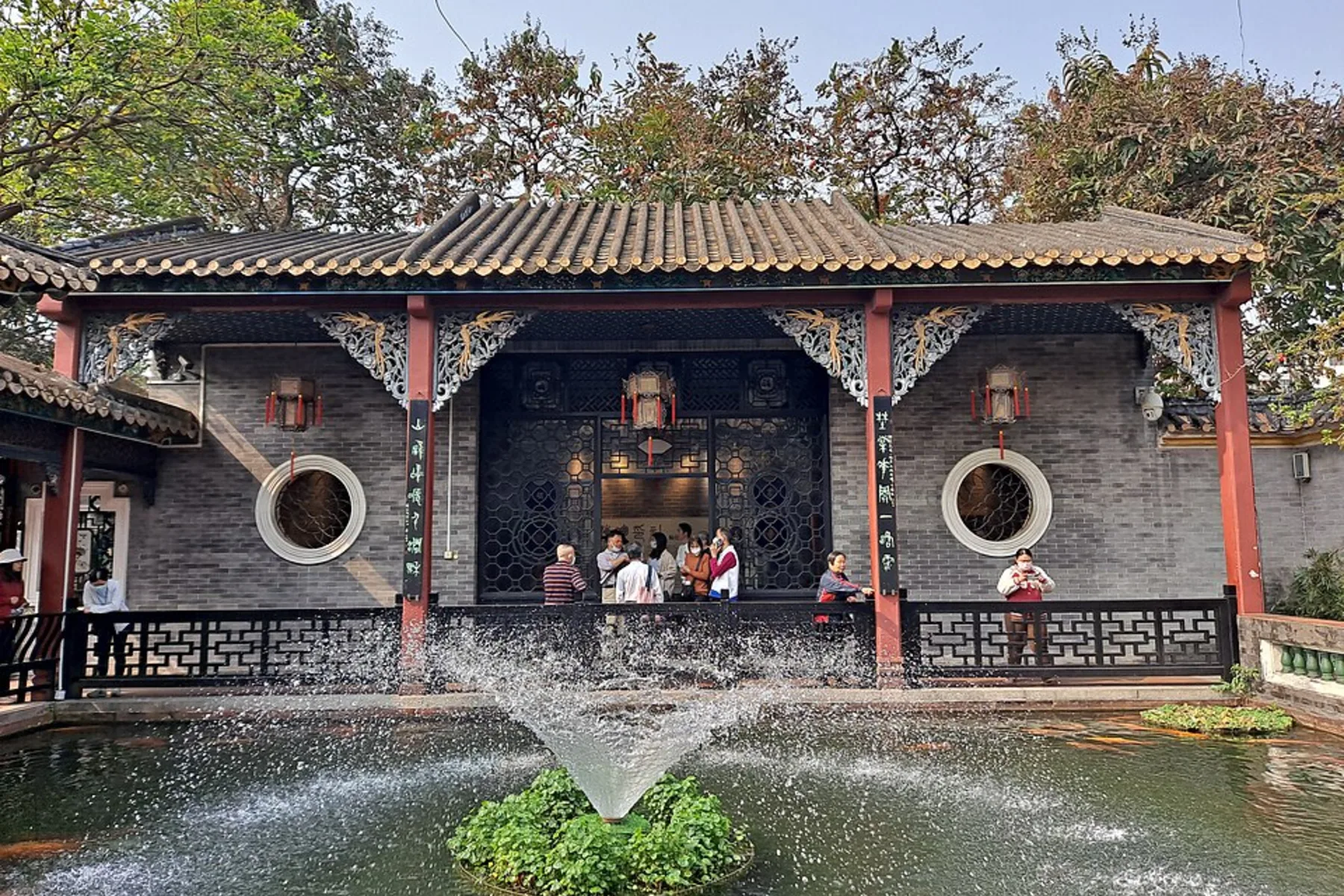 Explore Foshan
Understanding Foshan: A City of Five Districts
Learn how Foshan’s five districts differ, which areas suit culture, food, urban life or nature, and why every short trip needs a specific local base.
 Explore Foshan
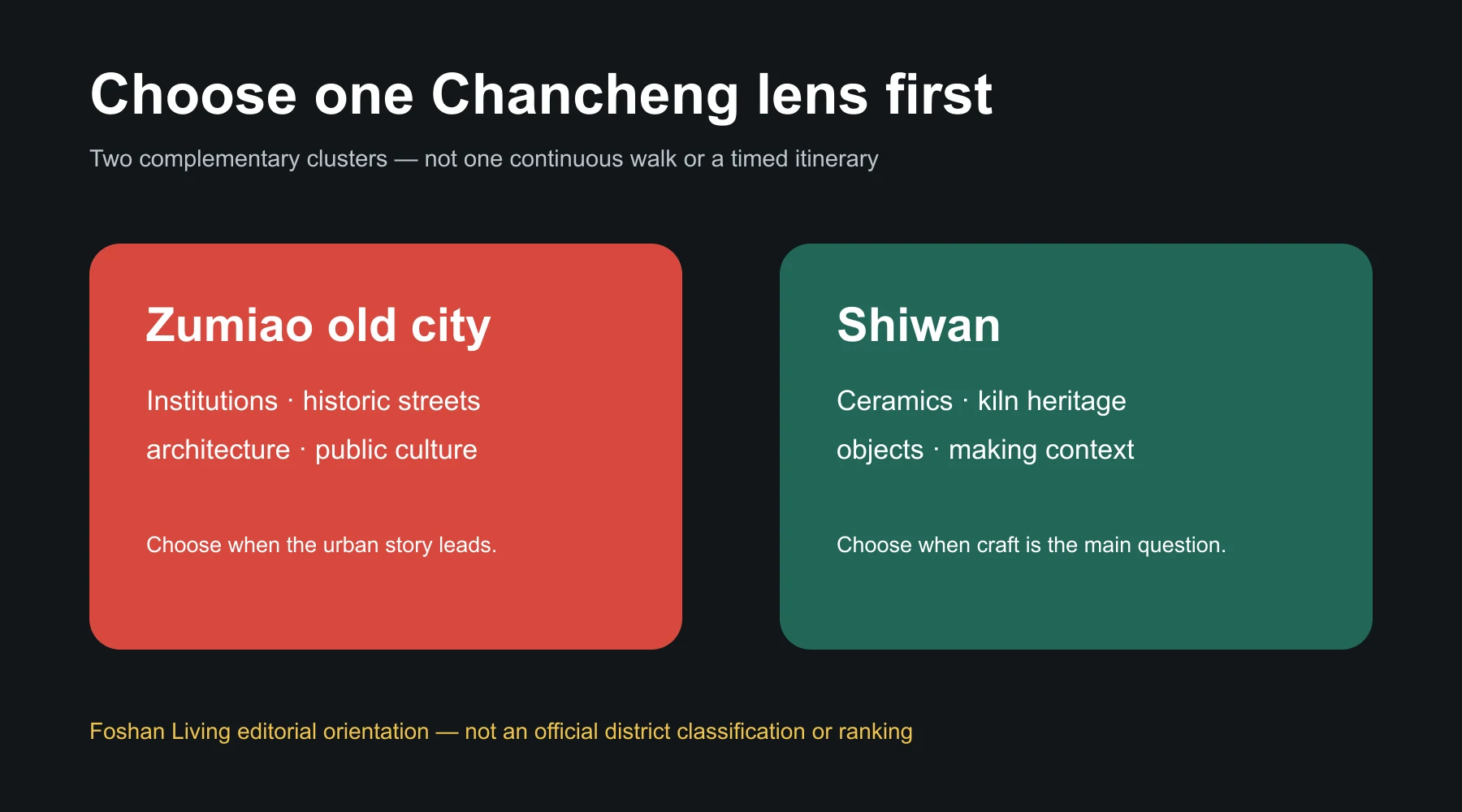
Zumiao Old City or Shiwan: How to Choose Your Chancheng Day
Compare Zumiao old city and Shiwan, choose one main Chancheng cluster, and add the other only after checking the complete route and current access.
 Explore Foshan
Chancheng: Foshan’s Historic Urban Core
Understand Chancheng through the Zumiao old city and Shiwan’s ceramic heritage, with guidance on walking scale, transport checks and where to base.
Plan your visitFirst Time in Foshan
Build a first trip around districts, transport, food and one deeper cultural interest.