Culture & history
Foshan Ancestral Temple Explained: Five Layers to Read
Read the Ancestral Temple as a Beidi religious setting, community institution, protected architectural complex and container for opera and martial memory.
On this page
- Start by resolving the name
- Read a complex, not one building
- Layer one: Beidi belief
- Layer two: community institution and public memory
- Layer three: architecture and decorative craft
- Follow sequence before collecting details
- Treat decoration as evidence, not a date stamp
- Layer four: Wanfutai and Cantonese opera
- Layer five: martial memory and lion dance
- Use a five-pass method during the visit
- Separate permanent meaning from current operations
- Avoid five common shortcuts
- Continue through Foshan culture
- About Zhang Wei
Foshan Ancestral Temple makes more sense when you stop treating it as one old building. It is a named Beidi religious setting, a historic community institution, a protected architectural complex and a place where opera, lion dance and martial-arts memory are interpreted together.
Those layers are related, but they are not interchangeable. Wanfutai does not turn every courtyard into an opera stage. A Wong Fei-hung or Ip Man display does not make the complex the source of every Foshan martial tradition. A temple fair does not mean a procession happens every day.
The short answer: begin with the temple's Beidi dedication, follow the spatial axis, notice how craft frames ritual and performance, then treat the opera and martial sections as specialist interpretations inside a wider institution. Check opening, tickets, room access and programmes separately with the current operator.
Start by resolving the name
“Foshan Ancestral Temple” is the established English name, but the word “ancestral” can mislead a first-time reader. It may suggest a hall devoted only to one lineage's ancestors. This named complex is instead centred on worship of Beidi, also connected with Xuanwu in Chinese religious-cultural history.
That distinction matters because Foshan contains many halls, temples and historic community buildings with different names, institutions and functions. You cannot transfer the Ancestral Temple's identity to every building labelled ci, zongci, miao or zumiao. The official name, responsible institution and site-specific records must come first.
In everyday English, “Zumiao” is also common shorthand for the temple and the surrounding central area. This article uses Foshan Ancestral Temple for the named cultural complex. It does not use “ancestral temple” as a universal architectural type.

Read a complex, not one building
Public-cultural information describes a complex that brings together historic architecture, a Confucian Temple, the Wong Fei-hung Memorial Hall and the Ip Man Hall. Wanfutai, a traditional stage, adds another spatial and performance layer. The operator's institutional framing also connects the site with folk culture, martial memory and lion dance.
This composition explains why a quick “temple or museum?” label fails. It is a temple setting interpreted through a museum institution. It contains distinct buildings and commemorative subjects. Some spaces speak primarily through religious dedication or architectural sequence; others use exhibition, performance or public memory.

The most useful first question is therefore not “What is the one main object?” Ask instead:
space?
visual impression?
boundary?
- Which institution or cultural subject does this part of the complex present?
- How does the threshold change between worship, exhibition and performance
- Which claim comes from an official label or record, and which is only your
- Does the current route allow access, or are you looking across a controlled
These questions keep several cultural systems visible without flattening them into one attraction.
Layer one: Beidi belief
The temple's dedication is the first interpretive layer, not decorative background. The Guangdong cultural-history source connects the complex with Beidi/Xuanwu belief. The national intangible-cultural-heritage record for the Foshan Ancestral Temple fair likewise links the temple, Beidi belief and traditional fair activity.
This means religious meaning is built into the identity of the place. Courtyards, halls, axes and thresholds are not simply scenic frames for later museums. Visitors should recognise that other people may approach the complex through worship, custom or community memory rather than architecture alone.
That recognition changes behaviour. Move around active religious practice without blocking it. Do not stage photographs in front of worshippers or assume that every object may be approached closely. A public entrance does not erase the difference between observing a cultural site and using a ritual space.
The temple fair provides another important distinction. It shows that belief can move into collective public activity, but it does not prove a permanent daily programme. Annual date, procession route, crowd control and performance schedule belong to the current event notice.
Layer two: community institution and public memory
Calling the Ancestral Temple a community institution does not mean it functions as a modern municipal government office. The phrase identifies a historical and cultural layer: shared worship, collective ritual, gathering, representation and memory can meet in one recognised place.
“Governance” is useful only when handled carefully. A major shared institution can help a community organise ritual, public presence and relationships among groups. That is different from claiming a fixed administrative constitution, a single governing body across all periods or direct continuity with today's city government.
Look for evidence of collective scale:
- a sequence that receives groups rather than only individuals;
- spaces that establish approach, pause and assembly;
- inscriptions or interpretation that identify institutions and patrons;
- boundaries between ritual, audience and performance areas;
- later museum or memorial uses that organise public memory.
These observations do not reconstruct a complete social history. They help the visitor understand why architecture, belief and performance can occupy the same complex. Site labels and specific historical records must carry the detailed claims.
The 1996 national key cultural-relic protection status, reported by the Guangdong cultural-history source, adds a modern conservation layer. Protection is not the same as freezing a site in one moment. Conservation, visitor management and interpretation shape how the public encounters historic fabric now.
Layer three: architecture and decorative craft
The Guangdong cultural-history account supports reading the complex through an axial organisation, architectural components and rich decoration. The key is to observe relationships before isolating photogenic details.

Follow sequence before collecting details
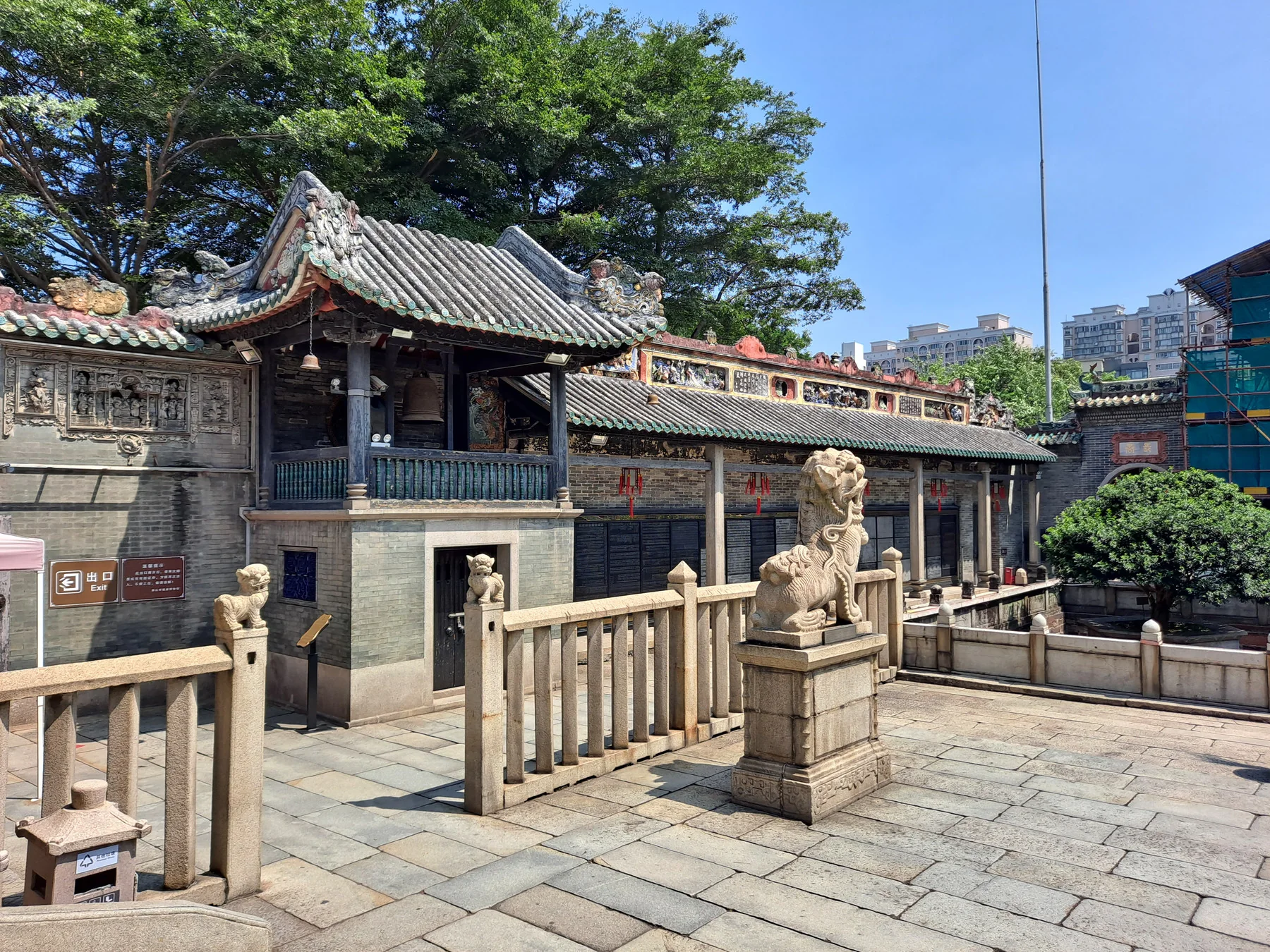
At each threshold, look back as well as forward. Ask how the axis aligns halls, courtyards and framed views. Notice where the route narrows, opens or changes direction. Compare spaces intended for movement with spaces that appear to hold an audience or focus attention.
Record the sequence in plain language:
- named entrance or threshold;
- open or transitional space;
- main visual focus;
- side building or secondary institution;
- change in access or use.
This method is more reliable than assuming every building belongs to the same construction phase. A historic complex can contain repair, replacement, conservation and later interpretation. The visible route is evidence of today's encounter, not a complete chronology.
Treat decoration as evidence, not a date stamp
Roof ornament, carving, painted surfaces and timber work show that architectural meaning is made through craft as well as plan. Their position matters. A distant roof figure works differently from a carving at hand level or a painted surface framing an interior threshold.
For each detail, record:
the phase yourself.
- material or apparent material;
- position on the building;
- viewing distance;
- relationship to structure, ritual or performance;
- wording on the current interpretive label;
- whether the area looks conserved, repaired or newly presented—without deciding
Colour does not prove that a surface is new. Wear does not prove original age. Style does not identify a maker. A responsible caption states what is visible and what the official interpretation confirms.
For the wider city method, use the Foshan culture framework rather than treating this single complex as a summary of all Lingnan architecture.
Layer four: Wanfutai and Cantonese opera
Wanfutai gives performance architecture a specific place within the complex. The stage belongs to a setting shaped by temple space, audience relationship and public cultural memory. It should not be reduced to a decorative backdrop.
At the parent-page level, three points are enough:
narrative-singing label.
relationship, but it does not prove a show is scheduled.
- Wanfutai is a traditional stage within the Ancestral Temple setting.
- Cantonese opera is a full theatre form, not simply a costume display or
- An empty stage can still be studied through architecture and audience
The detailed reading—stage opening, audience position, entrances, timber and decoration—belongs to the Wanfutai traditional-stage guide. That specialist page also explains why old performance frequency cannot be copied into a current programme.
If a performance is important to your visit, verify the date, cast, venue, ticket, seating and photography conditions from the current operator. Do not infer a performance from a stage setup, rehearsal sound or old photograph.
Layer five: martial memory and lion dance
The Wong Fei-hung Memorial Hall and Ip Man Hall place two famous figures inside the museum complex's public interpretation. Official operator material also connects the institution with martial culture and lion dance.
These are strong entry points, but their boundaries matter.
A memorial hall shows how a person is presented in public memory. It does not by itself prove every biographical detail, lineage claim or film episode. The same rule applies to photographs, reconstructed scenes and later objects: identify the evidence type before turning it into history.
Lion dance adds another distinction. It has relationships with martial training, community activity, ritual and staged performance, but those contexts are not identical. A museum label, demonstration and competition may show different parts of the practice.
Use the published Foshan kung-fu guide to separate public records, transmission accounts and cinema-shaped memory. The Ancestral Temple page only explains why martial subjects are present inside the wider cultural complex; it does not claim that every Foshan style, school or lineage is represented there.
Current demonstrations require their own check. A courtyard associated with lion dance or martial interpretation does not guarantee a performance on the day you visit.
Use a five-pass method during the visit
The five layers become manageable when each pass has one question.
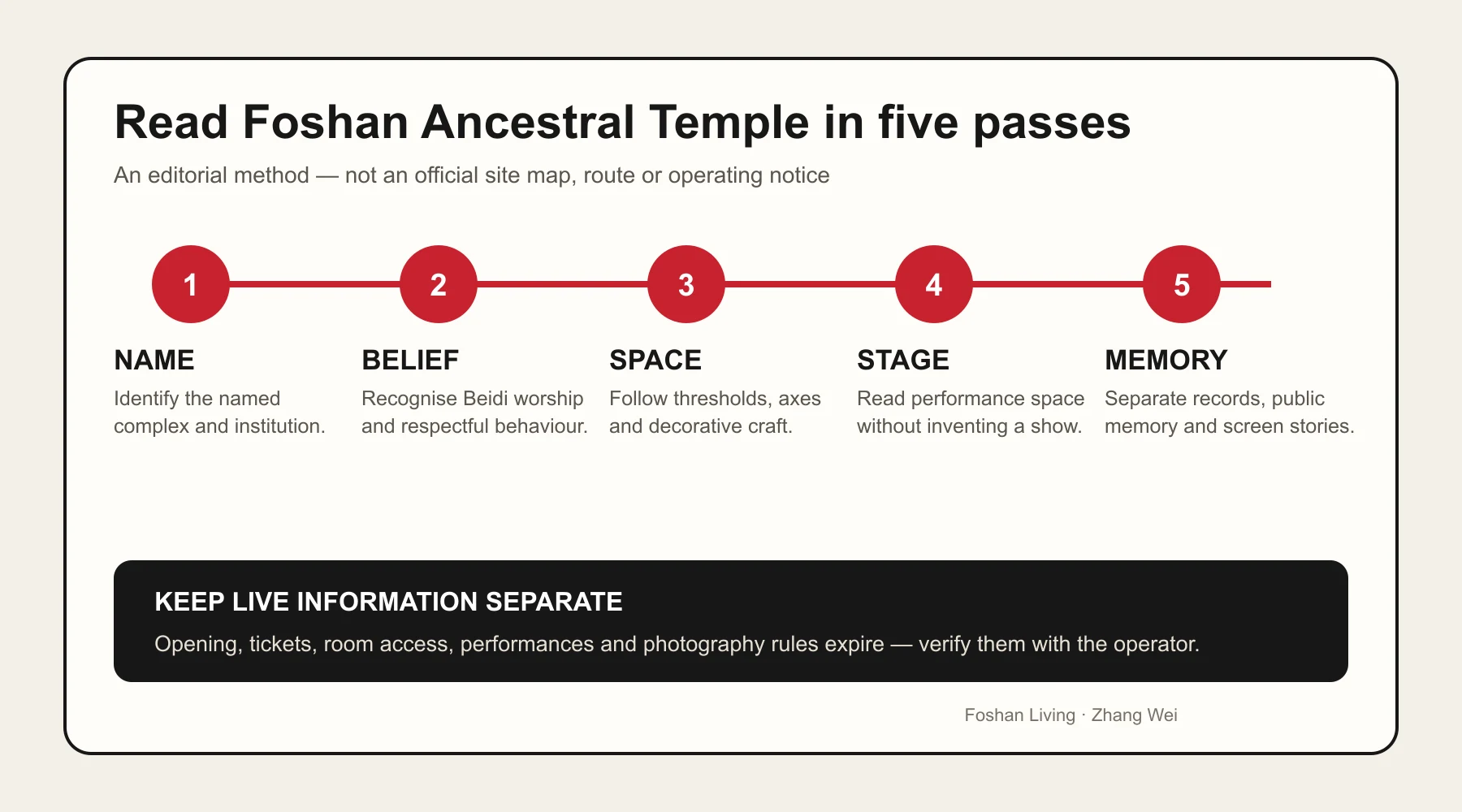
Pass one — name and institution. Read the official name of the complex and the label for the current building or hall. Do not rely on the English word “ancestral.”
Pass two — belief and behaviour. Identify where religious meaning is active. Observe respectfully and separate everyday worship from a festival programme.
Pass three — space and craft. Follow the axis and thresholds. Choose two decorative details and record material, position and viewing distance without guessing date or authenticity.
Pass four — performance. Read Wanfutai in relation to audience and temple space. If no show is scheduled, treat the absence as an operational fact, not a judgment that the stage lacks cultural life.
Pass five — memory. In martial or commemorative displays, label each statement as public record, institutional interpretation, transmission account or popular screen story.
This sequence prevents one strong interest from swallowing the others. A kung-fu fan still sees belief and architecture. An architecture visitor still recognises living ritual and performance. An opera visitor sees why the stage belongs to a larger institution.
Separate permanent meaning from current operations
Keep two notes.
The evergreen note records:
- Beidi dedication;
- the complex's named cultural components;
- protected-building context;
- the relationship among ritual, architecture, stage and public memory;
- your evidence labels and unanswered questions.
The live note records, with a date:
- opening and last entry;
- ticket and eligible concessions;
- entrance or partial closure;
- current exhibition access;
- performance or demonstration schedule;
- photography, accessibility and crowd-control information.
The live note expires. Confirm it through the Foshan Ancestral Temple Museum operator before travelling. A search snippet, old travel post or previous event guide is not a current operating notice.
Avoid five common shortcuts
“Ancestral Temple means clan hall.” The established English name cannot replace the site's Beidi dedication and institution-specific history.
“Everything here is from one period.” A protected complex can contain multiple phases, repairs and later interpretation.
“Wanfutai means there is a show today.” A stage and a programme are different evidence.
“The memorial halls prove every film story.” Public memory, transmission accounts, documented history and cinema must remain separate.
“The temple fair is a daily visitor feature.” Cultural significance can be stable while dates, routes and access change annually.
Continue through Foshan culture
beside ceramics, gardens, streets and other community institutions.
for the specialist performance-space method.
dance and evidence boundaries.
between observation, performance and hands-on experiences.
- Use Foshan's culture framework to place the complex
- Read Wanfutai as a traditional Cantonese-opera stage
- Use Foshan kung fu for martial traditions, lion
- Use Things to Do in Foshan to choose
About Zhang Wei
Zhang Wei writes about Foshan's culture, history, kung fu and performance traditions. His guides separate public records, institutional interpretation, transmission accounts and screen-shaped memory so visitors can understand a place without turning dynamic programmes or inherited stories into permanent fact.
Image credits and disclosures
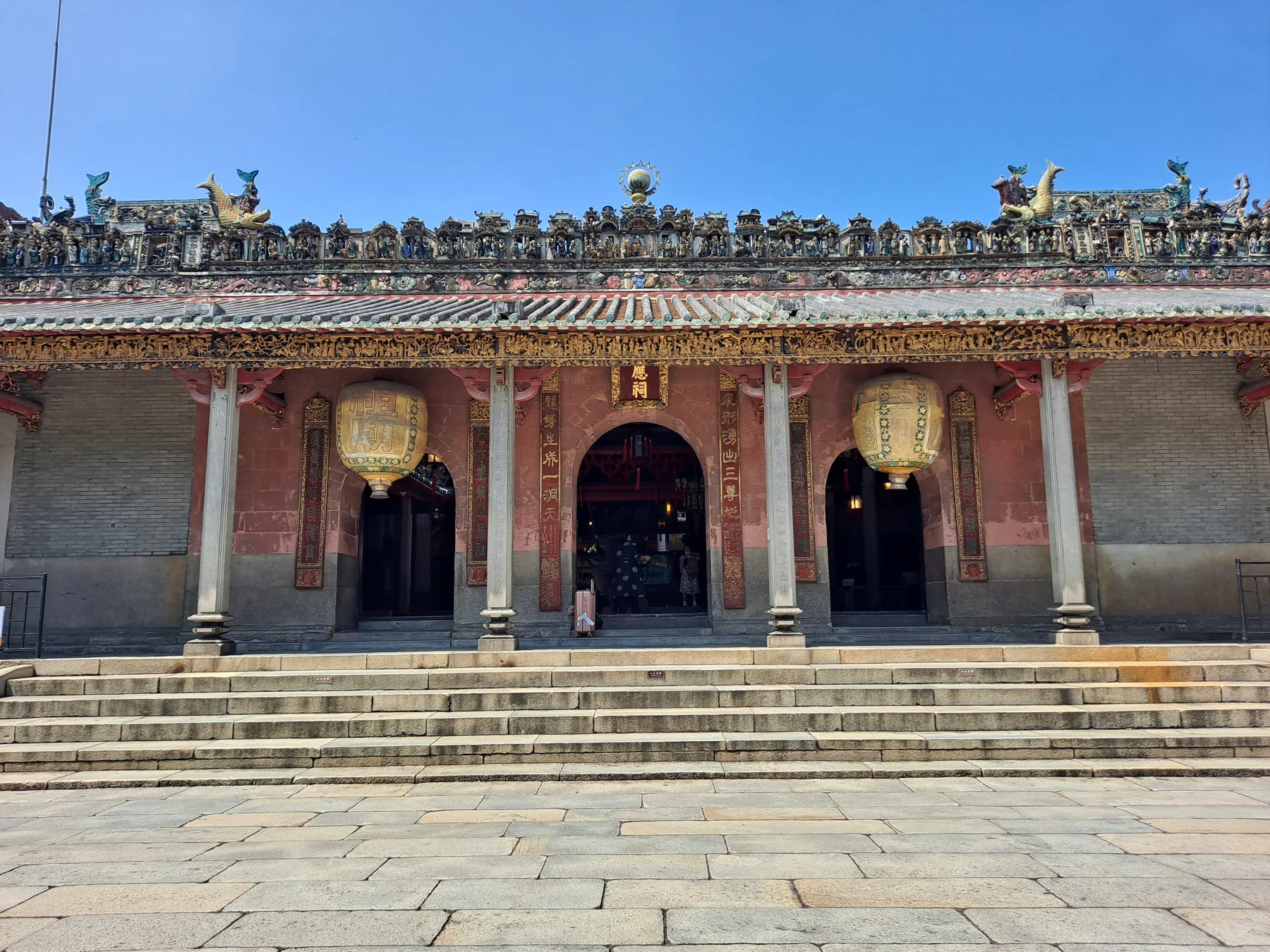
- hero.webp This photograph, made on 3 September 2022, records one hall facade and its roof decoration inside the named complex. It does not identify every construction phase, confirm current room access or show that the visible condition is unchanged. 钉钉 · CC BY-SA 4.0; Commons file page records own work, creator, date and licence · CC BY-SA 4.0
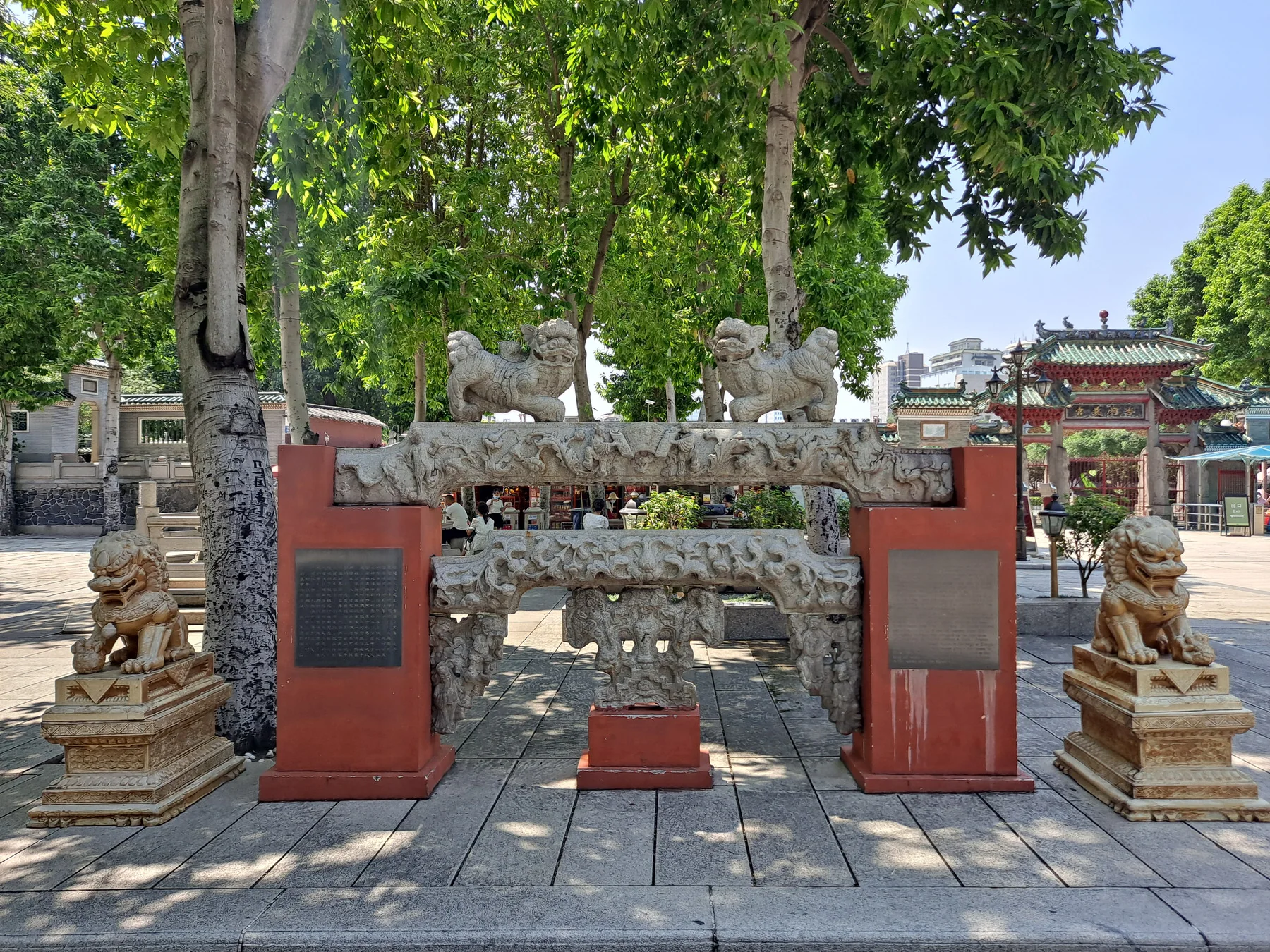
- body-01-threshold.webp This dated 2022 photograph records stone elements, trees and a framed threshold within the complex. It supports close observation of sequence and material position; it does not establish the age, authorship or original function of every visible object. 钉钉 · CC BY-SA 4.0; Commons file page records own work, creator, date and licence · CC BY-SA 4.0
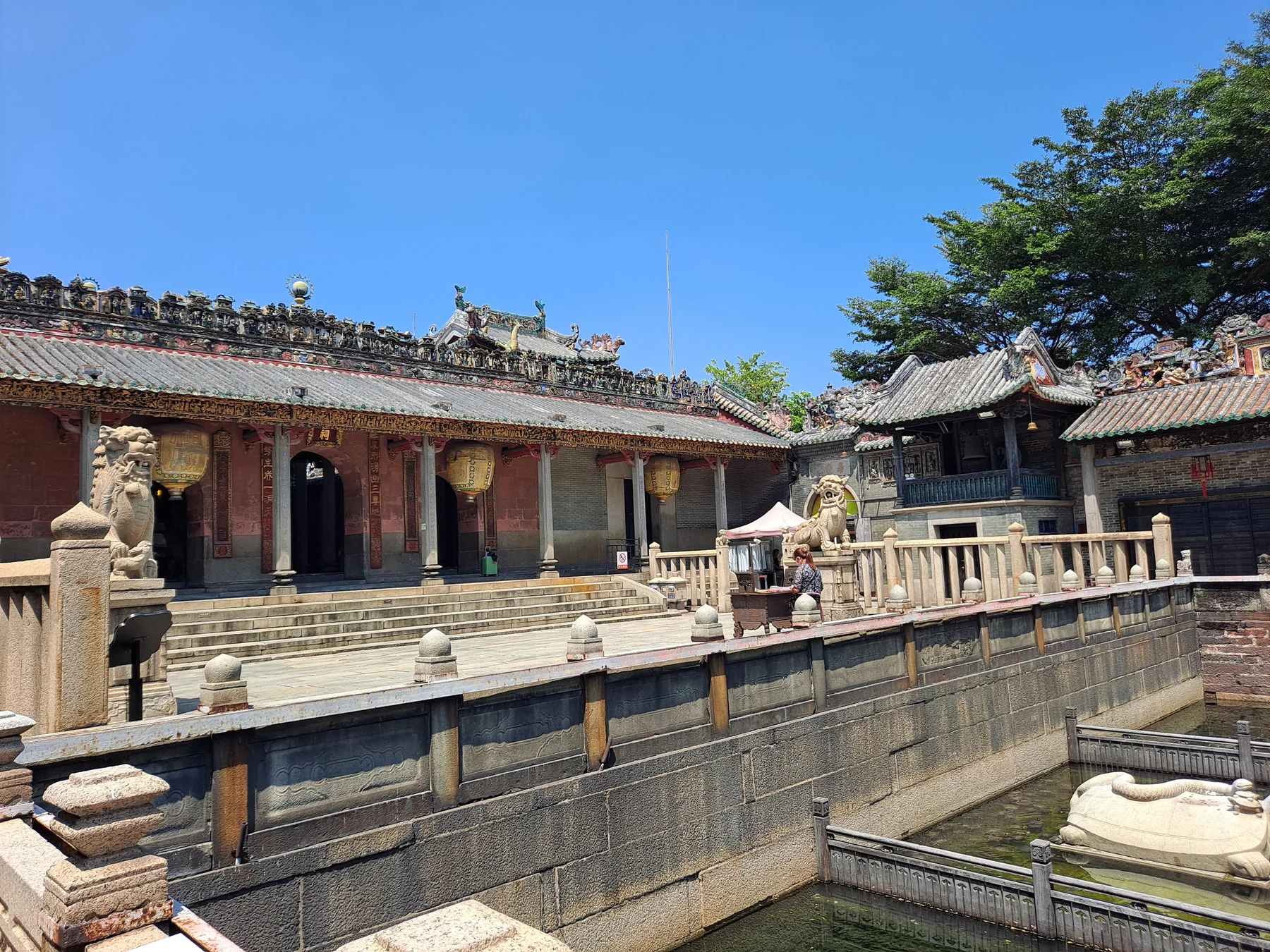
- body-02-courtyard.webp This 2022 wide view records the relationship among a courtyard, historic halls, roofs, railings and water. It does not establish the name or date of every visible structure, current circulation or unrestricted access. 钉钉 · CC BY-SA 4.0; Commons file page records own work, creator, date and licence · CC BY-SA 4.0
- body-03-building-context.webp This photograph records one 2022 relationship among roof lines, a side building, courtyard boundaries and later city fabric. It does not authenticate decoration, assign a construction phase or confirm present visitor routing. 钉钉 · CC BY-SA 4.0; Commons file page records own work, creator, date and licence · CC BY-SA 4.0
- body-04-five-layer-reading.webp Foshan Living’s editorial diagram turns the article into five observation passes. It is not an official site map, prescribed route, architectural chronology or operating notice. Zhang Wei / Foshan Living · Original editorial infographic created for this article


Keep exploring
Related Foshan guides
 Explore Foshan
Chancheng or Shunde: Where Should You Start in Foshan?
Choosing between Chancheng and Shunde for a first Foshan trip? Compare heritage, food, neighbourhood pace, transport planning and where to stay.
 Explore Foshan
Understanding Foshan: A City of Five Districts
Learn how Foshan’s five districts differ, which areas suit culture, food, urban life or nature, and why every short trip needs a specific local base.
 Explore Foshan
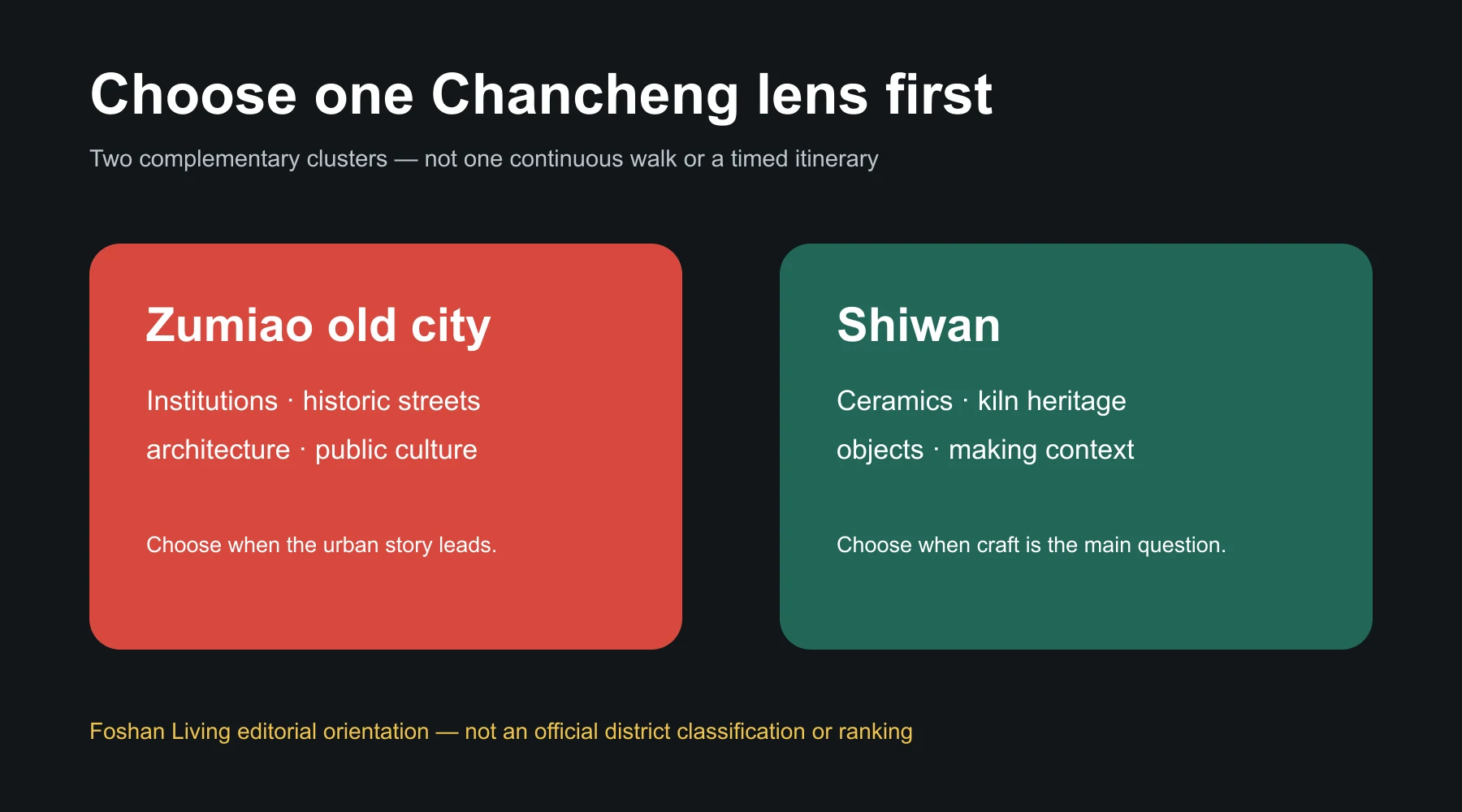
Zumiao Old City or Shiwan: How to Choose Your Chancheng Day
Compare Zumiao old city and Shiwan, choose one main Chancheng cluster, and add the other only after checking the complete route and current access.
 Explore Foshan
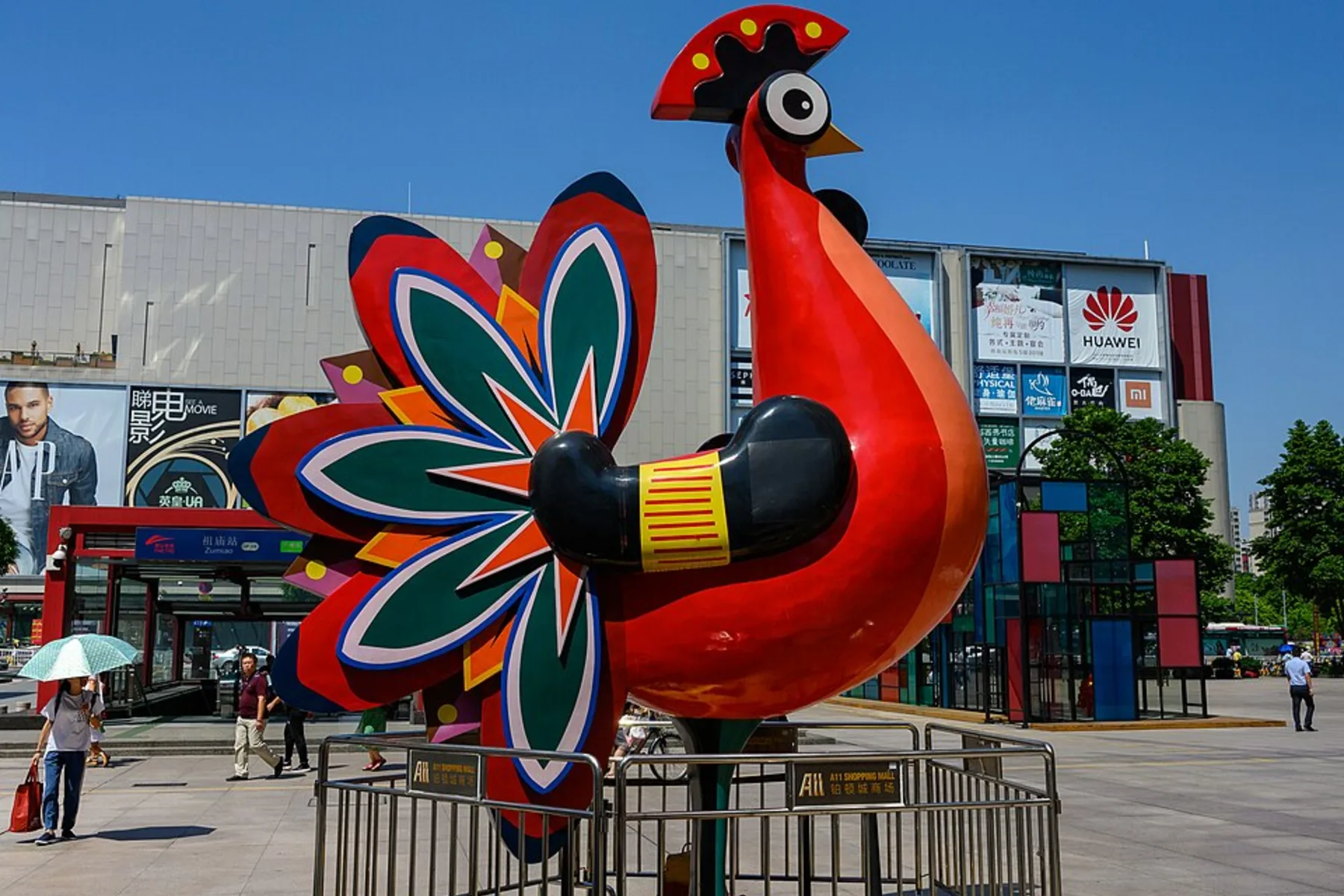
Chancheng: Foshan’s Historic Urban Core
Understand Chancheng through the Zumiao old city and Shiwan’s ceramic heritage, with guidance on walking scale, transport checks and where to base.
Plan your visitFirst Time in Foshan
Build a first trip around districts, transport, food and one deeper cultural interest.