Food & drink
How to Read a Food Market in Foshan
Start with the market map, follow its own zones, inspect one stall carefully and keep current observations separate from cultural, origin and safety claims.

On this page
- Decide what this guide is and is not
- Start with the market and operator layer
- Read zones before individual stalls
- Begin with the broad categories
- Notice how each zone works
- Use transitions as information
- Read one stall as current evidence
- Keep market context separate from authenticity
- Lane one: direct observation
- Lane two: attributed explanation
- Lane three: independently documented context
- Use a two-pass market walk
- Pass one: orientation
- Pass two: one documented subject
- Check weight and transaction information
- Treat cooked food as a separate decision
- Build a dated market field note
- Know what must be checked live
- Continue exploring Foshan food
- About Daniel Osei
A Foshan food market is easiest to understand when you stop trying to “see everything” and read it in layers. Begin with the entrance and operator information. Follow the market’s own zones. Then choose one stall and record only what the current display, label and seller can actually tell you.
That method is more useful than a list of famous markets. Names, stalls, prices, opening times and stock change. The distinction between an observed fact and a cultural claim does not.
What you will get from this guide: a two-pass market walk, a stall-reading checklist, a cautious way to use weighing and public-information points, and a field-note format that keeps one visit from becoming a false citywide rule.
Decide what this guide is and is not
This is a reading guide, not a market recommendation page. It does not tell you which market is “best,” which one local residents supposedly prefer or when a particular stall opens. It also does not treat an older-looking space as more authentic than a renovated one.
Foshan has documented programmes concerned with market layout, access, management, weighing and public information. A Shunde People’s Congress research page, for example, discussed entrance guidance, floor maps, product zoning and service functions while examining named Daliang markets. Foshan’s wider upgrade reporting also treated urban, village and wholesale markets as different types that could not all be approached in exactly the same way.
Those records support a useful conclusion: a market is a working public-commercial system, not merely a photogenic room full of produce. They do not prove the current condition of any market you enter.
Use this article to answer four questions:
documented fact?
- How does this market organise information and movement today?
- What does this particular stall display or say today?
- Which parts are direct observation, seller explanation or independently
- What would need to be checked again on another visit?
Start with the market and operator layer
Before focusing on fish, vegetables, roast meats or snacks, pause near the entrance. Look for the market name, a management or service point, a layout map, zone signs, public notices and a route to raise a transaction problem.
Record what is visibly present. Do not infer what ought to be there.
A practical entrance note might contain:
| Field | What to record |
|---|---|
| Market identity | Exact displayed name, not a map-app nickname |
| Visit context | Date, entrance used and approximate stage of the day |
| Operator layer | Management desk, service point or posted operator name, if visible |
| Orientation | Map, zone directory, hanging signs or none observed |
| Public information | Notices, test display, licence display or weighing point actually seen |
| Access | Steps, ramp, aisle width and obstacles on the route you used |
This first layer prevents a common mistake: confusing one vendor with the market operator. A stallholder can explain the current stall; the management point may handle market-wide wayfinding or complaints. Neither automatically speaks for all markets in Foshan.
Do not photograph a licence, payment code, phone number or person merely because it is on display. Reading public information and republishing identifiable details are different actions.
Read zones before individual stalls
The most durable way to understand a market is to follow the categories it uses for itself. Foshan’s documented market-upgrade work has paid attention to maps, category zoning and separation of different trading conditions. The exact labels and layout still vary by market.
Begin with the broad categories
Walk once without buying. Note whether the market distinguishes some of these areas:
- vegetables, fruit or other fresh produce;
- meat, poultry or eggs;
- live or chilled aquatic products;
- dried goods, grains, condiments or preserved foods;
- tofu or other prepared ingredients;
- roast meats, cooked food or other ready-to-eat products;
- household goods or services that sit outside the food sections.
This is an observation list, not an official universal taxonomy. A small neighbourhood market may combine categories. A larger market may divide them more precisely.
Notice how each zone works
The useful question is not only “What is sold here?” Ask:
- Is the product dry, wet, chilled, live, raw or ready to eat?
- Is it displayed as individual pieces, bundles, trays or by weight?
- Does the customer select the item, or does the seller portion it?
- Is preparation visible, separate or not observed?
- Which sign belongs to the market, and which belongs only to the stall?
The answer helps you read the transaction. It does not prove origin, freshness, quality or safety.
Use transitions as information
Pay attention when the floor, counter type, drainage, temperature, enclosure or signage changes between zones. These transitions explain how the space manages different products and customer movements.
Avoid turning the transition into a verdict. A glass screen is a visible feature, not proof that every handling step is safe. A wet floor is a condition to navigate carefully, not evidence about an entire market.
Read one stall as current evidence
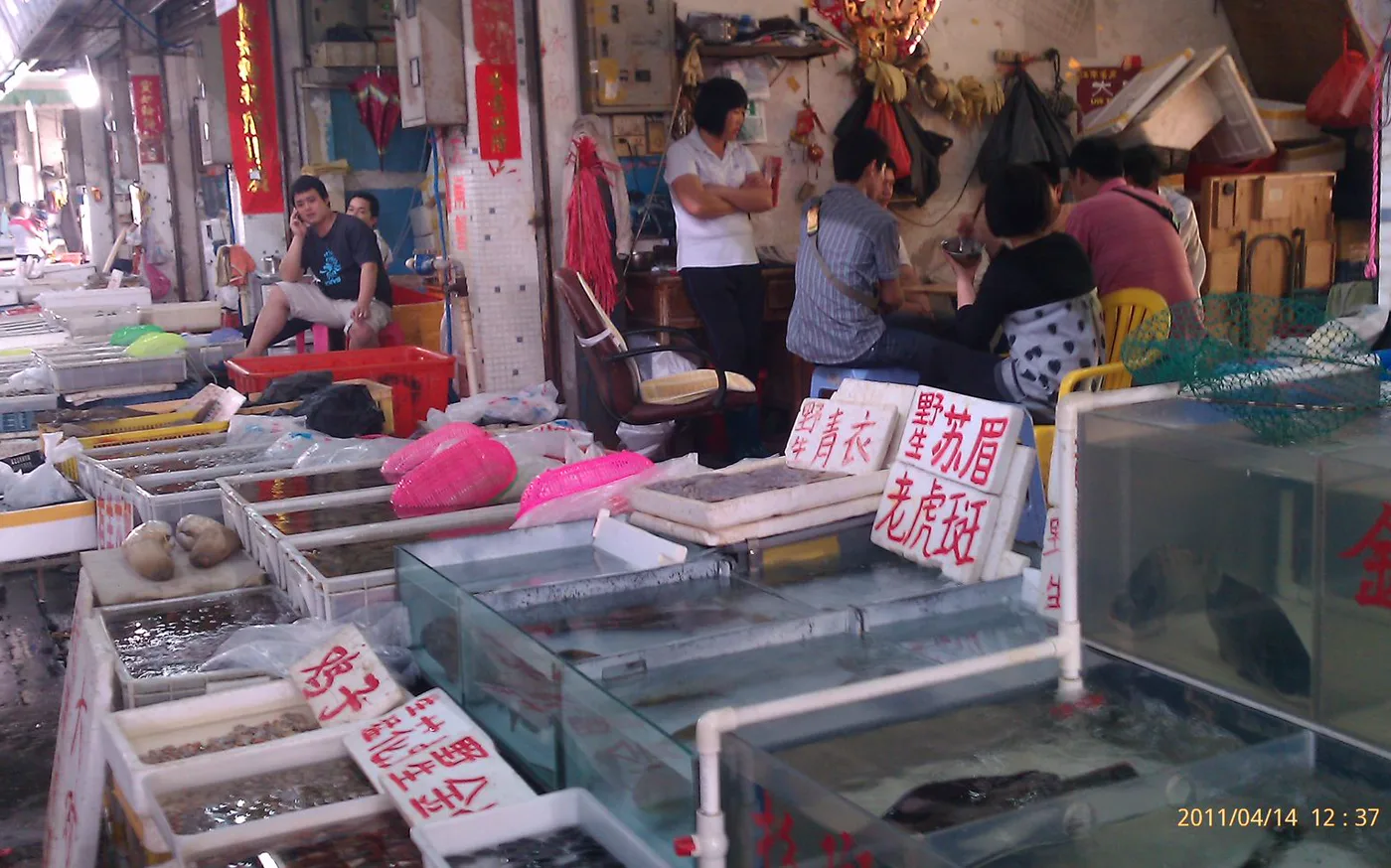
After the first walk, choose one stall that fits your actual food interest. Spend several minutes reading it closely instead of collecting dozens of unexplained photographs.
.jpg)
Start with six fields:
state.
- Displayed product name: copy the exact Chinese wording if possible.
- Form: whole, cut, live, chilled, dried, wrapped, cooked or another visible
- Unit: per piece, bundle, tray, portion, weight or another confirmed basis.
- Price status: displayed, market-priced, quoted verbally or not recorded.
- Claim owner: market sign, stall sign, package label or seller explanation.
- Observation time: the date and visit context.
.jpg)
.jpg)
If you ask a question, make it narrow:
product name?
- What is this item called here?
- Is the displayed figure per unit or per weight?
- Is this sold raw, cooked or ready to eat?
- Is it prepared by this stall or supplied by another producer?
- Is the named place an origin, a style, a supplier location or part of the
Write the answer as attribution:
> The seller described this batch as…
Do not silently rewrite it as:
> This is how Foshan produces the item.
A conversation is valuable local evidence about one current encounter. It is not independent proof of history, origin, legal status or a citywide custom.
Keep market context separate from authenticity
Food markets can show how ingredients, prepared foods, household needs and public services meet in one daily space. That is enough cultural value. You do not need to call the market “authentic.”
Use three evidence lanes.
Lane one: direct observation
Examples include the displayed name, the zone sign, the form of the product, the unit shown and the public scale you actually located. Date these observations.
Lane two: attributed explanation
Examples include a vendor’s account of preparation, sourcing or customer use. Name the speaker by role rather than turning the statement into an unqualified fact. Obtain permission before recording or identifying anyone.
Lane three: independently documented context
Heritage status, a documented production method, a historic association or a regulatory requirement needs a suitable source beyond the stall. Link to that source or leave the claim out.
This distinction matters when a product name contains a town, village or traditional label. The name may express style, association, branding, origin or something else. Ask what it means in that transaction; do not decide from the word alone.
Use a two-pass market walk
A two-pass walk reduces confusion and unnecessary disruption.
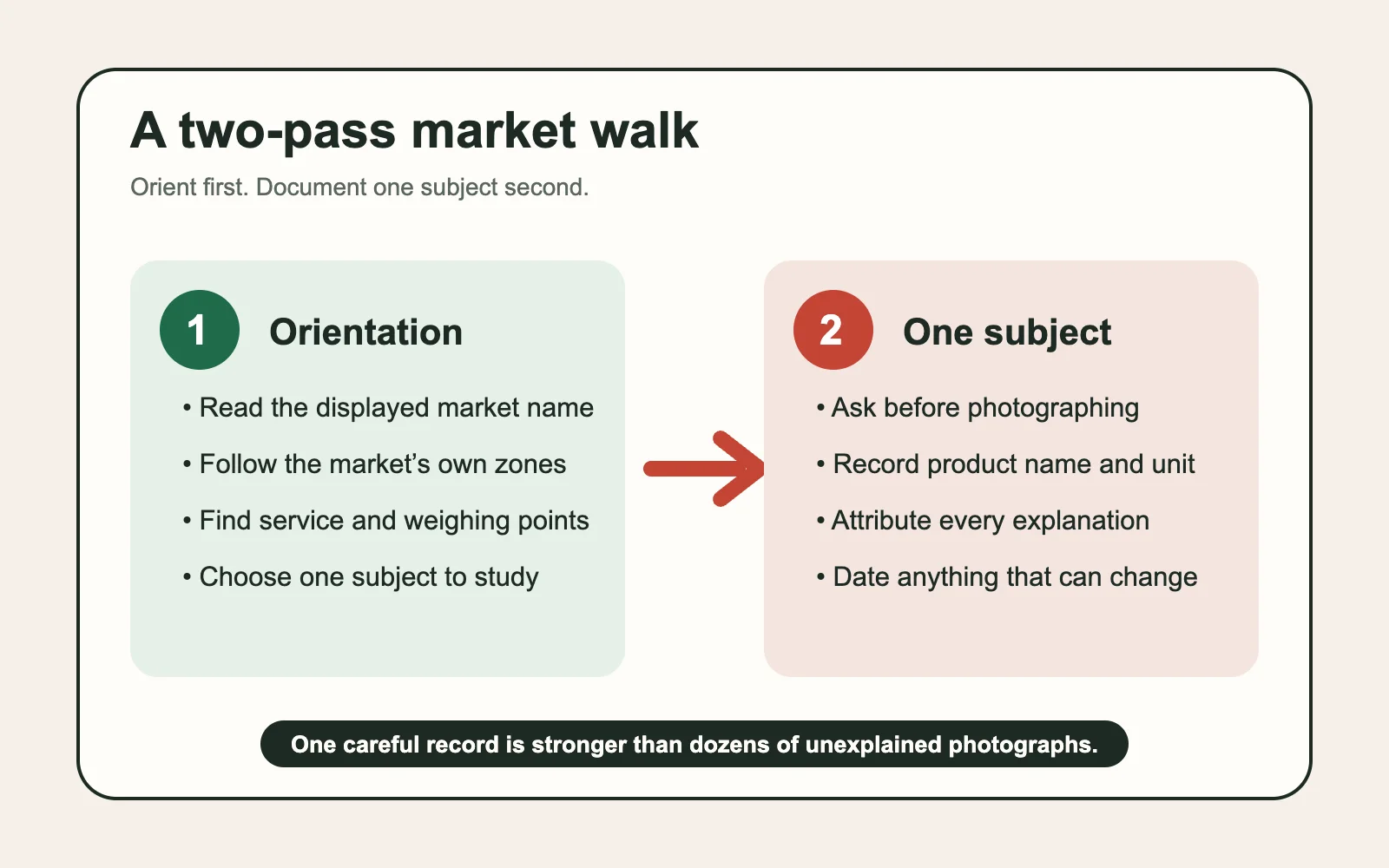
Pass one: orientation
- read the market name and entrance information;
- find the broad zones;
- identify the management or service point if one is visible;
- note where public weighing or complaint information appears;
- observe light, aisle conditions, steps and wet areas;
- decide which single subject deserves a closer look.
Do not begin with a camera in someone’s face. Market access does not create permission to photograph people, stalls, screens or transactions for publication.
Pass two: one documented subject
- return to one stall or zone;
- ask before photographing;
- record the product name, unit and claim owner;
- capture the wider stall context before a close detail;
- ask only the questions needed for the article;
- buy only if you genuinely want the item and understand the transaction.
For a publication image, record the photographer, date, exact market, zone, subject, permission giver and permitted use. A seller may control a stall but not the rights to every sign, package design, person or neighbouring display in the frame.
Check weight and transaction information
Foshan market-regulation reporting has repeatedly treated scale management, public reweighing and complaint handling as practical consumer issues. Named markets have used unified scales, public scales, service points or management records. These examples do not mean every market currently uses the same system.
For a weighed purchase:
- confirm the product and unit before agreeing;
- watch whether a container, water, wrapping or other material is included;
- read the displayed weight and amount if the screen is visible;
- ask for clarification before payment if the basis is unclear;
- locate a public scale or management point if you want to recheck;
- preserve the transaction record needed for a complaint.
Do not publish a fixed complaint number from an evergreen article without a maintenance owner. Use the current official market-regulation or municipal service channel at the time of the visit.
A successful reweighing confirms one measurement. It does not certify product quality, origin or food safety.
Treat cooked food as a separate decision
Ready-to-eat food should not be treated as just another colourful market image. First identify what the stall and product actually are.
Ask:
- Is this sold as ready to eat, or does it require further cooking?
- Is cutting or portioning done at the stall?
- Is the displayed name a product, technique, place association or brand?
- What is the confirmed unit?
- Are ingredients important to your group available from the operator?
- When was this answer obtained?
Keep visual observations modest. Separation, enclosure, refrigeration equipment or a posted document can be recorded as visible features. They cannot support a promise that the food is safe, allergen-free or suitable for a particular person.
For bounded public-health guidance, use Foshan Living’s separate Food Safety Basics for First-Time Diners in Foshan once that guide is published. If the required information is unavailable, choose another item rather than inventing certainty.
Build a dated market field note
Use one compact record after the visit:
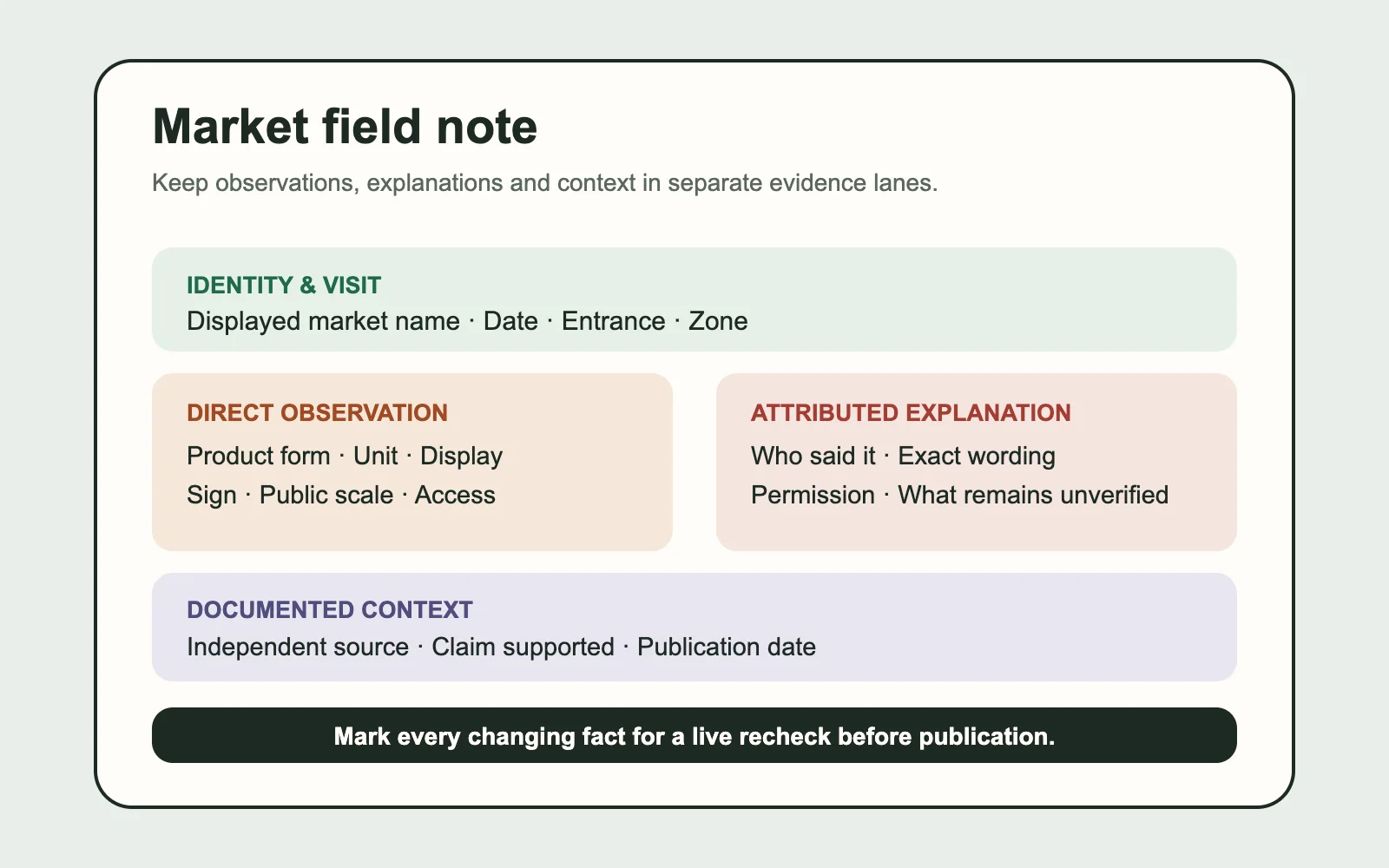
| Field | Example of the right level |
|---|---|
| Market | Exact displayed name |
| Visit | Date and entrance used |
| Zone | Market’s displayed label or “label not observed” |
| Stall subject | Exact product or service examined |
| Form and unit | What was visible and what was confirmed |
| Claim source | Sign, label, seller, operator or independent source |
| Transaction check | Weight/unit confirmed, public scale used or not checked |
| Cultural context | Only what a suitable source supports |
| Image rights | Photographer, permission, subject and permitted use |
| Recheck | Facts that must be confirmed next time |
This note makes future comparison possible. It also protects the article from overclaiming.
If another market uses different labels, that is not a contradiction to erase. Record the difference. A useful market guide allows local variation instead of forcing every space into one template.
Know what must be checked live
Before visiting or publishing a named example, verify:
- the exact market identity and entrance;
- current operating day and hours;
- redevelopment, relocation or closure status;
- current operator and public-information point;
- photography and publication permission;
- stall presence, stock and product form;
- unit, weight, price and payment method;
- current licence, test or traceability information if relevant;
- current complaint route;
- access conditions for the route you plan to use.
These belong in a maintained dynamic layer, not in the evergreen article.
The durable method is simple: read the market’s information first, follow its zones, document one stall carefully, attribute every explanation and recheck anything that can change.
Continue exploring Foshan food
Start with Understanding Foshan and Shunde Food to separate city, district, town and market context. The forthcoming Main Food Categories of Shunde Cuisine guide will compare ingredient, technique and table-role lenses without turning a market display into a cuisine canon.
When you move from observation to a meal, How a Shared Cantonese Meal Works provides a role-based ordering method.
About Daniel Osei
Daniel Osei is Foshan Living’s Food & drink correspondent. He develops evidence-led guides to Shunde ingredients, techniques, markets, table roles and ordering decisions while keeping changing operator facts and public-health claims in their proper evidence lanes. See all articles by Daniel Osei.
Image credits and disclosures
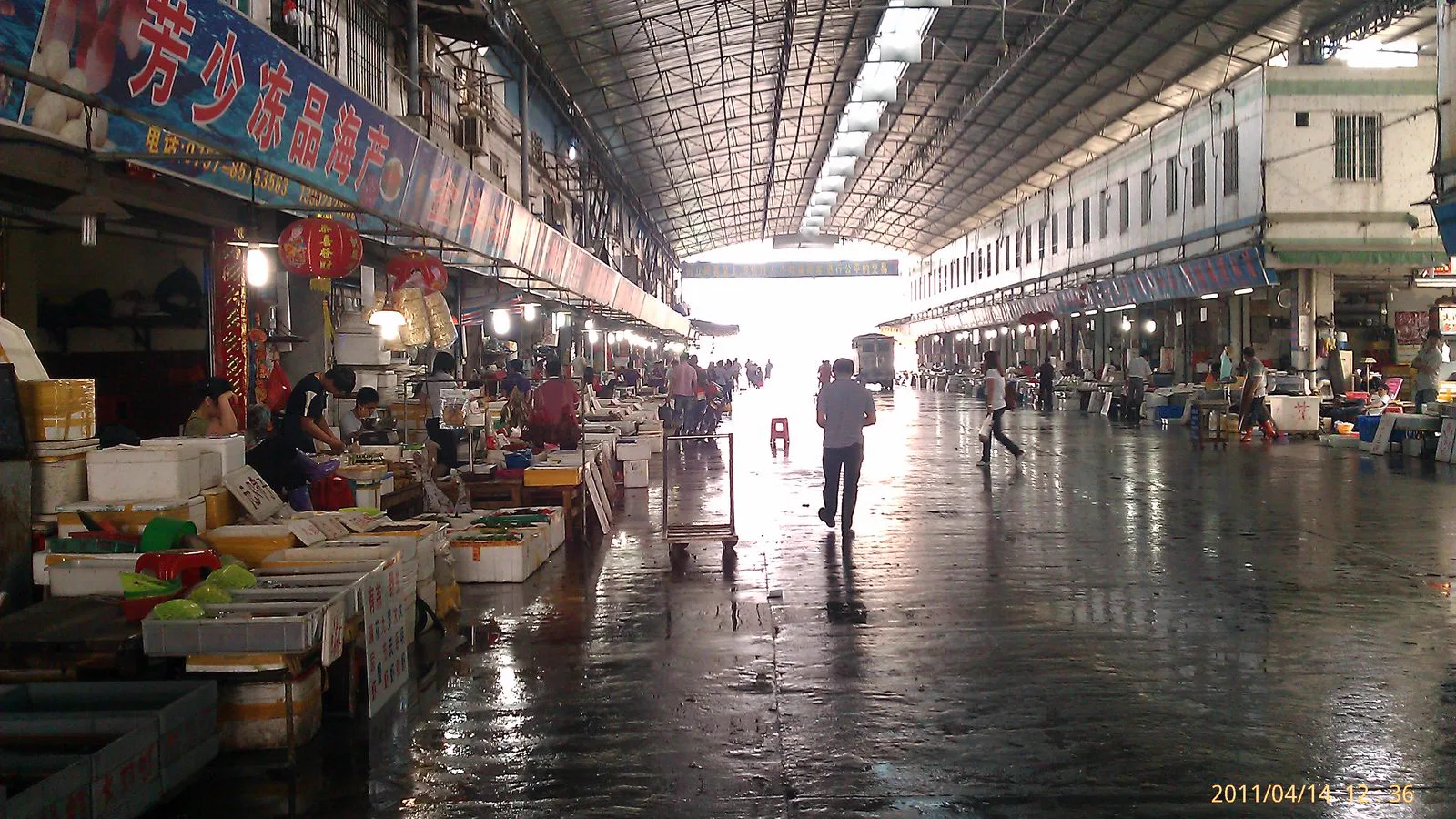
- hero.webp Pingdi Seafood Market photographed in Foshan on 14 April 2011. This dated documentary view shows a market aisle and stall context; it does not represent the market's current operator, layout, products or condition. shawnmung · CC BY-SA 3.0; centre-cropped, resized and converted to WebP; attribution and change disclosure required · CC BY-SA 3.0
- body-01-stall-context.webp A stall at Pingdi Seafood Market on 14 April 2011. The wider frame preserves counter, display and customer context, but cannot establish current product names, prices, origin, safety or market-wide practice. shawnmung · CC BY-SA 3.0; centre-cropped, resized and converted to WebP; attribution and change disclosure required · CC BY-SA 3.0
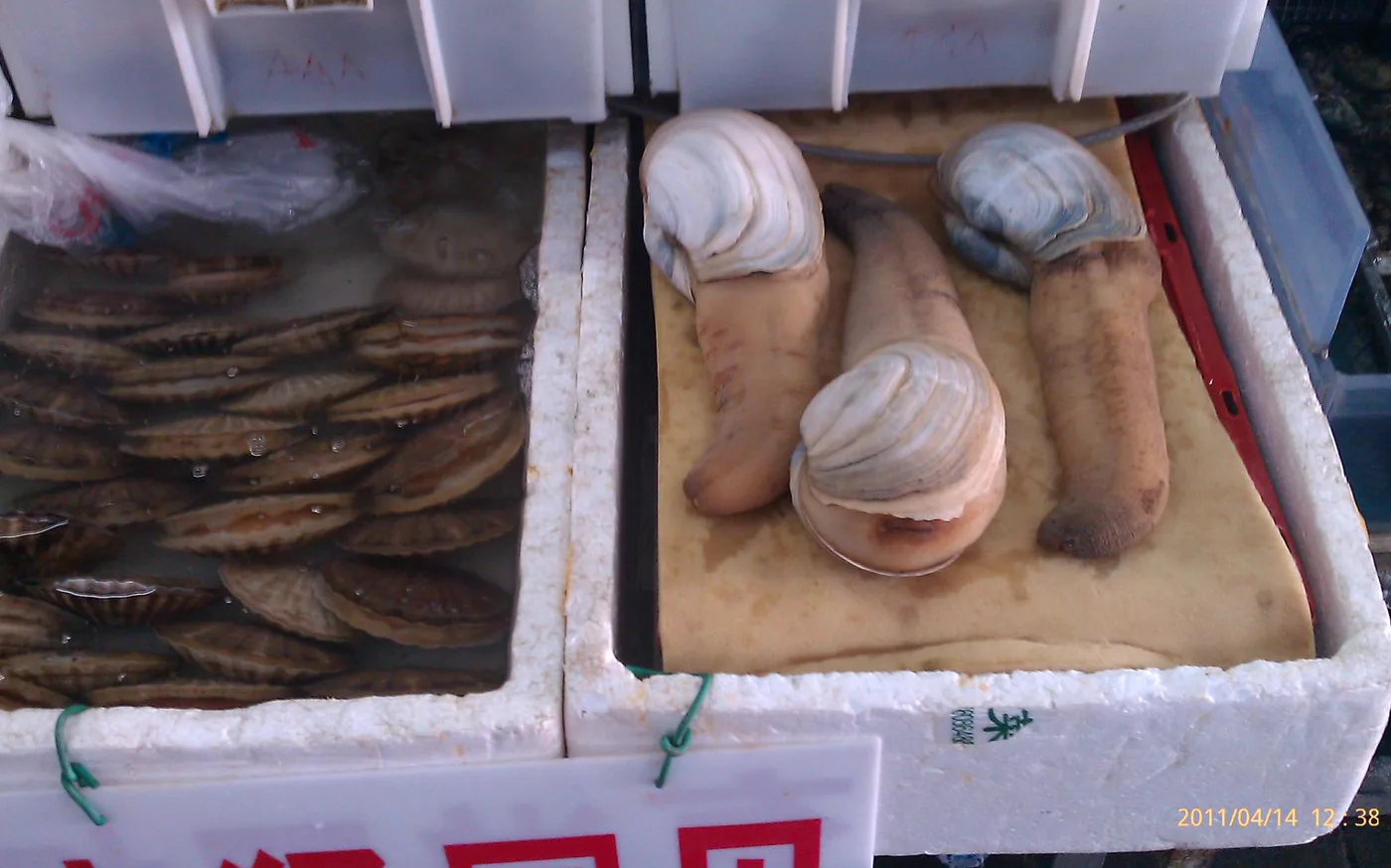
- body-02-shellfish-display.webp A dated shellfish display photographed at Pingdi Seafood Market on 14 April 2011. A close view can document visible form and display method; it cannot prove the species name, unit, origin, freshness, legality or safety. shawnmung · CC BY-SA 3.0; centre-cropped, resized and converted to WebP; attribution and change disclosure required · CC BY-SA 3.0
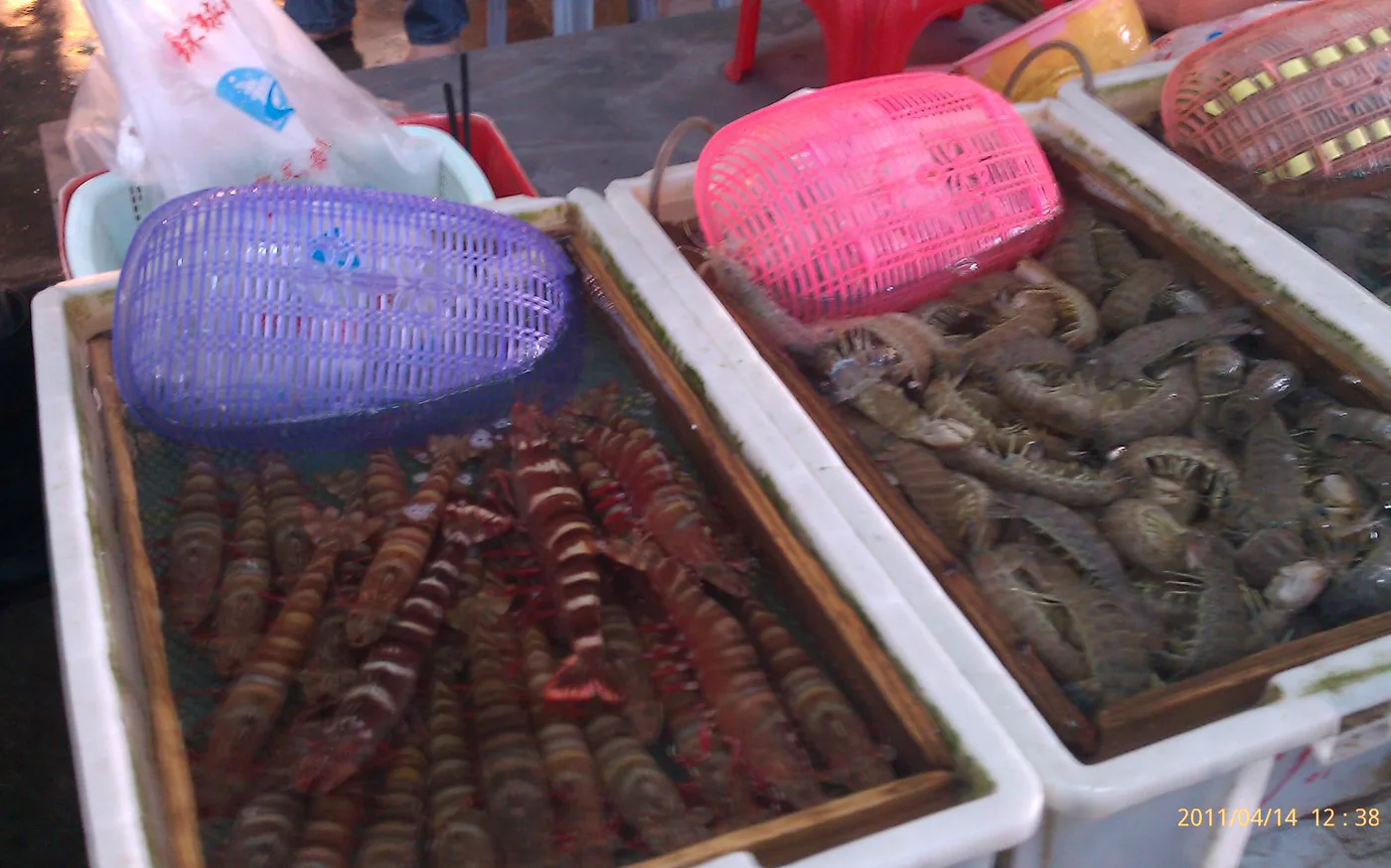
- body-03-live-display.webp Live crustaceans in a Foshan market display on 14 April 2011. The photograph supports only the visible display context at that time; it is not evidence of a current stall, price, product origin or handling standard. shawnmung · CC BY-SA 3.0; centre-cropped, resized and converted to WebP; attribution and change disclosure required · CC BY-SA 3.0
- body-04-two-pass-walk.webp Foshan Living's two-pass method separates market orientation from detailed documentation of one consenting subject. Original editorial graphic; it does not depict a real market, route, transaction or operator rule. Foshan Living / Daniel Osei · Project-original SVG rendered locally; no third-party icons or data
- body-05-field-note.webp An original Foshan Living field-note structure. The fields are editorial prompts, not a completed record of a real market, person, stall or transaction. Foshan Living / Daniel Osei · Project-original SVG rendered locally; no third-party icons or data
.jpg)
Keep exploring
Related Foshan guides
 Explore Foshan
Chancheng or Shunde: Where Should You Start in Foshan?
Choosing between Chancheng and Shunde for a first Foshan trip? Compare heritage, food, neighbourhood pace, transport planning and where to stay.
 Explore Foshan
Understanding Foshan: A City of Five Districts
Learn how Foshan’s five districts differ, which areas suit culture, food, urban life or nature, and why every short trip needs a specific local base.
 Explore Foshan
Zumiao Old City or Shiwan: How to Choose Your Chancheng Day
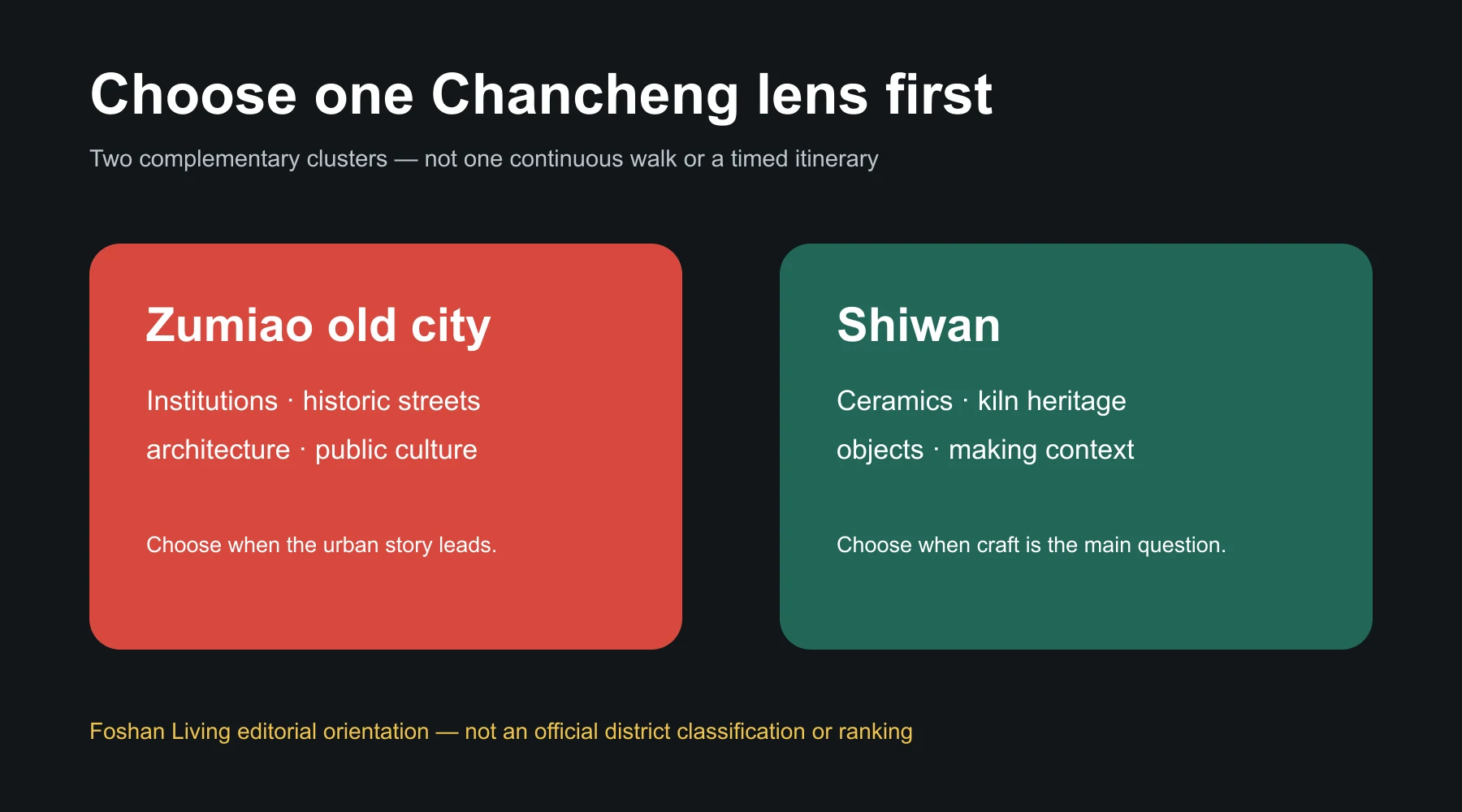
Compare Zumiao old city and Shiwan, choose one main Chancheng cluster, and add the other only after checking the complete route and current access.
 Explore Foshan
Chancheng: Foshan’s Historic Urban Core
Understand Chancheng through the Zumiao old city and Shiwan’s ceramic heritage, with guidance on walking scale, transport checks and where to base.
Plan your visitFirst Time in Foshan
Build a first trip around districts, transport, food and one deeper cultural interest.